

[비즈한국] A challenger has emerged before the United States, which seeks to dominate artificial intelligence (AI) hegemony. It is ‘DeepSeek,’ a Chinese AI startup that has implemented an AI model with ChatGPT-level performance without high-end chips. With the arrival of DeepSeek, which boasts significantly lower development costs compared to its competitors, questions are being raised about the massive investment plans of big tech companies and the AI leadership of the U.S. DeepSeek, which sent shockwaves through Silicon Valley, was born from the hands of a hedge fund businessman. Founder Liang Wenfeng, who has captured the attention of the world, is increasingly cementing his position in the AI industry, recently attending a private symposium hosted by the Chinese Premier.
AI 'Cost-Effectiveness' Shakes Silicon Valley
DeepSeek is shaking up Silicon Valley by highlighting that AI can also be developed economically. Global tech companies, led by OpenAI, have shared the belief that if more money, chips, power, and data are injected, AI will continue to advance. This aligns with thoughts shared by OpenAI CEO Sam Altman on his blog last November. Altman wrote, "Deep learning is effective, it’s getting better as we scale it as expected, and we are investing more and more resources," adding, "While the possibilities for what happens next are open, the most important thing is that AI gets better as it scales."
However, the new AI chatbot ‘DeepSeek-R1,’ released on the 20th (local time), posed a powerful topic of ‘cost-effectiveness’ to the AI field. R1 is known to have performance that rivals OpenAI's o1 model in mathematics, coding, and natural language reasoning, and all its models are free. Development costs are far cheaper. It was built in two months for $6 million (8.6 billion KRW) by utilizing Nvidia's low-end chips intended for export to China for training. While this is an estimate as the exact development cost was not disclosed, it is incomparably small compared to the billions of dollars poured in by big tech companies. Microsoft, a major partner of OpenAI, plans to invest approximately $80 billion (115 trillion KRW) in AI infrastructure this year alone.
Rumors of 'Massive Stockpiling of Nvidia Chips'
There is also intense interest in founder Liang Wenfeng, who appeared like a comet and put top U.S. companies on edge. Liang Wenfeng is a hedge fund manager and entrepreneur who built his career in finance, not AI technology. Because he has not been exposed much to the media, he is often described as a ‘reclusive leader.’ According to Chinese media and Reuters, he was born in Guangdong Province in southern China, raised by parents who were elementary school teachers, and received his bachelor's and master's degrees in Information and Communications Engineering from Zhejiang University in Zhejiang Province, eastern China, the home base of e-commerce giant Alibaba and other tech firms.
He stepped into the AI field in 2015 when he co-founded a hedge fund called High-Flyer. This fund moved away from traditional machine learning algorithms and focused on AI-prediction-based trading strategies. In 2019, High-Flyer established a subsidiary dedicated to researching AI algorithms and applications for trading. The Financial Times quoted an industry insider as saying, "Liang Wenfeng built an excellent infrastructure team that understands how chips work. He brought the best talent from this hedge fund to DeepSeek."
Liang Wenfeng founded Hangzhou-based DeepSeek in 2023. In an interview with Chinese media Waves, he dismissed the opinion that it was too late for a startup to jump into AI or that it was financially impossible. Liang Wenfeng said, "At this point, large tech firms or startups are not overwhelmingly in the lead," adding, "Reproduction is relatively cheap. Based on published papers and open-source code, minimal training time or fine-tuning is enough."
Paradoxically, U.S. export sanctions sit behind DeepSeek's ‘innovation.’ Analysts suggest that as the U.S. has been restricting exports to target China's advanced semiconductor and AI capabilities to secure a technological edge, an ultra-low-cost AI model emerged while searching for efficient ways to bypass this.
Deep-seated concerns about China's position in the AI field are also evident. Liang Wenfeng remarked, "We often say there is a 1-2 year gap between Chinese and American AI, but the real gap is the difference between originality and imitation," or "If it doesn't change, China will always be a follower. A certain amount of risk is inevitable."
Foreign media are paying attention to rumors that Liang Wenfeng stockpiled a large quantity of Nvidia A100 chips in 2021. Exports of these chips to China were banned in September 2022. The BBC estimates the stockpile at about 50,000 units and believes that both these high-performance chips and low-end chips were used in DeepSeek's technology.
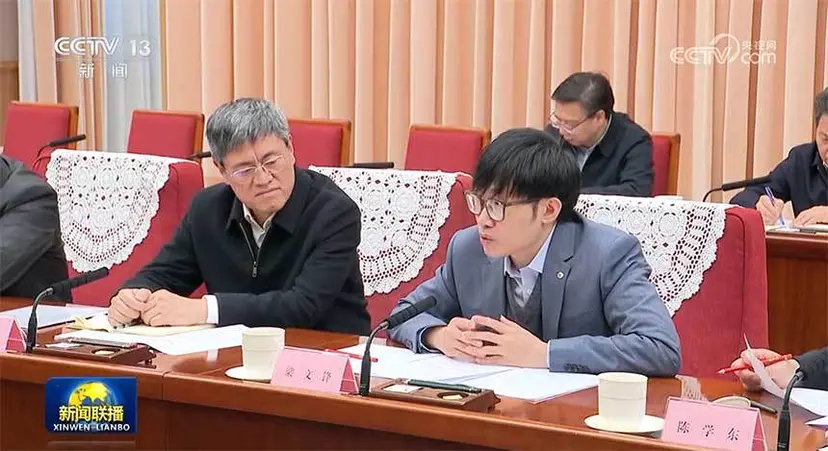
Although it has only been ten days since DeepSeek unveiled R1, the impact has been significant enough to cause U.S. tech stocks to plummet simultaneously. Issues such as the management of sensitive information, unauthorized collection of personal data, or suspicions that it was packaged as low-cost for promotion despite using more expensive chips and more capital have also been raised. However, the ripples the Chinese startup DeepSeek has created in the global AI industry are expected to continue. Liang Wenfeng emerged as the new face of Chinese industry, attending the meeting presided over by Premier Li Keqiang on the 20th as the sole attendee from the AI sector.
The BBC predicted, "DeepSeek's achievement has overturned the existing belief that large budgets and top-tier chips are the only solution in AI development," adding, "DeepSeek's progress will spark greater ambition within China and inspire other tech firms to pursue similar paths of innovation."