

[비즈한국] Trump, who once promised, “I will return in one way or another,” has officially returned to the White House after four years, armed with an even stronger "America First" agenda. The semiconductor industry is deeply troubled as it watches the launch of the second Trump administration. Amid a trend of comprehensive trade policy reviews, Korean semiconductor companies are facing an unpredictable business environment marked by potential subsidy cuts and tariff bombs. There is also widespread concern that as U.S.-China tensions reignite, they could be caught in the crossfire of Trump's sanctions on Chinese exports. Can the Korean semiconductor industry overcome this crisis while facing such reefs in the absence of a president?
Trump Dislikes the CHIPS Act; Subsidies Secured, But Tensions Persist
Since taking office on the 20th (local time), U.S. President Donald Trump has been issuing executive orders across all fields, including the economy, diplomacy, society, and the environment. Dark clouds have also gathered over the semiconductor sector, the largest export item accounting for one-fifth of South Korea's total exports. While there has been no message directly targeting South Korea or its chip industry yet, the future remains a concern. President Trump has strongly expressed his will to follow a path different from the Biden administration. While former President Joe Biden did not hesitate to inject massive capital into foreign companies to build a semiconductor supply chain within U.S. territory, Trump prefers tariffs over "carrots."
For now, the industry is relieved to have avoided the worst-case scenario of a total repeal, as expectations grow that the "CHIPS Act" will remain intact. The CHIPS Act is a law that provides a total of $52.7 billion (approximately 75 trillion won) over five years, including $39 billion in production subsidies and $13.2 billion in R&D subsidies, to companies building chip factories in the U.S. A condition for receiving subsidies is that companies cannot expand their production capacity in China by more than 5% for 10 years. The ultimate goal is to exclude China and restart the U.S. semiconductor industry. The industry predicts that "since this policy has the support of both U.S. political parties, President Trump will generally maintain it."
South Korea is considered one of the primary beneficiaries of the CHIPS Act. Samsung Electronics is set to receive $4.7 billion (approximately 6.9 trillion won) in subsidies, the third-largest amount after the U.S.'s Intel ($7.86 billion) and Taiwan's TSMC ($6.6 billion). The ratio of subsidies to total investment is about 12.8%, which is higher than the other two companies. SK Hynix000660, ranked 7th in support scale, has been allocated $400 million (approximately 660 billion won).
Although the industry breathed a sigh of relief when payments were finalized last month, the variables have not disappeared. Tension in the semiconductor industry peaked when, during his transition period, Trump's side hinted at reviewing subsidy policies. During his campaign, Trump publicly criticized the policy, saying, "Chip subsidies are so bad" and "Taiwan stole our chip business." His logic was that rather than handing money to wealthy foreign companies, the U.S. should impose tariffs on foreign semiconductors to force companies to build factories in the U.S. Although the Biden administration expressed its intention to complete subsidy payments before its term ended, it has not yet been fully executed. According to CNBC, Wendell Huang, Chief Financial Officer (CFO) of TSMC, stated on the 19th that the company received a portion ($1.5 billion) of its fourth-quarter subsidies.
How to Overcome the Absence of Leadership and Protectionist Policies
If U.S.-China trade conflicts intensify, South Korea’s position—sandwiched between the two—will shrink. The Biden administration issued a series of sanctions on China regarding advanced semiconductors until its final days in office, and it is predicted that the second Trump term may carry out even more ruthless trade sanctions.
Voices of concern are rising over the lack of policy response capabilities, such as the absence of leadership due to the ongoing martial law and impeachment political situation, and delays in passing special semiconductor legislation, even as the semiconductor industry that drives exports faces a crisis. Unlike the U.S., Taiwan, and Japan, which provide trillions of won in support for semiconductor facilities, South Korea currently only applies tax deduction benefits. The "Special Act on Semiconductors" aims to provide direct subsidies to secure the competitiveness of domestic companies. Although the ruling and opposition parties initially reached a consensus and the ruling party designated it as a party platform, the bill was pushed into the next year as they failed to narrow differences over a clause regarding "exemptions from the 52-hour workweek for high-income R&D personnel."
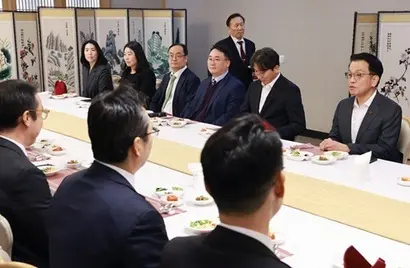
The government held its first discussion on the 24th to respond to Trump, who has set out to re-examine whether the U.S. is losing out on deals. At a meeting on external economic affairs, Acting President Choi Sang-mok (Deputy Prime Minister and Minister of Economy and Finance) emphasized the principle of prioritizing national interest, ordering, "We will re-examine our response directions, focusing on issues with high spillover effects, and pursue sequential responses through external economic meetings and active communication with companies." This instruction considers the impact of the "America First Trade Policy" memorandum signed by Trump immediately after taking office, which directs a review of existing trade agreements signed by the U.S. and recommends appropriate revisions. While no specific country was named, experts say the Korea-U.S. Free Trade Agreement (FTA) is unlikely to be exempt.
Economic organizations are also scrambling to find a breakthrough. Experts agree that forming a control tower for U.S.-related policies is urgent. The Korea Economic Association (KEA) is operating a "Trump 2.0 Task Force" to seek responses to the policy uncertainty of the early Trump administration, and held an emergency meeting on the 23rd. Jung Chul, head of the TF and president of the Korea Economic Research Institute, stated, "The next 100 days will be a critical crossroads that determines the fate of the Korean industry. We will cooperate with U.S. partners, including economic organizations and think tanks, to convey the voice of the Korean business community and help Korean companies find opportunities amidst the crisis."
Kim Soo-dong, a director at the Korea Institute for Industrial Economics & Trade, noted, "We must form a public-private joint consultative body to establish a unified communication channel that delivers the positions and opinions of our companies and government to the U.S. administration."