

[비즈한국] As the duty-free industry faces a prolonged downturn, the issue of worker job insecurity is escalating. With duty-free stores deciding to close and brands pulling out one after another, contract workers are suffering from the fear that they could lose their jobs overnight.

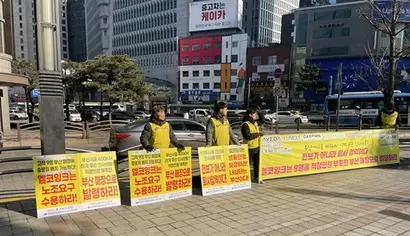
Protests Continue in Front of Shinsegae Duty Free Main Branch
On the 9th, Shinsegae DF announced that operations at the Shinsegae Duty Free Busan branch would end on the 24th. Shinsegae Group entered the duty-free business in 2012 by acquiring the Busan Paradise Duty Free. The Busan branch was Shinsegae’s first duty-free store and had long been considered a "cash cow" for the company. However, as the duty-free industry slump persisted, Shinsegae DF’s performance plummeted, eventually leading to the decision to return the Busan branch's license—which was valid until 2026—early and shut down the store.
The closure of the Shinsegae Duty Free Busan branch has brought employment issues to the forefront. Contract workers who worked at the Busan branch are appealing that they are on the verge of losing their jobs due to the store's closure. In particular, employees of Elca Ink—the Korean subsidiary that sells products for the U.S. cosmetics giant Estée Lauder Companies—claim they have received unfair personnel transfer notices due to the Busan branch closure.
According to the Department Store & Duty Free Sales Service Labor Union, as the Shinsegae Duty Free Busan branch decided to close, contract partners with stores inside the duty-free shop reassigned their employees to other duty-free shops within Busan. In contrast, 9 out of 11 Elca Ink employees who worked at the Busan branch were transferred to areas outside of Busan, such as Seoul, Incheon, and Jeju. The union argues that the company’s unilateral long-distance transfers are essentially an attempt to pressure them into resigning, calling it an unfair personnel action.
The union held a rally in front of the Shinsegae Duty Free Busan branch on December 20, and a protest in front of the Shinsegae Duty Free main branch on January 7, urging the company to take responsibility for job security. On the 17th, the union held a protest in front of Elca Ink’s headquarters (in Gangnam-gu, Seoul), and since the 20th, they have been conducting one-person protests in front of the Elca Ink headquarters and the Shinsegae Duty Free main branch.
A union official pointed out, "When we checked the situation at other duty-free shops in Busan, there was a labor shortage. Each brand needs at least three people, and five to six are needed for normal operations, but currently, only two or three are working. It is unfair treatment to issue long-distance transfers when there are sufficient opportunities for relocation within Busan."
An industry insider noted, "The overall situation in the duty-free market is poor, but the regional situation is even more serious. Since adding sales staff to stores that aren't generating revenue is just an added cost for brands, they seem to be conservative about hiring."
It has been confirmed that Elca Ink and the labor union have recently entered into discussions regarding personnel transfers following the closure. The atmosphere suggests that negotiations are moving toward expanding the number of transfers within Busan. BizHankook contacted Elca Ink for comment, but they could not be reached.
Prolonged Duty-Free Industry Slump Heightens Job Insecurity
Contract workers at duty-free stores maintain that Shinsegae Duty Free also bears responsibility for job security. While Shinsegae Duty Free does not directly employ contract workers, they argue that the company exacerbated job insecurity by failing to properly share information regarding the store closure.
A union official said, "Shinsegae Duty Free significantly reduced its own staff at the Busan branch last November. Only 15 out of 80 employees remained. Even as contract workers watched the main office staff leave, they had no idea what was happening. They just had to work several times harder to fill the gaps left by the departing staff."
They continued, "We sent official letters to Shinsegae Duty Free three times to understand the situation and requested a dialogue, but we received no response. They didn't even share the schedule (of the closure). Only after we held a press conference on the 7th did they share the closure date with the contract partners."
In response, Shinsegae DF explained, "Once the closure was finalized, we shared the schedule with the brands immediately. We had been in continuous communication with the brands. At the time of last year's voluntary retirement period, nothing had been decided regarding the closure of the Busan branch. Many employees left through voluntary retirement, and there were also requests for brand withdrawals. We had been holding on while many brands requested to pull out, but when it reached a point where we could no longer continue, we made the decision to close."
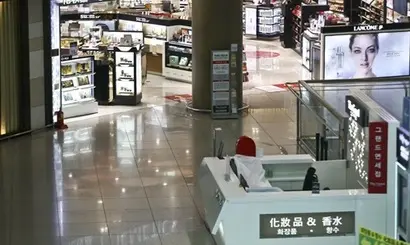
When the Shinsegae Duty Free Gangnam branch closed in 2021, many contract workers lost their jobs as well. At the time, Shinsegae DF reassigned its own employees from the Gangnam branch to the Myeong-dong branch, and in consideration of employment issues, recommended that contract partners also rotate their staff to the Myeong-dong branch. However, due to the unstable market conditions during the COVID-19 pandemic, some companies laid off workers citing the closure.
In duty-free shops, about 80 to 90 percent of the workforce belongs to contract or dispatch agencies. Unlike duty-free shop employees, who are guaranteed employment even during a closure, contract workers are constantly at risk of losing their jobs. When Walkerhill Duty Free closed in 2016, the company guaranteed employment for 200 of its head office staff, but stated that the employment of 700 contract workers was "a matter for the brands to decide." During the 2019 closure of Galleria Duty Free 63, about 130 contract workers faced job loss, but the company dodged responsibility by saying, "future personnel demand will occur continuously."
Industry experts worry that as the duty-free industry slump continues, job insecurity among workers will spread. As of the third quarter of last year, the cumulative losses of the four major domestic duty-free operators—Lotte, Shilla, Shinsegae, and Hyundai—amounted to 135.5 billion won. Lotte Duty Free implemented voluntary retirement last year and reduced the floor area of its Lotte World Tower branch in Seoul. HDC Shilla Duty Free is also facing the expiration of its license at the end of this year, fueling concerns about another closure.
An industry insider stated, "The duty-free business is currently in the worst condition among all retail sectors. Since the duty-free industry is also sensitive to political influences, some say the sense of crisis is as high as it was during the COVID-19 era. Job insecurity in the duty-free industry is bound to grow for the time being."