

[비즈한국] As North Korea claims to have successfully test-fired a hypersonic ballistic missile on the 7th, attention is focusing on the potential emergence of South Korea's own 'hypersonic missiles.' Amid this, it has been confirmed through reporting that South Korea is also developing a hypersonic cruise missile type—which utilizes a scramjet engine, a technology more complex and advanced than the glide-vehicle type used by North Korea—with Hyundai Rotem064350 leading the core project.
North Korea announced on the 7th that it successfully test-fired a 'new hypersonic medium-to-long-range ballistic missile.' Hypersonic missiles generally refer to missiles that fly at speeds of Mach 5 (6,120 km/h) or higher within the atmosphere and travel along unpredictable trajectories. Compared to ballistic missiles that follow a predictable path, they are difficult to track and intercept. Furthermore, since they do not exit the atmosphere and re-enter, but instead fly at low altitudes within the atmosphere, detection itself is difficult, making it challenging to counter with existing defense systems.
Military powers are conducting research to secure hypersonic missile technology. Russia is the frontrunner in this development race. Russia has three types of missiles deployed in the field: the Kinzhal, Zircon, and Avangard. Notably, through the war in Ukraine, Russia became the first country to use the Kinzhal hypersonic missile in actual combat. China is also a powerhouse in hypersonic missile development. The deployed Dongfeng-17 is estimated to reach speeds of Mach 5 with a range of up to 2,500 km. The United States has also developed the Long-Range Hypersonic Weapon (LRHW) and the AGM-183 Air-Launched Rapid Response Weapon (ARRW).
A hypersonic missile development race is also underway between the two Koreas. Since September 2021, North Korea has been developing two types: a ray-shaped glider dubbed Hwasong-8 and a cone-shaped version similar to a Maneuverable Reentry Vehicle (MARV), both of which are hypersonic glide vehicles. Since claiming success in a test-fire of the cone-shaped missile through state media in January last year, North Korea has conducted multiple additional test flights.
The South Korean military is also developing hypersonic missiles. The Agency for Defense Development (ADD) is currently developing 'Hycore,' a South Korean hypersonic missile test vehicle. Hanwha Aerospace012450, Hyundai Rotem, Danam Systems, and KAIST are known to be participating in the research and development (R&D).
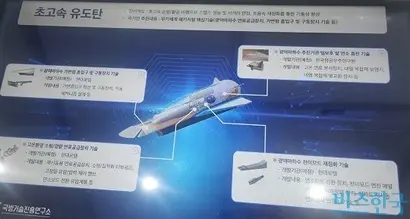
The most notable company in hypersonic missile R&D is Hyundai Rotem. Hyundai Rotem is developing technologies for ultra-high-temperature ceramic composite leading edges, ultra-high-temperature heat-resistant coatings, lightweight structural combustion tubes, cooling shells, and performance testing required for hypersonic missiles flying at Mach 10 or higher.
Additionally, Hyundai Rotem is developing key technologies for a hypersonic cruise missile that utilizes a scramjet engine, which is technically more difficult and advanced than the glide-type hypersonic missile test-fired by North Korea. At the '2024 Defense Core Technology Planning and Achievement Conference' on November 14 last year, Hyundai Rotem introduced a development program for key technologies for hypersonic missiles to be integrated into the KF-21 fighter jet. The hypersonic missile for which Hyundai Rotem is in charge of the core project has a range of over 1,000 km and a warhead weight of over 300 kg. It cruises for about 500 km at a maximum of Mach 5 at an altitude of 30 km, and glides at hypersonic speeds for about 300 km to extend its range, thereby reducing fuel consumption.
There are also differences from the existing Hycore under development. Since Hycore does not integrate a seeker and warhead, its total flight time is 1 minute, with the scramjet engine designed to operate for only about 5 seconds. As such, no separate cooling design was applied. However, the hypersonic cruise missile is configured to enable long-duration flight in high-altitude environments by applying heat exchangers and regenerative cooling technology. An industry official explained, "Hyundai Rotem is leading the development based on the experience it has steadily accumulated while participating in projects related to hypersonic missiles. They are also consistently hiring talent related to hypersonic missiles. They will become a company to watch in the hypersonic missile field in the future."