

[비즈한국] Chinese electronics company Xiaomi has established a Korean corporate entity and entered the domestic market in earnest. Xiaomi quickly dominated its home market with low-priced smartphones before expanding its global reach into regions like India and South America. The company plans to sequentially release product lines—ranging from smartphones and smartwatches to robot vacuums, TVs, and power banks—that have already built up demand through overseas direct purchasing and online channels.
On the 22nd, Xiaomi launched its flagship smartphones and began sales at carrier stores. This marks the first time that Xiaomi smartphones have been sold simultaneously at offline stores of all three major South Korean mobile carriers. However, there are no dedicated offline stores or device experience zones established yet. While some assess that it will be difficult to achieve meaningful results in the “haughty” South Korean smartphone market dominated by Samsung and Apple, others suggest that with aggressive marketing, there is a chance for success in the mid-to-low-end product segment.
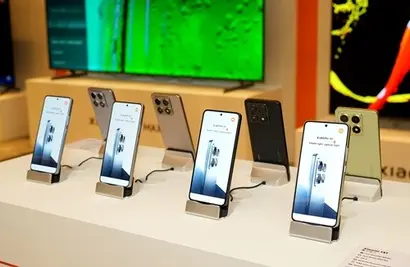
Will new, mid-to-low-end models with price competitiveness overcome the limits of the domestic market?
Having thrown its hat into the Korean market, Xiaomi is first focusing on smartphones. During a press conference on the 15th announcing the establishment of Xiaomi Korea and its entry into the Korean market, the company unveiled five new electronic products. The items that drew the most attention were the premium smartphone "Xiaomi 14T" and the mid-to-low-end "Redmi Note 14 Pro 5G."
The Xiaomi 14T focuses on camera functionality, which has been cited as one of the weaknesses of Xiaomi smartphones. Through a three-year partnership with Japanese camera maker Leica, they have improved photo quality such as night shooting, and Google's AI technology has been incorporated for device control and information search features. The Redmi Note 14, the latest version of the Redmi Note series which has surpassed 420 million units in cumulative global sales, features enhanced durability and camera performance. The Xiaomi 14T, which was released online first on the 15th, is priced in the 590,000 KRW range for the base model (8GB+256GB) and the 640,000 KRW range for the 8GB+512GB model. It shows a clear ambition to capture domestic mid-to-low-end smartphone demand at a price lower than in Europe (approx. 970,000 KRW).
In the case of the lower-priced Xiaomi Redmi Note 14, it is possible to purchase the product for as low as 70,000 KRW when applying carrier subsidies. According to the telecommunications industry on the 22nd, LG Uplus032640 provides a maximum public subsidy of 286,000 KRW and an additional subsidy of 42,900 KRW for the Redmi Note 14 8GB+256GB model (launch price around 390,000 KRW) when using a "55 rate plan" or higher. This is the largest subsidy among the three major carriers. SK Telecom017670 and KT030200 offer maximum subsidies of 143,700 KRW and 276,000 KRW, respectively.
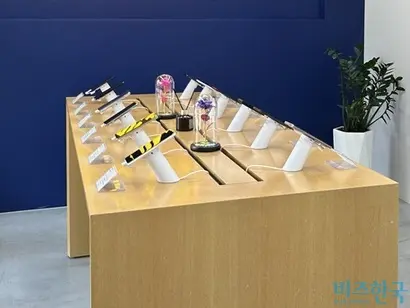
Partnered with three major carriers, but a "slow start" due to weak demand
Xiaomi is expanding its business partnerships with the three major domestic carriers into the offline sales arena. The plan is to expand sales channels, previously limited to online distribution, by utilizing carrier agencies nationwide as offline retail outlets. In the past, Xiaomi smartphones were imported and sold individually by online retailers until Xiaomi headquarters signed contracts with two Korean distributors in 2016 and briefly operated direct stores. However, due to the nature of the Korean market where foreign devices struggle to survive, inadequate after-sales service (AS) systems, and a carrier-led device distribution structure, it hit limits and performance was sluggish both offline and online. As of the third quarter of last year, Xiaomi's market share in the Korean smartphone market, where Samsung holds 80% and Apple 19%, is a mere 1%.
It is difficult to predict how much market share Xiaomi, with its new start as a Korean corporate entity, will take in the smartphone sector. Improving AS policies and expanding offline touchpoints to attract customers and increase satisfaction are considered Xiaomi's main tasks. While it was expected that accessibility to products would increase through the three major carrier agencies, it was found that the conditions are not yet in place.
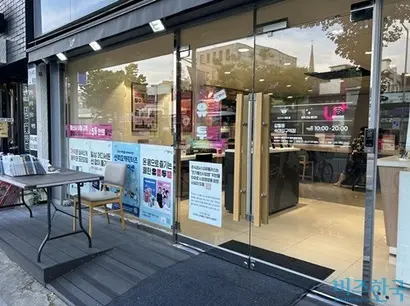
Although agency sales opened on the launch date of the 22nd, it is not easy for customers to actually purchase the new products in stores. An employee at an agency located in Yongsan-gu, Seoul, said, "There are currently no products in stock. There were no specific instructions regarding the new Xiaomi products, and even if they are stocked, only a small quantity will be secured due to low demand." An employee at an agency in Guro-gu, Seoul, also explained, "We don't know what the stock levels will be or how many units each agency will receive," adding, "If there are customers waiting, we could take reservations and sell them once they are in stock."
As demand for Xiaomi smartphones is skewed toward online channel purchases and unlocked (SIM-free) phones, it is expected that business will continue to focus on the official online store and unlocked devices even after the launch of Xiaomi Korea. Some point out that the manufacturer's capabilities are key. According to the industry, manufacturers support the installation of experience zones at carrier agencies so that customers can experience the actual devices before purchasing. If the manufacturer does not invest in display units, agencies are forced to purchase the products individually to provide them to customers, but in the case of Xiaomi, which has low demand, it is difficult for customers to actually check the products even if they visit the agency. Samsung Electronics005930, for example, provides experience spaces called "S-Zones" at agencies.
An industry official said, "Since the volume itself is expected to be very small, there won't be many places where the products are displayed," adding, "It is still difficult to predict sales, but since foreign devices do not sell well in Korea, we will have to watch to see if they can drive demand." Another industry official stated, "There are no agencies identified that consistently keep Xiaomi devices in stock."
Xiaomi plans to resolve the issue of unofficial sales and increase consumer satisfaction by operating official AS centers and guaranteeing authenticity for purchases made through official channels such as its own website, Coupang, and Naver. There is also a prospect that offline stores where customers can experience major products will be opened in major shopping malls within the first half of this year. A Xiaomi official emphasized, "Offline stores will open during the first half of the year," and added, "We will provide services that meet the expectations of our customers."