

[비즈한국] At the ‘Defense Capability Improvement and Defense Industry Promotion Support Project Briefing’ held by the Defense Acquisition Program Administration on the 20th, the design of the ‘Short-Range Air-to-Air Missile-II,’ currently under domestic research and development for the first time, was unveiled. The project, following the bid announcement this March, is expected to have its contract finalized before this autumn.
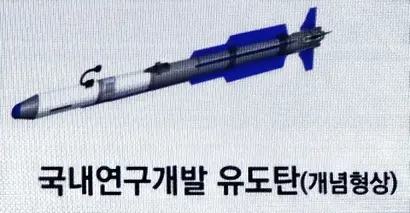
Currently, two types of air-to-air missiles and one type of air-to-ground missile are scheduled to be integrated into the KF-21 Boramae fighter. Among these, only the air-to-ground missile is currently undergoing domestic R&D. The missiles the KF-21 would use for aerial combat—MBDA's Meteor and Diehl's AIM-2000—are imported from abroad. The price of a Meteor is estimated at over 4 billion KRW, and the AIM-2000 is over 500 million KRW, with prices likely to rise further due to future inflation. Accordingly, the Defense Acquisition Program Administration decided to develop the ‘Short-Range Air-to-Air Missile-II,’ a new missile to replace the AIM-2000, which is technically easier to address.
The newly unveiled air-to-air missile-II features a unique design that combines the typical form of modern short-range air-to-air missiles with characteristics from the AIM-2000 and the ‘Haegung’ surface-to-air missile developed by LIG Nex1079550. The missile shares the same connection interface as the AIM-2000. The umbilical cable structure, which exchanges target data between the fighter and the missile and provides power, and the pylon mounting mechanism are identical. This is designed to be compatible with NATO-standard fighters, offering scalability for easy integration not only into the KF-21 but also into foreign aircraft. The air-to-air-II adopts the two-stage strake technology used in the Haegung missile to reduce air resistance while securing lift. Additionally, it features enlarged tail fins to enhance instantaneous maneuverability. This maximizes the change in airflow caused by wing movement, resulting in faster turn rates.
The Imaging Infrared (IIR) seeker has been reduced in size and improved in performance. Notably, the seeker’s resolution is 2 to 3 times higher than competing products, allowing for long-range target detection and reducing the likelihood of being deceived by enemy decoys or jamming equipment. Through a data link, it can also engage targets that the seeker has not yet detected, as well as enemies located behind the aircraft. The rocket motor case has been switched from carbon composites to aluminum to increase structural strength. Consequently, the Short-Range-II is expected to be capable of high-G maneuvers of at least 50G.
A total of 435.9 billion KRW will be invested by 2032 to equip the KF-21 with the air-to-air-II missile. The system development execution plan and vendor contracts are expected to be finalized between August and September of this year. Currently, LIG Nex1 and Hanwha Aerospace012450 are expected to participate in the project, though the final contracting method has not yet been determined. It is a fact, however, that LIG Nex1, which produces similar weapon systems, has researched various air-to-air missile technologies. The infrared detector, a core component of the IIR seeker, is expected to utilize products from i3system214430, the only domestic manufacturer. The development of the air-to-air-II missile is expected to be a significant milestone in elevating the technological prowess and competitiveness of South Korea’s defense industry.