

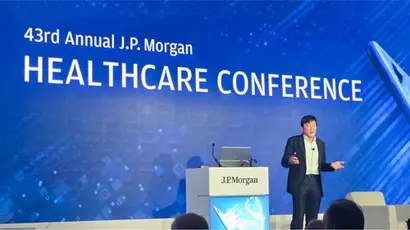
[비즈한국] The 43rd JP Morgan Healthcare Conference, the world’s largest event for the pharmaceutical and biotechnology industry, was held in San Francisco, USA, from the 13th to the 16th (local time). We examined the key topics from this conference, which drew over 550 companies and 8,000 participants, and the blueprints presented by domestic companies.
Multiple 'Big Deals' in M&As and Technology Transfers
The most notable aspects of this year’s JP Morgan Healthcare Conference were the announcements of mergers and acquisitions and technology transfers by global big pharma companies. Johnson & Johnson (J&J) acquired Intra-Cellular Therapies for approximately $14.6 billion (about 21.18 trillion KRW), gaining ‘Caplyta’ (ingredient name: lumateperone), a treatment for schizophrenia and bipolar disorder, and ‘ITI-1284,’ a phase 2 clinical drug being developed for generalized anxiety disorder and Alzheimer’s. Eli Lilly announced the acquisition of Scorpion Therapeutics’ breast cancer drug candidate ‘STX-478’ for approximately $2.5 billion (about 3.63 trillion KRW).
GlaxoSmithKline (GSK) acquired the rare cancer treatment company IDRx for $1.15 billion (1.67 trillion KRW). Through this deal, GSK secured the targeted cancer therapy substance ‘IDRx-42’ developed by IDRx. Lantheus acquired Life Molecular Imaging for approximately $350 million (about 508.015 billion KRW).
Technology transfers also continued. Boehringer Ingelheim and Chugai Pharmaceutical, a subsidiary of the Roche Group, introduced ADC (Antibody-Drug Conjugate) platforms from Synaffix and Araris Biotech for approximately $1.3 billion (about 1.89 trillion KRW) and $780 million (about 1.13 trillion KRW), respectively. Eli Lilly licensed a treatment for idiopathic pulmonary fibrosis from Medea Therapeutics for up to $76 million (about 110.23 billion KRW).
Full-Scale Competition in Oral Obesity Treatments Begins
Interest in obesity treatments remained intense this year. Eli Lilly announced that it would release the results of phase 3 clinical trials for the oral version of Zepbound in the second quarter of this year. David Ricks, CEO of Eli Lilly, stated, “If the clinical results for oral Zepbound are successful, we plan to file for approval within a few weeks and begin launches in the US, followed by Europe and Japan.” Regarding the sharp decline in stock price due to Q4 revenue forecasts falling short of initial expectations last year, Ricks explained, “Anything that falls short of expectations is bound to be disappointing,” adding, “Our expected annual growth rate for 2024 was 32%, and we exceeded expected revenue by $4 billion.”
Pfizer also demonstrated its commitment to developing an oral obesity drug. Albert Bourla, CEO of Pfizer, stated during his main track presentation, “We are all-in on the development of obesity treatments. We expect to begin phase 3 studies for our oral obesity drug candidate, danuglipron, in the second half of the year.” He added, “After the program for the twice-daily version was discontinued in December 2023, we switched to a once-daily version. We will provide a more convenient alternative for patients.”
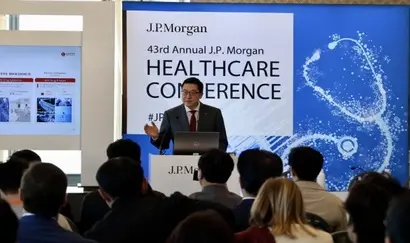
Choi In-young, Head of the R&D Center at Hanmi Pharmaceutical128940, said, “While some say Hanmi Pharmaceutical is late to the game while Eli Lilly and Novo Nordisk dominate the market, I am confident we will succeed.” She added, “Eli Lilly is conducting combination clinical trials to preserve muscle, but we prevent the loss of muscle during weight loss. That is why everyone will covet our pipeline.” Hanmi Pharmaceutical has an obesity drug pipeline that includes the Glucagon-like peptide-1 (GLP-1) based ‘efpelenatide’ and triple agonists ‘HM15275’ and ‘HM17321.’ Seo Jung-jin, Chairman of Celltrion068270, also stated, “We are developing a triple-agonist oral obesity treatment,” and added, “We will enter pre-clinical trials in two to three years.”
Domestic Companies Emphasize CDMO Capabilities and Drug Pipelines
Domestic companies such as Samsung Biologics, Celltrion, Lotte Biologics, Bridge Biotherapeutics288330, and Hugel also gave presentations. Samsung Biologics emphasized its CDMO (Contract Development and Manufacturing Organization) capabilities. Once its Plant 6, which aims for completion by 2027, is finished, Samsung Biologics’ total production capacity will reach 964,000 liters, the largest in the world. CEO John Rim stated, “We will continue our growth in 2025 through the completion of Plant 5 and the initiation of ADC production,” adding, “We will accelerate our expansion strategy centered on three pillars: production capacity, business portfolio, and geographic footprint.”
Celltrion unveiled its roadmap for new drug pipelines. Celltrion will enter four new drug candidates into clinical trials this year. CEO Seo Jin-seok stated that the development of ADCs and multi-specific antibody drugs will lead Celltrion’s future growth. CEO Seo said, “By 2028, we will submit Investigational New Drug (IND) applications for a total of 13 candidates, including 9 in the ADC field and 4 in the multi-specific antibody field.”
Lotte Biologics presented a blueprint for the conversion of its Syracuse, New York bio-campus into a CDMO facility and the Songdo Bio-Campus. It also unveiled its self-developed ADC platform, ‘SoluFlex Link.’ During his presentation, CEO James Park said, “The Songdo Bio-Campus Plant 1, scheduled for completion this year, will be a flexible, large-scale production facility equipped with an optimized operating system.” He added, “By leveraging production process automation, advanced manufacturing technology, and the geographical advantages of Songdo and New York, we will maximize operational efficiency to become a global company with both customer satisfaction and quality competitiveness.”