

[비즈한국] The European economy has recently been facing severe challenges. Germany, once the "locomotive of Europe," has lost its stature and is now struggling with economic difficulties so significant that it has been stigmatized as the "sick man of Europe." To make matters worse, the political situation is unstable. The AfD (Alternative for Germany), a party classified by some as far-right—to the point of being compared to the Nazi party—has secured a significant number of seats in German state parliamentary elections, following its performance in the 2024 European Parliament election, fueling political anxiety. Recently, Elon Musk publicly endorsed this party, raising concerns that it may impact the early general election scheduled for February, creating a chaotic atmosphere both internally and externally.
Currently, the GDP of the entire European Union (EU) stands at approximately $19.4 trillion (2.8 quadrillion KRW), significantly trailing behind the United States' $27.36 trillion (3.96 quadrillion KRW). Considering that the two regions were at roughly similar levels in 2008, this gap over the past 16 years starkly illustrates the stagnation of the European economy.
Europe's Startup Ecosystem Compared to Silicon Valley
When discussing technology, entrepreneurship, and startup ecosystems, Silicon Valley is indispensable. The humble garage where Hewlett and Packard began their business in 1939 is recognized as the birthplace of Silicon Valley and is designated as a California Historical Landmark. College dropout founders, development in garages, and active industry-academia cooperation with institutions like Stanford University have become symbols of Silicon Valley. Since Silicon Valley entered its growth phase as early as the 1950s, it possesses an infrastructure built on a long history of successes and failures, making a direct comparison with the European startup ecosystem perhaps unfair.
However, for a long time, Europe has pondered how to create its own unique advantages while competing with the United States. The recent economic downturn has served as an opportunity to rethink whether those efforts are moving in the right direction.
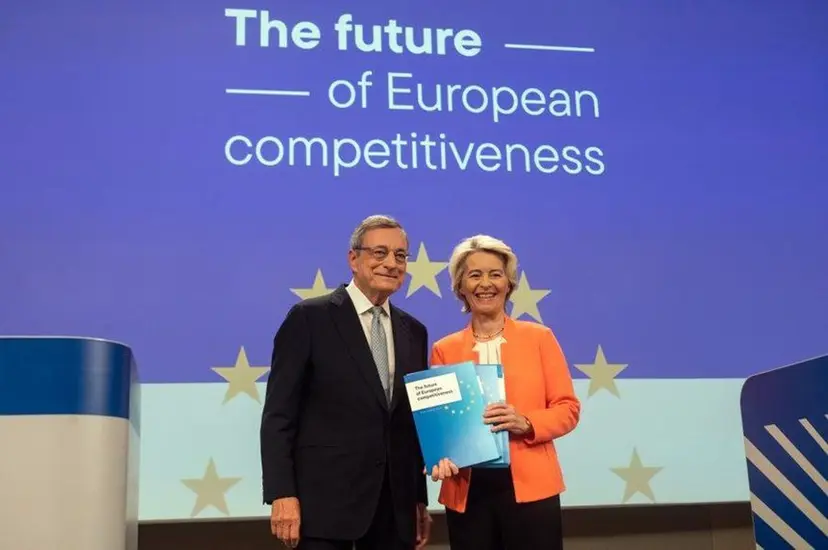
On September 9, 2024, former European Central Bank (ECB) President Mario Draghi highlighted the major problems facing the European economy in his 'EU Competitiveness Report' as follows:
First, he emphasizes the "innovation gap." Europe has fallen behind the U.S. and China in technological innovation, which could lead to weakened competitiveness in the digital and clean technology sectors. Additionally, high energy costs are eroding the competitiveness of European companies, and this problem could worsen if the transition to clean energy is delayed.
Third, Europe is vulnerable in its supply chains due to high dependence on external nations for key industries like semiconductors, which could pose a threat to economic security. Fourth, Europe's productivity growth rate is stagnant, which has a negative impact on economic growth and the improvement of living standards. Fifth, an aging population and declining birth rates could lead to labor shortages and slower economic growth. Sixth, complex regulations and bureaucracy hinder business activities, particularly impeding the growth of startups and innovative companies. Seventh, Europe has failed to secure independence in defense and foreign policy, which may lead to a decline in influence on the global stage.
The Draghi Report proposes an additional annual investment of 750 billion to 800 billion euros (1.121 to 1.195 quadrillion KRW) to address these issues. It emphasizes that Europe must reshape its economic structure and strengthen its competitiveness. The report warns that without this additional investment, Europe will be unable to maintain new technology development, climate responsibility, and global independence.
The Draghi Report is expected to be reflected in the policy-making process of the "von der Leyen II" European Commission, which launched last November. Consequently, various debates have erupted across all walks of life in Europe regarding the content of this report. While the section on easing corporate regulatory burdens has received a positive reaction from businesses, there have been conflicting responses. The European Trade Union Confederation (ETUC) criticized the report, emphasizing the need for a regulatory environment that protects workers' and union rights, and the European Environmental Bureau (EEB) criticized it for overlooking ecological crises and social inequality by focusing on deregulation for clean industries.
European Founders Ask: "When Will We Be Like the U.S.?"
Various opinions have also emerged from the European startup ecosystem. Many have voiced, "Why can't Europe be like the U.S.?" There is an active debate on LinkedIn regarding why the European startup ecosystem fails to grow.
The reasons can be summarized into three main points. First, while the U.S. promotes innovation through a large, unified market, Europe's fragmented market structure by country hinders growth and places a burden on entrepreneurs to overcome regulations in each nation. Second, Europe is heavily dependent on the U.S. technologically and has failed to build its own independent digital economy. Third, Europe currently lacks a $1 trillion (1.451 quadrillion KRW) tech company. While there are successful tech companies like Spotify and SAP, none have reached the trillion-dollar market cap achieved by Apple, Microsoft, Amazon, and Google in the U.S. Skype, which had the potential to be a European trillion-dollar company, was acquired by Microsoft, becoming a U.S. success story. This case clearly reveals the limitations of the European ecosystem's ability to raise capital for late-stage startups.
In 2023, the scale of VC funding invested in European startups was $52 billion (74 trillion KRW). U.S. startup investment was triple that amount. This situation persisted in 2024. As total funding decreased due to ongoing inflation and rising interest rates, European investors showed a highly cautious tendency. European pension funds, which manage about $9 trillion (1.292 quadrillion KRW) in assets, allocate only about 0.01% to the VC sector. Because financing opportunities within Europe are limited, investment in late-stage startups that require massive capital has not been active. This is why famous startups needing late-stage funding, such as London’s autonomous driving startup Wayve, Paris-based Mistral AI, and Cologne’s DeepL, all prioritize contact with U.S. investors. This environment, which makes it difficult to grow into big tech companies in Europe, acts as an obstacle to creating a virtuous cycle where European big tech companies acquire European startups.
German-born entrepreneur Ole Lehmann, who runs AI Solopreneur, strongly criticizes the European startup ecosystem.

He argued that while the GDP of the U.S. and Europe was at a similar level in 2008, the gap has since widened, stating, "It is the result of Europe choosing security over growth and regulation over innovation." According to his analysis, European talent generally chooses one of two paths: moving to the U.S. for higher pay (the average annual salary in the tech sector is over $250,000) or venturing into Southeast Asia or Eastern Europe, where fixed costs are lower, to start a company. Because of this, much talent is leaving Europe.
The biggest problem is European bureaucracy. Employment laws make hiring and firing difficult, and tax rates are too high for small and medium-sized businesses to bear. Even Spotify, cited as a European tech success story, moved its headquarters to New York and went public there; ARM was acquired by Nvidia; and Klarna is also preparing for a U.S. IPO.
He criticized, "Europe is like a museum that is great at preserving the past but terrible at creating the future." Lehmann himself left Germany to build his business in Cyprus.
There Are Things Only Europe Can Do
There is also a different perspective. Nick Mulder, CEO of Berlin-based fintech startup Hypofriend, emphasizes that Europe is not a place with only disadvantages.

Mulder argues that for entrepreneurs and those working in startups, Europe is far more attractive than the U.S. if they want to maintain a sustainable "life" in addition to work, and that this will continue to be the case. He claims that those who say "Europe sucks" in the startup ecosystem assume the startup founder or employee is a "young, tech-sector, single male with no children," and that for older founders with families, Europe remains attractive.
Europe offers high-quality healthcare at a much lower cost than the U.S. and operates family-friendly policies such as maternity leave, parental leave, free education, and paid vacation. Berlin, Germany, has a 78% lower cost of living compared to San Francisco, with significant differences particularly in housing and education costs.
There is also an argument that Eastern Europe should not be excluded when looking at Europe. The "Europe" referred to by those speaking of its downfall is Western Europe (the UK, France, Germany, etc.), but recently, Eastern Europe—particularly Poland—is receiving attention as a new growth engine for the continent.
Poland, which emerged from the communist system in 1989, currently has the fastest-growing economy in Europe. Based on low taxes, simplified regulations, and a strong work ethic, Poland is emerging as a new investment hub in Silicon Valley. Global corporations are making large-scale investments: Microsoft has invested $1 billion, Google has established a major R&D center, and Intel has plans to build a new semiconductor center, allowing Poland to build a unique innovation ecosystem within Europe. It is argued that Poland is a "sleeping giant" that possesses all the strengths of rapidly grown East Asian countries like South Korea and Singapore, and that it is the European country that major Western European nations should learn from and will be the future of Europe.
Korean Companies Should Carefully Evaluate Before Going Overseas
These economic and political situations in Europe provide important implications for the global expansion strategies of Korean companies. While the U.S. offers high innovation and growth potential, markets like Eastern Europe—especially Poland—are worth noting in terms of deregulation and being a land of opportunity. Conversely, Europe's social welfare and stability are attractive to companies considering long-term investment and family-oriented settlement.
When asked for the reasons for their global expansion, there are more Korean entrepreneurs than expected who vaguely say, "because everyone is going to the U.S." or "because I've always liked Europe." When that happens, the hardships and adversity they will soon face are visible before anything else.
In conclusion, the debate over whether Europe should change like the U.S. is not a simple matter of choosing one or the other. It is necessary to accurately weigh how open the market is depending on the company's sector, how to prepare for related certifications and regulations, and how much time and money the founder or person in charge will need to spend initially to establish the company, before making a choice.
Author Eunseo Lee majored in law in South Korea and studied theater in Berlin. Based in Berlin, a city of art and a European startup hub, she is leading 123factory, bridging the startup ecosystems of Korea and Germany while growing alongside the city.