

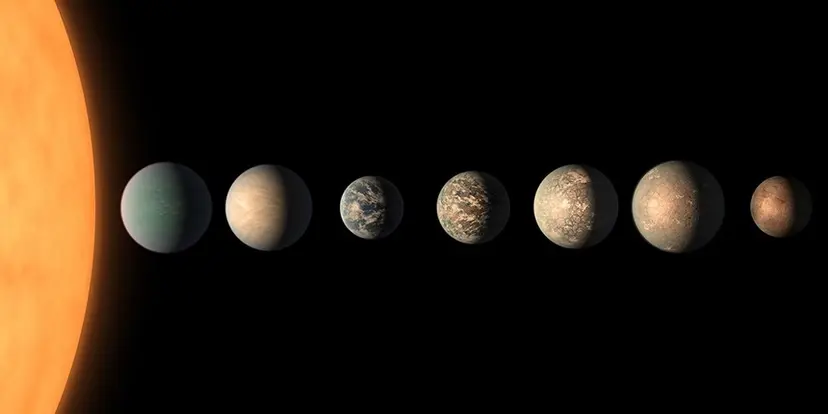
[비즈한국] The TRAPPIST-1 planetary system has garnered significant attention since its initial discovery. In reality, the central star is a very light and dwarf star with only 9% of the Sun's mass. The surface temperature of the star is a mere 2,500 degrees. Despite this, it attracted immense interest because seven planets were discovered orbiting it all at once.
The planets are named TRAPPIST-1 b, c, d, e, f, g, and h in order, starting from the innermost. Notably, four of these—d, e, f, and g—orbit at appropriate distances from the central star, within the range where liquid water oceans could potentially exist on their surfaces. Given that four planets are orbiting within the habitable zone of a single star simultaneously, this system has been considered a prime candidate for signs of extraterrestrial life.
However, for life to thrive, more luck is required. The planets must be covered by a sufficiently thick atmosphere. Without an atmosphere, no life form could breathe on their surfaces.
As it has been a focal point for a long time, TRAPPIST-1 is one of the most observed targets by the James Webb Space Telescope. Last year, the observation results for the innermost planets, b and c, were released. Unfortunately, according to the data, no clear, thick atmosphere was identified on either planet. It is estimated that they have either no atmosphere at all or a very thin one.
However, it is too early to be disappointed. To begin with, planets b and c are located far too close to the central star, so there were never high expectations for the existence of life there. The outer planets are more important.
Looking at the James Webb Space Telescope's observation schedule, which is open to anyone, astronomers completed their observations of the TRAPPIST-1 planets a long time ago. Yet, no significant analysis results have been released. Are they hiding something?
TRAPPIST-1 is a red dwarf star, much smaller and dimmer than the Sun. In fact, whether conditions for life can be created around red dwarfs remains a hotly debated topic with divided opinions. If one thinks simply, one might assume that as long as a planet is at an appropriate distance from the central star, the temperature would be neither too hot nor too cold, making it suitable for life. But it is not that simple.
Red dwarfs, in particular, are quite complex. During their initial stages, when gas clouds are churning and the star begins to shine, red dwarfs can have a devastating impact on their surroundings. Because the star is so small, intense convection occurs, with material moving up and down within it. This forms a powerful magnetic field around the star. A large amount of material in plasma form is pulled up from the stellar surface by the magnetic field. A significant quantity of material flows outward along the complex, twisted magnetic field lines. The moment these bundles of magnetic fields entangle and snap, the dragged material is ejected into space at high speeds, creating powerful flares.
Specifically, since red dwarfs are inherently dim, planets must be very close to the star to receive sufficient heat. The Goldilocks zone—the habitable zone—around the star is formed very narrowly. Therefore, compared to larger stars, planets around small stars are actually more exposed to the threat of flares.
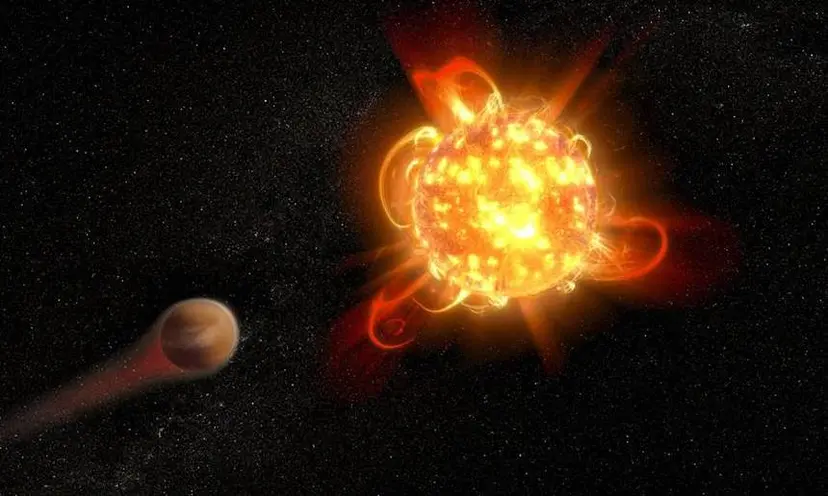
Stellar flares pouring toward a planet can strip away a significant portion of its atmosphere. Not only light molecules like hydrogen and helium but even much heavier molecules like carbon dioxide, oxygen, and nitrogen can be removed. For example, a rocky planet surrounded by a relatively thin atmosphere, like Earth, could have virtually its entire atmosphere stripped away by the powerful flares emitted by a red dwarf.
For a planet to withstand these threats and maintain its atmosphere, it must be wrapped in a strong, separate magnetic shield to protect itself from the star's violent flares. In fact, in the case of Mars, even though it is farther from the Sun than Earth, it is believed that it lost its ancient oceans and atmosphere long ago because it lacked a magnetic shield.
It is not just rocky planets that struggle around red dwarfs. Massive gas planets, like Jupiter, are also at risk. The atmospheres of gas planets, composed primarily of light gases, are also vulnerable to attacks from stellar flares. Their outer atmospheres can be stripped away over time, causing the planet itself to shrink.
One interesting point is that a significant number of exoplanets discovered so far are large gas giants located far too close to their central stars. These types of planets are classified as "Hot Jupiters." There is not a single planet of this kind in our solar system. In our solar system, all large gas giants exist only in the outer reaches.
The existence of Hot Jupiters beyond our solar system remains another mystery that has not been fully solved. It is possible that they were born in the outer regions far from their stars but migrated inward after interacting gravitationally with other planets. This is the possibility of planetary migration. Even so, how they maintain a thick atmosphere for a long time remains difficult to explain.
Last year, astronomers used James Webb observations to confirm the presence—or lack—of an atmosphere on the two innermost planets, b and c, around TRAPPIST-1. The most traditional method for identifying an atmosphere on a planet is to utilize the "transit" method, where the planet passes in front of the star. If a planet is covered by an atmosphere, we can see starlight that has passed through that atmosphere when the planet transits the star. In this process, a portion of the starlight is absorbed by the atmospheric components. By comparing this to the spectrum of starlight that did not pass through the planet's atmosphere, we can determine its composition. However, if the atmosphere is too thin, this method is difficult to use because the chances of starlight passing through a thin atmosphere are low.
The James Webb Space Telescope is much more sensitive than Hubble. Thanks to this, astronomers used a slightly special method in their recent observations. They observed not only the moment the planet transits the star but also the moment the planet passes behind the star, observing the starlight reflected off the planet's surface. If a planet has a thin atmosphere, it circulates evenly, reducing the diurnal temperature range. The difference between the nighttime temperature of the side facing away from the star and the daytime temperature of the side facing the star is not large. Conversely, if there is no atmosphere at all, the diurnal temperature range becomes more extreme. Unfortunately, past James Webb observations showed that both TRAPPIST-1 b and c exhibited extreme diurnal temperature ranges. It appears that these two planets lack even a thin atmosphere.
But the real protagonists are elsewhere. These two planets have such small orbits around the central star that their temperatures are inherently too high. It is difficult to expect the existence of life there. However, the four planets d, e, f, and g follow orbits within the habitable zone.
Recently, astronomers analyzed TRAPPIST-1e assuming various environments. It is a rocky planet like Earth. Likewise, it likely had bubbling liquid lava immediately after it was churned by asteroid impacts. As the lava cools, the planet constantly receives starlight in various forms, including ultraviolet, visible, and infrared light from the central star. The combined influence of this geological environment and starlight can affect the amount and chemical composition of the planet's atmosphere. Astronomers modeled how the surface temperature and atmospheric pressure could change under these various assumed conditions.
First, assuming TRAPPIST-1e initially had an atmosphere similar to Earth's current one, the results show that the planet could continue to maintain its atmosphere even hundreds of millions of years after its formation. After the liquid lava on the surface cooled to form a solid crust, the main component of the atmosphere would be carbon dioxide. Some oxygen and water molecules would also remain. Because it retains its atmosphere, a greenhouse effect occurs, and the planet's surface can maintain a warm temperature. If the atmospheric composition of this planet were similar to Earth's from the start, it could still maintain its atmosphere even when threatened by flares from the central red dwarf.
There is also a possibility that TRAPPIST-1e had a very thick hydrogen atmosphere, unlike Earth but more like Uranus or Neptune. Interestingly, in this case, it takes longer for the surface, which was bubbling with liquid lava, to harden into solid rock. As the planet hardens into a solid surface, more hydrogen escapes into space, while relatively heavier molecules like water, carbon dioxide, and oxygen remain to form the main components of the planet's atmosphere. According to this model, the planet maintains a good atmospheric composition suitable for life, and the surface temperature drops to a level where life can exist. This is a very encouraging result. Even if TRAPPIST-1e did not start with an atmosphere similar to Earth's but rather a thick hydrogen one like Uranus or Neptune, the complex influence of geological processes and the central star's radiation could still create an environment where life could thrive.
On the other hand, the results for TRAPPIST-1b, which is much closer to the central star, are bleak. Assuming it also initially had a thick hydrogen atmosphere, most of the atmosphere would be blown away into space by the intense stellar winds and radiation pouring from the central star. Only a very thin, sparse oxygen atmosphere would remain. Because it consists almost entirely of oxygen with almost no other components, it is a very thin atmosphere unsuitable for life. Ultimately, it was difficult to create an atmosphere conducive to life on TRAPPIST-1b, which is close to the star, under any scenario.
In comparison, TRAPPIST-1e is much more promising. Regardless of whether its initial atmospheric composition was similar to Earth's or to Uranus/Neptune's, there is a possibility that it still has conditions that could support life.
In fact, TRAPPIST-1e has already been observed by the James Webb Space Telescope. However, at the time of the observation to confirm the existence of an atmosphere on TRAPPIST-1e, the central star happened to produce a violent flare. The dazzling flare suddenly covered the light of the planet, making it impossible to distinguish between the flare light and the starlight reflected off the planet's surface. Therefore, some astronomers estimate that the results for TRAPPIST-1d or f might be released before those for TRAPPIST-1e.
TRAPPIST-1 has been a source of high expectations for a long time because seven planets were discovered there at once, and four of them are in the habitable zone. It would be very disheartening if not even a single sign of life were confirmed in such a place.
Observing the moment a planet passes behind a star to detect the reflection of starlight—in addition to when it transits the star—is a new observation method attempted for the first time. The observations of the TRAPPIST-1 planets so far have actually been based on small datasets obtained from only one or two attempts. Ultimately, the only way to reach a more precise and certain judgment is to observe the TRAPPIST-1 planets repeatedly over a longer period.
TRAPPIST-1 is a compelling target, but the James Webb Space Telescope is not a tool that exists solely to look at this one exoplanetary system. There are too many observation schedules backed up, ranging from celestial bodies in our solar system to countless stars and galaxies. Depending on how much more we can target the TRAPPIST-1 planets amidst a busy schedule, our expectations and conclusions will change.
Reference
https://academic.oup.com/mnras/article/531/1/468/7659831
About the author, Woong-bae Ji: He loves cats and the universe. After watching 'Galaxy Express 999' as a child, he dreamed of sharing the beauty of the universe. Currently, he researches galaxy evolution through galaxy interactions at the Yonsei University Galaxy Evolution Research Center and the Near-Field Cosmology Laboratory. He is involved in various science communication activities, including lectures and writing. He has authored books such as 'The Observatory of Flirting', 'Thinking About the Universe All Day', and 'Stars, The Science of Light'.