

[비즈한국] One of the major construction firms that most people would recognize recently requested a loan from a reconstruction association to cover a bid bond. A bid bond is a deposit paid by a construction company to participate in a reconstruction project’s bidding process; it typically ranges from 10 billion won for smaller projects to tens of billions of won for larger ones. (For reference, the bid bond required by the Gaepo Jugong Complex 6 & 7 Reconstruction Project Association in Gangnam-gu, Seoul, was 50 billion won.) In such a climate, a construction company has resorted to asking the association for a "bid bond loan." The company's liquidity is so poor that it is willing to pay a higher interest rate than the market average just to borrow the deposit money.
On the 16th, Daejeo Construction, ranked 103rd in construction capability and 2nd in the Gyeongnam region, succumbed to its financial difficulties and filed for court receivership with the Busan Rehabilitation Court. Established in 1948, Daejeo Construction had expanded its business reach from roads, railways, and ports to housing and urban development projects. However, it faced management difficulties as the scale of unpaid receivables grew due to the recent downturn in the construction industry and soaring construction costs. In 2023, the company recorded a deficit of 9.7 billion won.
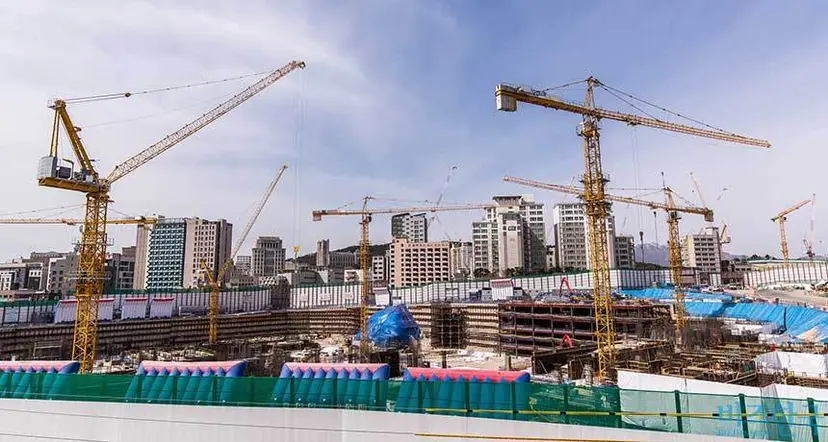
Growing Concerns for Construction Companies
Concerns surrounding the domestic construction industry are mounting. At the end of last year, as Shindong-A Construction, a mid-sized firm ranked 58th in the Ministry of Land, Infrastructure and Transport’s construction capability assessment, entered court receivership, financial circles commented that "what was bound to happen has happened." In particular, there is talk that the liquidity of construction firms is so poor that they are even resorting to borrowing bid bonds.
While Shindong-A Construction actively participated in apartment projects using its "Familie" brand, it failed to achieve meaningful results recently. The "Geomdan New Town Familie Elif," which it ambitiously launched for sale last year, recorded an average subscription rate of 0.51 to 1, failing to meet demand in the first and second rounds. In the process, the company could not cover a bill worth 6 billion won that matured last December. Ultimately, Shindong-A Construction had to file for corporate rehabilitation with the Seoul Rehabilitation Court, just five years after exiting a workout program in 2019.
The liquidity crisis is also a problem facing major construction firms. The debt ratios of domestic large and mid-sized construction companies are rising rapidly. According to the Financial Supervisory Service's Data Analysis, Retrieval and Transfer System (DART), as of the third quarter of last year, three out of the top 10 construction firms had debt ratios exceeding 200%. Generally, a ratio of over 200% is considered risky. Outside the top 10, companies like Kyeryong Construction Industrial013580 (17th, 231.2%), Dongbu Corporation005960 (22nd, 249.9%), Hanshin Engineering & Construction004960 (28th, 221%), HL D&I Halla (30th, 269.3%), and Doosan Construction (32nd, 338%) showed poor debt ratios. Companies with debt ratios exceeding 400% included Taeyoung E&C (24th, 747%) and Kumho Construction (20th, 640%), which had applied for workouts and corporate rehabilitation, respectively.
Unbilled Construction Costs Also Rising for Top 10 Firms
The liquidity crisis is expected to continue as the unbilled construction costs of the top 10 construction firms reached 19.5933 trillion won as of the third quarter of last year, an 11.68% increase from the end of the previous year. Samsung C&T Engineering & Construction Group (2.7 trillion won), HDC Hyundai Development Company (1.3 trillion won), Lotte E&C (1.85 trillion won), and Daewoo E&C (1.63 trillion won) all show significant volumes of unbilled construction costs. Unbilled construction costs represent work that has been performed but for which the client has not yet made payment, and they are considered potential bad debt. If agreements with clients are not reached, it could negatively impact cash flow. This is why there are growing concerns that a chain of failures among mid-sized construction firms could begin in earnest.
Since 2023, construction firms around the top 100 mark, including Daewoo Industrial Development (75th), Daewoo Shipbuilding & Marine Engineering Construction (83rd), Daechang Enterprise (109th), and Shinil (113th), have been unable to weather the construction industry downturn and have filed for court receivership one after another.
Difficulties are inevitable this year as well, due to rising raw material prices, a high exchange rate, and increased political uncertainty. In particular, small and mid-sized as well as regional construction firms lack the financing capabilities of larger firms, making their liquidity more vulnerable to economic deterioration. Currently, even the financial sector is taking a cautious stance regarding lending to construction firms.
A bank official in charge of real estate project financing (PF) hinted, "Liquidity is currently so poor that some construction firms are even borrowing tens of billions of won for reconstruction bid bonds. The problem is that there is no indication the real estate market will improve immediately this year. Especially since firms outside the top 10 face relatively higher risks from unsold units, I understand that the financial authorities are keeping a close watch as the liquidity crisis could start with small and mid-sized construction firms this year."