

[비즈한국] It has been three years since the start of the Ukraine war, often referred to as a "drone war." Currently, both Russian and Ukrainian forces are mobilizing tens of thousands of drones, and the core of military operations is shifting toward fully unmanned systems like drones. Russia, which initially deployed large-scale armored warfare—a legacy of the Soviet era—suffered immense losses due to medium-sized combat drones like the Turkish-made Bayraktar TB2 and inexpensive FPV (First Person View) drones costing only a few hundred dollars. Consequently, they are now resorting to distributing tanks equipped with so-called "cope cages" to defend against these drones.
Ukraine is facing similar challenges. Advanced armored units provided by the West, such as the Leopard 2 and M1A1 Abrams tanks, have taken heavy hits from Russian FPV drones, and artillery units have seen a significant reduction in fire missions due to attacks by Russian-made ZALA Lancet loitering munitions, even in "safe zones" far from the front lines.
Just a few days ago, the Ukrainian capital of Kyiv was struck by over a hundred Shahed-136 drones produced by Russia with Iranian support. As such, the Ukraine war has become a testament to the fact that drones are the core weapon of future warfare.
In this situation, South Korea is also working diligently to prepare for drone warfare. The Army, Navy, and Air Force are all dedicating efforts to drone forces and research, operating drone research centers, training centers, and pilot units. Additionally, various projects are underway to rapidly acquire drone capabilities.
The problem lies in anti-drone projects intended to protect friendly forces in this drone-centric environment. Currently, the South Korean military, the Defense Acquisition Program Administration (DAPA), and the Ministry of National Defense are focusing on various anti-drone weapons, testing several systems in actual field and air defense units to evaluate their combat performance. Stationary drone defense systems are also expected to be unveiled soon.
However, the pace at which drones and anti-drone systems are evolving in the Ukraine war is so fast that South Korea's drone war preparations are gradually becoming obsolete. New, next-generation weapons that neutralize existing products are being put into practical use at a frightening speed, even before current products are fully deployed.
Andriy Anatosh, head of the Dronarium Academy, a drone training unit of the Ukrainian military whom I recently interviewed, is dedicating his life to researching and producing drones with operational concepts completely different from existing ones. He explained that a new type of "fiber-optic drone" is changing the landscape of drone combat and will create a shift as significant as the difference between warfare before and after the introduction of drones.
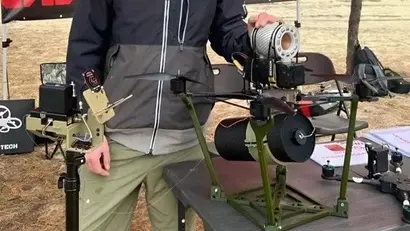
Fiber-optic drones utilize a fiber-optic cable for communication between the drone and the pilot. When a container holding a tightly coiled, extremely thin fiber-optic cable is attached to the drone, the FPV drone becomes an almost "invincible weapon."
The reason fiber-optic drones are so lethal is that they render existing anti-drone systems useless. Most anti-drone systems use "soft-kill" methods, disrupting flight by targeting radio frequencies. This includes jamming, geofencing, spoofing, and hacking. However, fiber-optic drones are immune to electromagnetic interference, making all these methods ineffective. Therefore, it is impossible to neutralize these drones with electronic warfare equipment or anti-drone guns. The Ukrainian military has successfully carried out numerous drone strikes using these fiber-optic drones that the enemy could not counter.
However, fiber-optic drones do have some drawbacks. Because they must drag the fiber-optic wire, the drone's flight performance is reduced, and its use is limited in areas like dense forests where the fiber can easily break. Furthermore, the Russian military is also actively utilizing these fiber-optic drones. Fiber-optic containers for drones are sold for about $300 on the Chinese B2B site 'Alibaba,' and China is supplying them to both Ukraine and Russia.
To overcome these limitations, the Ukrainian military is focusing on "AI drones." AI drones feature FPV drones equipped with target acquisition and automatic tracking capabilities, some of which are already being used in combat. These drones use Google's 'Tensor Flow Edge TPU' board to perform AI calculations within the drone itself without needing communication with a server.
The South Korean military and its military science and technology are failing to keep pace with the speed of drone development. Currently, the anti-drone systems deployed to the South Korean Army and air defense units are 100% soft-kill, relying mostly on GPS spoofing equipment. The recently deployed Laser Air Defense Weapon Block-I features hard-kill capabilities, but its use is extremely limited.
To solve this, "hard-kill drones" must be developed, but the military and DAPA are hesitant to actively adopt them. While more than two domestic companies are attempting to develop hard-kill drones, it is difficult to mature the technology through private research alone without the military's test evaluations and formal requirement generation.
In particular, the development of "warhead-integrated hard-kill" drones containing explosives is even more difficult. The Coyote hard-kill drone created by the U.S. company RTX successfully destroyed an enemy drone with an explosive-laden warhead, but small and medium-sized domestic drone companies struggle to secure such technology due to regulatory and cost issues.
Even after the Ukraine war ends, there is a high possibility that military tensions will continue, particularly in Northeast Asia. North Korea could also introduce or develop its own fiber-optic FPV drones through cooperation with Ukraine or Russia. To prepare for this, it is imperative to shift the direction of anti-drone systems from soft-kill to hard-kill methods.