

[비즈한국] As the International Maritime Organization (IMO) tightens greenhouse gas reduction regulations, the global shipbuilding industry is undergoing a rapid transition toward the eco-friendly ship market. The domestic shipbuilding industry is focusing on developing and winning orders for high-value-added vessels that use eco-friendly fuels such as LNG, methanol, and ammonia to strengthen its competitiveness. As China rapidly expands its footprint in the eco-friendly market through low costs and mass production, experts point out that Korea must maintain its technological edge through the commercialization of next-generation eco-friendly ships and increased government support.
The Chinese shipbuilding industry is achieving success in large vessel orders through mass production of bulk carriers and container ships. This is the secret behind their ability to capture over 70% of global orders since August of last year. According to Clarkson Research, a British institution specializing in shipbuilding and shipping market conditions, global ship orders in December of last year totaled 1.94 million CGT (86 vessels). Of this, China accounted for 1.66 million CGT (67 vessels, 86%), ranking first globally. China has held the top spot for six consecutive years from 2019 to last year, benefiting from low labor costs and cheaper locally sourced raw materials.
Korea recorded 70,000 CGT (3 vessels, 4%). While lagging behind China significantly in terms of volume, analysts suggest this is the result of domestic firms—which have already secured a backlog of three to four years of work—focusing on selective orders for high-value-added vessel types, such as eco-friendly ships.
The reason Korea is focusing on eco-friendly ships is due to the IMO’s strengthened carbon regulations aimed at achieving maritime carbon neutrality by 2050. During the 81st Marine Environment Protection Committee (MEPC 81) held in London, UK, last year, the IMO decided to impose a levy on greenhouse gas emissions from all global ships starting in 2027. Consequently, shipping companies will have no choice but to use eco-friendly marine fuels, leading to a sharp rise in global demand for such vessels.
As of the third quarter of last year, domestic shipbuilders held the top spot in cumulative global orders for Liquefied Natural Gas (LNG) carriers. A shipbuilding boom centered on LNG carriers is expected to continue this year. On the 6th, HD Korea Shipbuilding & Offshore Engineering009540 delivered a 174,000-cubic-meter (㎥) LNG carrier ordered by an Asian shipping line in June 2022. Hanwha Ocean is also scheduled to deliver about 40 vessels this year, starting with an LNG carrier on the 7th. According to the Export-Import Bank of Korea’s Overseas Economic Research Institute, LNG demand is expected to grow by around 11% as new production increases, particularly in the US and the Middle East, from this year through next year.
The problem is that China is catching up quickly not only in scale but also in the field of high-value-added eco-friendly ships that require advanced technology. In fact, the China State Shipbuilding Corporation (CSSC) won orders for a total of 24 ultra-large LNG carriers from QatarEnergy last year. It appears they are gradually closing in on the LNG carrier market, where domestic shipbuilders previously held a relative advantage. According to the "Green Development Outline for the Shipbuilding Industry" announced by the Chinese government last year, China plans to establish a green development system and strengthen its capacity to supply eco-friendly shipbuilding equipment by this year.
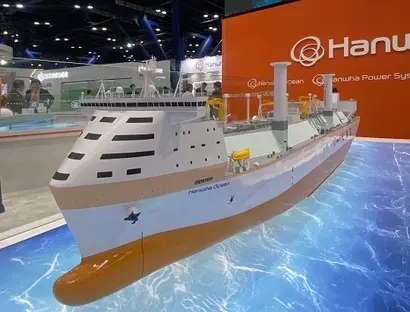
In response, the domestic shipbuilding industry plans to widen the technological gap and boost competitiveness this year by commercializing other eco-friendly fuel ships, such as methanol and ammonia vessels, alongside LNG. HD Korea Shipbuilding & Offshore Engineering’s affiliate, HD Hyundai Mipo010620, signed the world’s first contract to build an ammonia-powered gas carrier with a European shipping company in 2023. To date, they have received orders for four ammonia-powered ships and are scheduled to deliver two of them this year. HD Hyundai Mipo recently began construction on a mid-sized ammonia-powered vessel. Samsung Heavy Industries010140 and Hanwha Ocean also aim to commercialize ammonia-powered ships within the year. Last year, Samsung Heavy Industries obtained technical certification for an ammonia fuel-cell-powered ship from the Norwegian classification society DNV and is currently securing core technologies by building ammonia demonstration facilities. Hanwha Ocean is also making efforts to commercialize ammonia-powered ships this year.
However, challenges such as high ship prices, fuel transportation costs, and infrastructure construction remain to be solved. Experts suggest that because eco-friendly marine fuel is generally more expensive than traditional fossil fuels, the government should provide subsidies to help maintain competitiveness. Lee Ho-chun, head of the Shipping Research Division at the Korea Maritime Institute (KMI), emphasized, "While fuels like methanol and LPG are being used as eco-friendly alternatives, their overall share remains extremely minimal. The biggest burden when using eco-friendly fuel is the price. Just as the government provided subsidies to promote electric vehicles, government subsidies will play a critical role in the early stages of adopting eco-friendly marine fuels."