

[비즈한국] “This character is an AI (Artificial Intelligence) and not a real person. Please consider everything the AI says as fiction.” Launched to the public in September 2022, 'Character.ai' is a service that allows users to converse with various AI character bots. While it emphasizes that it is fictional, it induces deep immersion. Rooted in fandom culture—with high demand for immersive conversation such as the British Harry Potter series, pop singer Taylor Swift, the American drama Game of Thrones, and DC Studios' Batman—it has grown rapidly, securing over 20 million active users. It has received such high interest that when Harry Potter, Batman, and Joker bots were abruptly removed due to copyright issues at the end of last November, complaints flooded the operating company and the production studios that own the intellectual property (IP).
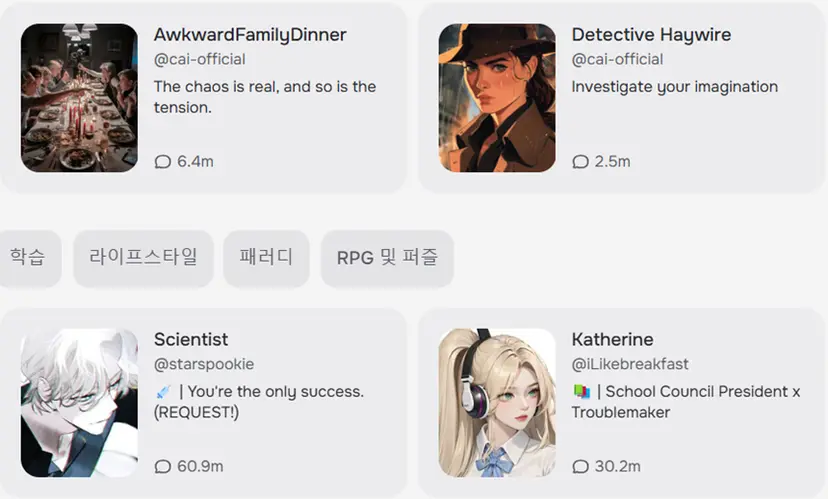
Character chat services, where users have virtual conversations with famous figures or avatars they have personally assigned personalities to, are emerging as an AI B2C (Business-to-Consumer) monetization model. Domestic startups 'Zeta' and 'Wrtn' have joined the competition, and global big tech companies like Google, Meta, and OpenAI are applying related services to their platforms or developing the technology.
It’s ‘Fictional,’ but You Get Hooked… AI Emerges as a Key Business Model
In the generative AI field, which is expected to expand from a market size of $13.5 billion (19.7 trillion won) in 2023 to $255.8 billion (329.5 trillion won) a decade later in 2033, domestic and international companies are focusing on building business models and securing their positions. Character chatbots are being pointed out as promising services for monetization targeting general users. While services aimed at role-playing with virtual characters and emotional exchange are still unfamiliar, expectations for their business scalability are high, as they are referred to as AI companion services or chatbot entertainment.
The corporate value of global leader Character.ai has reached $1 billion (1.4 trillion won). Two researchers who developed chatbots at Google left the company to found it. By last year, 18 million chatbots had been created, ranging from classic literature, movie, and game characters to psychological counselors. Domestic startups are also picking up the pace. Wrtn, an AI content creation platform, recorded 5 million active users last October, just one year and 10 months after launching its service. Wrtn Technologies, the domestic startup operating the service, has attracted 48 billion won in investment. Scatter Lab, known for its chatbot 'Lee Luda'—a concept of a female college student in her 20s—is tapping into the emotional AI market by launching the AI-based story platform 'Zeta' last year. It gathered 1 million users in its first 6 months, and has secured 41 billion won in investment to date, including from SK Telecom017670 (15 billion won), which signed a strategic partnership agreement, SoftBank (1.3 billion won), and Krafton259960 (1 billion won).
In addition to companies that put character chatting at the forefront, major big tech companies are actively introducing chat options with virtual figures or specific setting values. On the 9th (local time), the IT specialty media TechCrunch reported that OpenAI has introduced custom interaction options to its ChatGPT service. This method allows users to separately specify preferred names, professions, and characteristics for the chatbot, such as 'chatty' or 'encouraging.' Currently, this service update is only provided to some users. It is known that Meta is also preparing an update that adds an AI-dedicated tab to its messenger app, WhatsApp, to support conversations with 'popular AI characters' and the generation of AI characters.

Subscription Models and Partial Paid Services Launch; Copyright and Side Effects Remain Tasks to Solve
Where does the revenue for character chat services come from? In the case of Character.ai, which is the most advanced in monetization, the strategy of securing revenue through a target group stands out. While the basic service is provided for free, you must pay $9.99 per month to use the premium subscription model 'ai+ Plan.' In the paid version, you can access topics that are restricted in the free version and receive benefits such as faster responses.
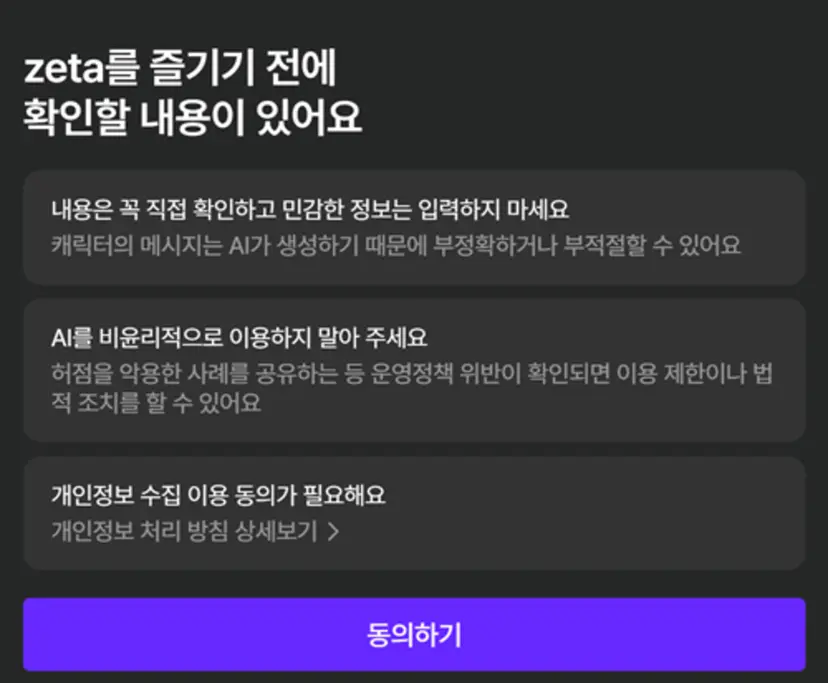
Although Wrtn is basically a free service, it started monetization by introducing a paid feature called 'Superchat' last October. According to Wrtn Technologies, there is a difference between standard chat and Superchat in the base AI models, which are 'Claude Haiku 3.0' and the most advanced 'New Claude 3.5,' respectively. The chatbot conversing through Superchat understands context more accurately and is completely immersed in the given role and situation. Zeta, which brands itself as an interactive AI content platform, added a paid feature last September where users can purchase the in-app currency 'Piece' to hear the AI character's voice during a chat. Looking at overseas service cases, 'ForeverVoices,' an AI voice chatbot incorporating influencer clones, and 'Replika,' which secured demand for purposes like pseudo-romantic relationships, have also begun building revenue models.
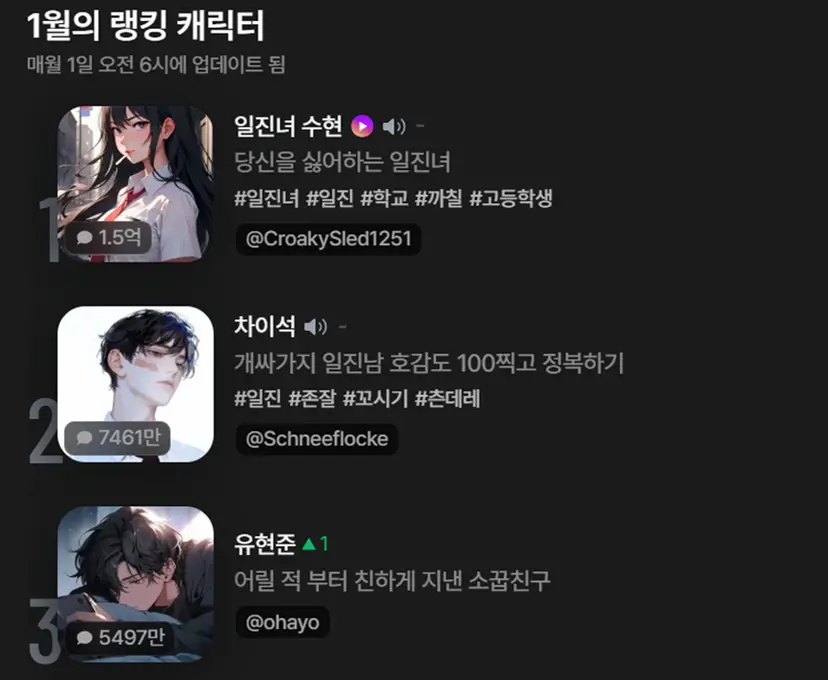
As the primary users of character chatting are mostly teenagers and people in their 20s, there is already resistance to monetization in the global market; however, the possibility of linkage with production fields such as real-time story creation or the entertainment industry is positive. Lee Im-bok, head of the Second Brain Research Institute, evaluated, "The basic framework is to assign a desired personality to an AI avatar and let it act independently. There are attractive selling points in platforms for resolving user loneliness or in counseling functions."
However, the risk that it could blur the boundaries between reality and fiction is also consistently raised. Domestic platforms are implementing safety measures by requiring ethical usage guidance and consent procedures or applying safety filters. Overseas, problems have actually surfaced. Last October, Character.ai was sued by a grieving family after an American boy, who had been chatting with a Game of Thrones character bot for several months, passed away. It is pointed out that the social controversy regarding the influence of the app could expand. Lee stated, "It is fun, but it may be difficult to secure the attraction for monetization in the long term. There is also a possibility that legal constraints such as copyright could become a stumbling block in the future."