

[비즈한국] There is a phrase, "The value of 'together'." It appeared in a corporate image advertisement over a decade ago. It is a wonderful copy that signifies that the power of togetherness can change the world. Doing things together implies empathy or communication, and this power can create a new paradigm. Art also holds value when it gains empathy from people. Empathy comes from the spirit of the times and a universal artistic language. The 'Korea Art Promotion Project' also aims to showcase the thoughts of various people through an accessible artistic language. Entering its 10th season, we support artists who strive to put into practice Confucius's idea that "good art must be simple."
J.M.G. Le Clézio, the French novelist who received the Nobel Prize in Literature in 2008, is a writer familiar to us. He has served as a juror for the Busan International Film Festival and even as an honorary ambassador for the Jeju New 7 Wonders of Nature, showing a special connection to Korea. He first became known in our literary circles thanks to his early work, "The Flood" (Le Procès-verbal). This novel is an anti-novel themed around the contradictions of life. At the end of the novel, there is a passage that summarizes the work's theme.
'From the moment we are born, we take one step closer to the door of death. Living day by day is dying.'
A Buddhist worldview that life is death can be glimpsed here. As such, 'contradiction' is an attractive theme for art. Therefore, regardless of time or place, it is not very difficult to find works that take contradiction as their subject.
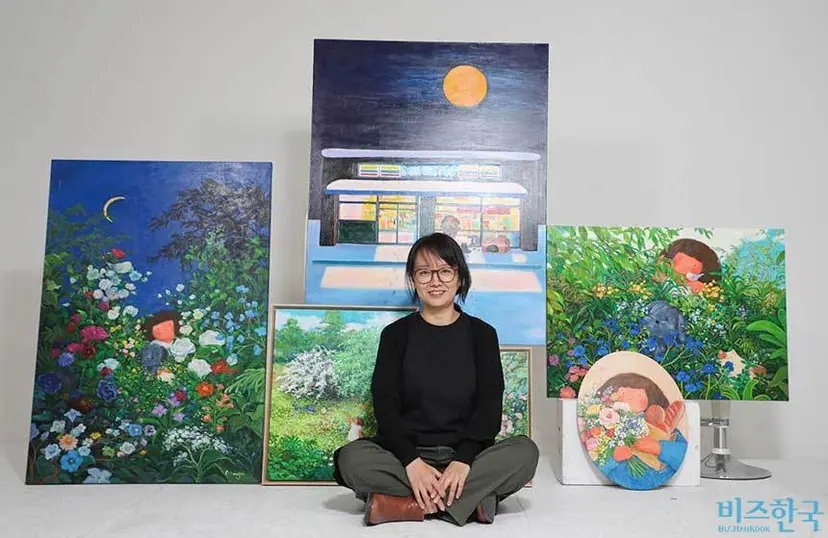
Kim Gro’s work also starts from contradiction. She captures the two faces of happiness on a single canvas. Just as light is brighter because there is darkness, she intends to emphasize the image of happiness.
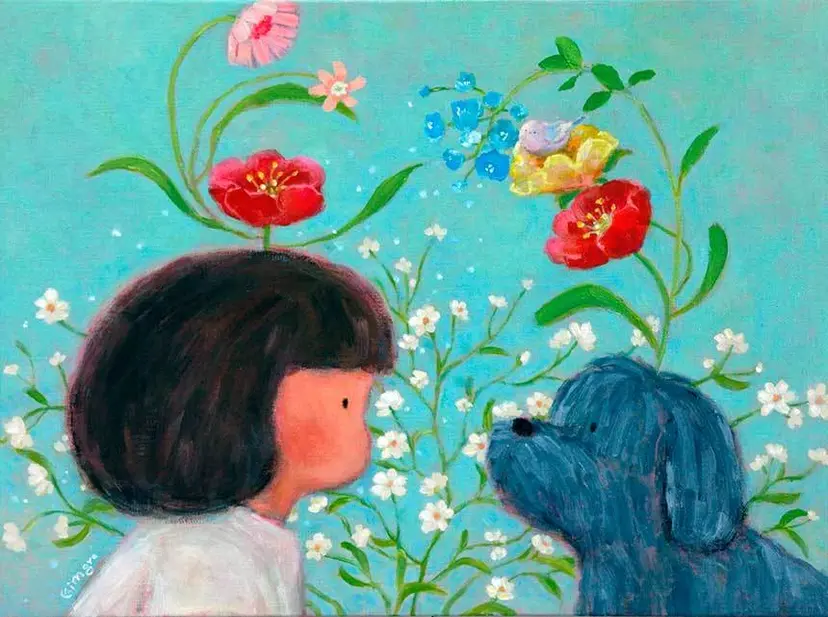
That is why things that are in opposition or conflict appear on the artist's canvas. Artificial objects and nature, outdoors and indoors, the past and the present or future. The decorative quality serves as the link that weaves these things together to harmonize within a single situation.
What catches the eye first in her paintings are the vibrant colors and characters with unique shapes. Thanks to this decorative nature, her paintings are easily read by the public. The fact that a painting is quickly captured by people's vision means it holds that much persuasiveness. This is the strength of Kim Gro's painting.
The theme of Kim Gro's painting is the appearance of happiness. Her works are the culmination of her efforts to draw out images of memories that made her happy in her life so that ordinary people can empathize with them. However, it is difficult to recognize happiness in that very moment. This is because experiences of misfortune take up a much larger part of life than memories of happiness.
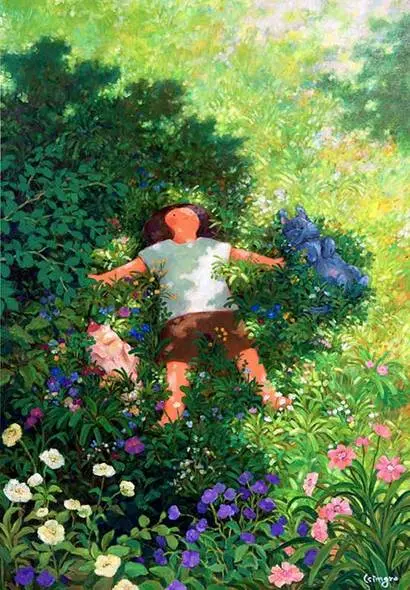
Her work begins with the realization that happiness stems from the very small things that can be held in one's hand. That is why the character that appears in the artist's work is named 'Osone'. It is an expression of the artist's will to find images of happiness in the small joys one can "Oh! grab in one's hand."
With small eyes, a long bob haircut, and a plump figure, Osone looks like a young child. It also gives the impression of a cute doll. The artist explains, "I created Osone by combining my own image with that of my family," adding that it is "a character with no age or gender."
Her work depicts situations that Osone stages while moving from place to place as if on a journey. The background, which contrasts with Osone's bright appearance, seems contradictory. Elements like dark forests or night skies serve to make Osone's bright image stand out even more.