

[비즈한국] The James Webb Space Telescope is uncovering unexpected and astonishing scenes at the very edge of the universe, shortly after the Big Bang. Some discoveries, however, are particularly baffling to astronomers, such as the tiny, faintly glowing red dots found at the edge of the cosmos. These spots are called "Little Red Dots" (LRDs). They are presumed to be primordial galaxies or primordial black holes that existed when the universe was less than 1 billion years old, but their exact nature remains unexplained.
Occasionally, some media outlets and YouTubers, borrowing the voices of mischievous astronomers excited about new discoveries, report in an exaggerated manner that "the Big Bang theory itself is being threatened." Fortunately, no discovery has yet led to the collapse of the existing Big Bang theory, but these findings are fascinating and intriguing enough to evoke such rhetoric in the press.
These red dots began to appear during James Webb's search for supermassive black holes that would have existed in the early universe shortly after the Big Bang. The early universe was less evolved compared to today; it was a time when supernovae had not yet occurred frequently. Most of it consisted of pure hydrogen and helium, and consequently, galaxies composed of such stars were similar. These primordial galaxies likely exhibited intense emission lines from hydrogen.
However, if a massive black hole existed at the center of a galaxy since its primordial days, the galaxy would have rotated rapidly around that central black hole, just like modern galaxies. As it rotated, some of the gaseous matter within the galaxy would move away from us, while another portion would move toward us. Observing the light of moving objects causes a Doppler effect, where wavelengths become longer or shorter.
Therefore, light from galaxies rotating rapidly with heavy black holes at their centers appears spread out toward both longer and shorter wavelengths. Sharp, pointed emission lines from various chemical components in the spectrum become broader and flatter. This is called line broadening. In particular, the more massive the black hole, the faster the galaxy rotates, and the broader the spectral lines become. These features are known as "broad lines."
Moreover, the galaxies at the edge of the universe targeted by James Webb are receding at speeds far exceeding the speed of light due to the expansion of the universe. This cosmic expansion causes a redshift, making the light from these galaxies appear shifted toward extremely long wavelengths. While the hydrogen gas inside these galaxies would have originally emitted light in the ultraviolet range with much shorter wavelengths, the light shifted into the infrared range, which has much longer wavelengths, during its long journey to Earth. The red, blurry dots seen by James Webb are light from billions of years ago that has undergone this extreme redshift.
However, as one red dot after another was discovered, a perplexing fact emerged. Initially, astronomers thought these red dots were light leaking from the very edge of the distant universe, with a massive black hole at the center, stretched into longer wavelengths by the expansion of the universe. But the problem is not that simple. Most of the red dots discovered so far do not show significant line broadening. The features that should obviously be present if a massive black hole were at the center are missing! The appearance is so strange that some even argue they might not be the ordinary galaxies we initially imagined.
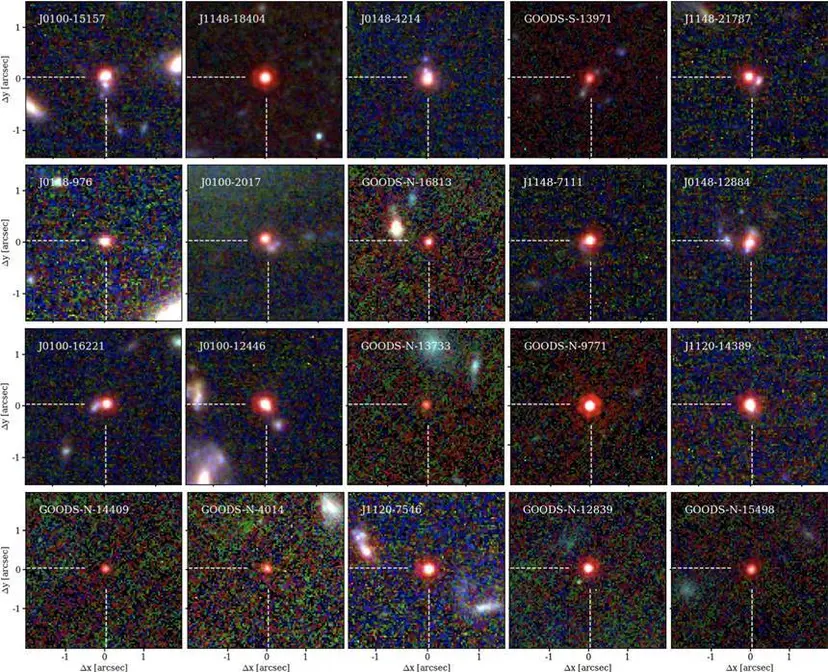
There are several hypotheses for this. First, it is possible that the supermassive black hole at the center is emitting such intense energy that the light from ordinary stars and gas clouds swirling around it is obscured. Alternatively, because they are early universe galaxies, they might be much smaller than galaxies today. Furthermore, they might look particularly red because they are enveloped in such dense dust clouds that the brighter, short-wavelength blue starlight emitted from within the galaxy is mostly masked.
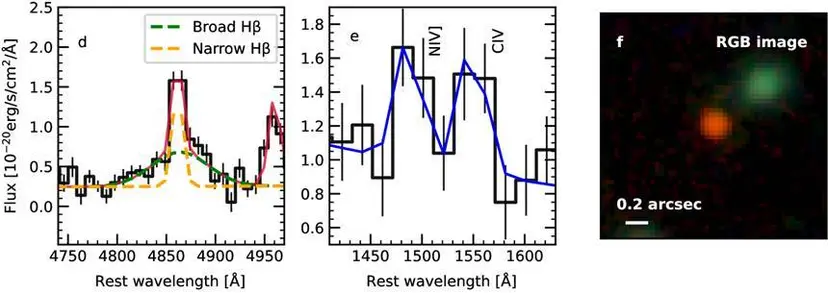
Astronomers analyzed CANUCS-LRD-z8.6, one of the red dots discovered by James Webb. It is a very distant galaxy with a redshift of about 8.6. This galaxy captures a glimpse of the universe when it was only 580 million years old. Consequently, its metal content is extremely low. This galaxy shows a faint but clearly identifiable line broadening. Estimates based on this suggest that the black hole hiding at its center exceeds 10 million times the mass of the Sun.
Since the black hole at the center of our Milky Way is 4 million times the mass of the Sun, the black hole in this red dot is incredibly heavy. This means a newborn primordial galaxy, existing when the universe was less than 600 million years old, harbored a black hole more than twice as heavy as the one in our galaxy, which is over 10 billion years old! It is hard to believe such a heavy black hole existed in the distant past, just as the universe was born.
Black holes grow by consuming matter through their powerful gravity. However, even a black hole cannot just swallow everything indiscriminately. At the same time, the matter gathered around it heats up, releasing powerful energy away from the black hole. The more matter a black hole consumes, the more intense the energy released in all directions becomes. If a black hole feeds too greedily, the energy released becomes too powerful, and it can no longer consume matter.
This limit on how much a black hole can feed is clearly defined as the Eddington limit. Explosive growth exceeding this limit is, as far as we know, impossible. Yet, the red dots in James Webb's photos clearly show the existence of super-sized primordial black holes that cannot be explained without such explosive growth.
There is one alternative to explain this. It is possible that when a primordial black hole was formed, no other stars were created around it, leaving only a supermassive black hole behind. What prevents the explosive growth of a black hole is the energy released as stars and gas clouds falling into the black hole are heated. Therefore, if such energy is not generated, the black hole could engage in a much faster and more aggressive "feeding frenzy" than we currently understand.
This might be possible if a "direct collapse" occurred, where a massive gas cloud in the primordial universe collapsed and coalesced into a supermassive black hole all at once, without forming individual stars. If that happened, the red dots discovered by the James Webb Space Telescope are, in fact, stray supermassive black holes wandering through the chaos of the early universe, belonging to no galaxy at all!
The recent findings by James Webb—often cited in the media as "threatening the Big Bang theory"—can be summarized in one sentence: "It seems that galaxies and black holes in the early universe, just after the Big Bang, grew faster than we had previously anticipated." Before James Webb, when we could only peer back to about 1 billion years after the Big Bang, we thought the universe had evolved at a steady growth rate from the very beginning. However, by peering into the universe within 1 billion years of the Big Bang, we have discovered signs that the universe may have gone through more intense "growing pains" when it was very young.
In fact, signs that black holes and galaxies in the early universe may have experienced more intense growth were cautiously suggested earlier by other survey observations. Using the Sloan Digital Sky Survey (SDSS), which maps galaxies across the universe, astronomers discovered what are known as "Green pea galaxies"—appearing as green spots—at distances of over 2 to 3 billion light-years. Because they are galaxies with very high and rich oxygen density, they glow brightly in green wavelengths. However, because they are infant galaxies from the distant past, they are only one-tenth the size of our galaxy. Thus, they appear as small peas in survey photos.
Moving beyond the pea patch into the deeper universe, we encounter "blueberry fields" that appear dimmer and have a faint blue hue. These are called "Blueberry galaxies"—faint, small spots that appear brightest in short, blue wavelengths near purple in the photos. Since systematic survey observations began in 2017, over 1,500 Blueberry galaxies have been identified. They are presumed to be galaxies where only bright, young, blue stars are packed at high density. They are likely starburst galaxies showing explosive star formation rates 10 to 100 times higher than current galaxies. Similarly, because they are younger infant galaxies in the deeper universe, they are less grown. They are only 1/3000th the size of our galaxy.
We thought the universe would be full of round, large galaxies like sunflowers. We thought as we looked further back into the past, we would only see small, underdeveloped sunflower seeds. But that was not the case. When we stepped further into the universe, we encountered an unexpectedly vast pea patch, and when we stepped even further, we found a giant blueberry field. Now that we have reached the edge of the observable universe through James Webb, we have encountered an unexpected giant "red millet field." Our universe, filled with countless beautifully shining galaxies today, is a flower that blossomed from a red millet field 13.8 billion years ago.
References
https://ui.adsabs.harvard.edu/abs/2024arXiv241204983T/abstract
https://ui.adsabs.harvard.edu/abs/2024arXiv241204557L/abstract
Who is author Ji Woong-bae? He loves cats and the universe. After watching "Galaxy Express 999" as a child, he dreamed of sharing the beauty of the cosmos. He is currently researching galaxy evolution through interactions at the Yonsei University Galaxy Evolution Research Center and the Near-Field Cosmology Laboratory, and is active in various scientific communication activities, including lectures and writing. He is the author of books such as "The Observatory of Flirting," "Thinking About the Universe All Day," and "Star, The Science of Light."