

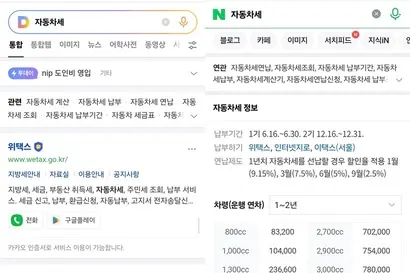
[비즈한국] Office worker Kang (32), who planned to pay his annual car tax in January again this year, opened his search bar to check the payment schedule. As it is his third year owning a car, he needed to verify the deduction criteria and payment amount, which differed from last year. When he searched for “car tax” on the Daum app, a link to Wetax (a local tax website) appeared. Hoping to simply browse information, Kang opened the Naver app and entered the same keyword. A tax table based on vehicle age and displacement appeared on the very first screen. At the bottom, a car tax calculator was also provided, allowing him to estimate the expected tax amount.
Office worker Jung (30s) is looking for accommodation ahead of a trip to Macau in March. The hotel he had previously booked required automatic payment at check-in, and since the payment amount in the reservation details was listed in Macau Pataca, he searched for the exchange rate for an accurate price comparison. When he typed “Macau Pataca” into the Daum portal search bar, it was filled only with informational blog posts. Eventually, he searched on Google and used the first exchange rate calculator that appeared to verify the price in Korean Won.
The portal service ‘Daum’ is in jeopardy. With even Naver under pressure from the expansion of global search engines, Daum's market share is hitting rock bottom. Two years ago, it broke the 5% barrier, and last year, it even briefly lost its spot as the third-largest search engine in Korea to Microsoft’s (MS) ‘Bing.’ Kakao035720 has been operating the business unit responsible for the Daum portal as an in-house independent company (CIC) since 2023. Contrary to its goal of focusing on search and content distribution, Daum’s standing and role have become even more ambiguous over the past few years. As criticism regarding insufficient search quality continues, the assessment is that it is becoming difficult to even retain existing users.
Abysmal search results, why is Daum like this?
User dissatisfaction with Daum's search function does not end with the two cases mentioned above. The primary limitation cited is that the information users seek through search is not properly retrieved. Services provided by the platform itself to enhance user convenience are also relatively limited. For instance, when searching for a Hyundai ‘Sonata,’ both Naver and Daum allow users to confirm basic information such as car models and prices by option after scrolling past multiple long-term rental advertisements.
However, the method differs. While Naver allows users to obtain information and even run a simulated quote without leaving the page, Daum redirects users to a partner site that provides automotive information after clicking "View Details." A Naver official stated, "We are conducting updates so that users can conveniently access reliable information." A Kakao official explained, "We have partnered with specialized firms to enable users to obtain more professional information in areas such as automobiles, real estate, and finance."

The exodus of content creators, who form one pillar of the portal ecosystem, has been underway for quite some time. This is because there are no advantages in terms of search exposure or advertising policies. While the purpose of running a personal blog varies by operator, profitability is a factor that cannot be ignored. Unlike Naver, Daum allowed users to generate revenue by attaching Google Ads; however, in the summer of 2023, it changed its policy to display its own advertisements at the top and bottom of blogs. Profitability is also important for the service provider. The reason given was to secure server operating costs to provide stable platform services.
Person A, who operates web channels including Tistory, emphasized, “Many users have left, saying their profits were cut in half or that they would focus on Naver instead. Although interest in personal platforms is growing, Tistory is on a path of decline. I don’t think it’s possible to reverse the already downward trend. Spam blogs and low-quality posts have increased, and the vitality of both the producers and the service has disappeared.” Kakao terminated the Daum Blog service, which it had operated for 17 years, in 2022 and integrated it into Tistory.
Dropping ‘search’ competitiveness for ‘content’?
Last year, Daum fell to fourth place after losing its third-place spot to Bing for the first time. Its market share, which was in the 6% range in 2022, has been decreasing by 1-2 percentage points (p) every year. While Naver’s standing is also shrinking, with the combined market share of Google and Bing approaching 40%, its rate of decline is less than 1%p. While Naver’s share rose following the online news consumption and portal demand triggered by the martial law incident on December 3 last year, Daum failed to rebound. As of last month, Daum's market share stood at 3%, a significant gap from Naver’s 64.7%. The participation rate of content creators like those on Tistory is undisclosed information.

Although Kakao started with the name ‘Daum Kakao’ during the 2014 merger, it changed its sign to just Kakao after one year. The platform’s center of gravity shifted toward KakaoTalk, and business strategies were also structured around Kakao. Daum is considered to have fallen behind without securing competitiveness between Naver, which focuses on the portal, and Google, which holds 90% of the global search engine market share.
Revenue for the Daum portal is also dropping. After quarterly revenue fell below 100 billion won in the fourth quarter of 2022, it even broke the 90 billion won threshold the following year. One of the main reasons cited is the decline in query count (QC). Due to the nature of portals, advertising revenue and content user influx cannot be separated from search. The number of Daum app users has decreased by 33% over five years, from 10.7 million in 2018 to 7.2 million in 2023.
Some raise concerns that with major companies fiercely competing over the "next step" for search engines, Daum will find it difficult to keep pace. Since last year, Google has been providing an “AI Overview” service that summarizes search results and shares links to the results. While there are clear limitations such as hallucinations, as it is in the early stages of adoption, most domestic and international companies like MS, OpenAI, and Naver are focusing on generative AI-based search engines. An industry official said, “Looking at Daum’s moves alone, they differ from search market trends. It is a pattern of focusing on KakaoTalk while falling behind in the advancement of portal and search services.”
Daum has put forward a strategy to secure competitiveness by focusing on content just as much as search. Some evaluate that apart from search market share, trends in other indicators such as content are relatively good. This judgment appears to have influenced the organizational name change from Daum CIC to Content CIC in the first half of last year. A Kakao official stated, “We are strengthening our role as a comprehensive content platform by operating not only Cafes, Brunch, and Tistory, but also news, Daum channels, and short-form content as separate tabs.”