

[비즈한국] Kim Nak-nyeon, President of the Academy of Korean Studies; Park Ji-hyang, Chairperson of the Northeast Asian History Foundation; Heo Dong-hyun, Chairman of the National Institute of Korean History; and Kim Hyeong-seok, Director of the Independence Hall of Korea.
All of those appointed as heads of the four major government-funded historical institutions in 2024 are figures associated with the New Right. Kim Nak-nyeon served as the director of the Naksungdae Institute of Economic Research and co-authored 'Anti-Japan Tribalism' with Professor Lee Young-hoon. Park Ji-hyang served as a member of the National Institute of Korean History during the Park Geun-hye administration, when the right-wing state-authored history textbooks were introduced. Heo Dong-hyun also served on the compilation deliberation committee for state-authored textbooks during the Park Geun-hye administration and participated in the 'Textbook Forum,' which created right-wing textbooks. Kim Hyeong-seok, also from the Naksungdae Institute of Economic Research, stirred controversy at the Korea Military Academy by advocating for the removal of General Hong Beom-do’s bust and stating, "During the colonial period, the nationality of our ancestors was Japanese." Lee Jong-chan, President of the Heritage of Korean Independence, was so outraged by news of his appointment that he immediately demanded its withdrawal, claiming, "There is a Japanese spy in Yongsan."
Yoon Suk Yeol, the "leader of an insurrection" who declared emergency martial law and now faces impeachment proceedings by the Constitutional Court, has shown irrational, pro-Japanese behavior as president that has sparked public outrage and questions among many citizens. 'Why Has South Korean Conservatism Become Anti-Nationalist Right-Wing?' seeks the reasons in the New Right. It uncovers the process and reality of how the right-wing, masquerading as conservatives, ultimately arrived at the New Right, weaving it together with South Korean history to expose how they became an "anti-nationalist right-wing."
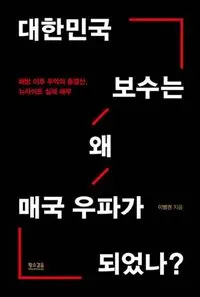
Why Has South Korean Conservatism Become Anti-Nationalist Right-Wing?
: A Final Accounting of the Post-Liberation Right-Wing and an Anatomy of the New Right
Written by Lee Byeong-kwon, Hwangso-georeum
160 pages, 16,800 won
The roots of the New Right trace back to the National Liberation (NL) Juche-faction student activists of the 1980s. Figures like Kim Young-hwan, author of the 'Steel Letter,' largely "converted" after witnessing the collapse of the communist bloc in the 1990s, meeting neo-liberalism while searching for the secrets behind the triumph of capitalism. Just like the pro-Japanese collaborator Yi Wan-yong, who said, "Joseon has always been a country that serves a greater power; what is the problem if the object of that service changes from China to Japan?", capitalism—which solved problems communism could not—became the highest value for these converted Juche-faction members. In doing so, they embraced the "colonial modernization theory" argued by Professor Ahn Byung-jik.
Ahn Byung-jik, once a progressive intellectual, visited the University of Tokyo as a visiting professor in the mid-1980s and sought to find a path to supplement his existing theories in the period of Japanese colonial rule. "Joseon did not have the capacity to modernize (become capitalist) on its own, but the foundations for capitalism were laid during the Japanese colonial period, making subsequent capitalization possible." Thus was born "colonial modernization theory," which traces the roots of South Korea's capitalist development to Japanese rule. The Naksungdae Institute of Economic Research, which he founded, became the theoretical foundation for South Korea's current New Right, and his student, Lee Young-hoon, wrote 'Anti-Japan Tribalism.' The author asserts that the Naksungdae Institute of Economic Research is backed by the Japanese far-right.
The author also exposes the fact that the Nippon Foundation (formerly the Sasakawa Foundation), established by Class-A war criminal Ryoichi Sasakawa, provided massive funds to major universities and intellectuals in Korea. During the Japanese colonial period, Sasakawa made a fortune selling drugs in Manchukuo and provided large sums of money to support the war. He was a self-proclaimed fascist who became a billionaire in the gambling industry after serving time as a war criminal. This dirty money flowed into the Korean intellectual community. In 1995, the Nippon Foundation "secretly" provided 10 billion won to Yonsei University for an "Asia Research Fund." Rumors abound that the channel for delivering these funds was Professor Yoon Ki-joong, the father of Yoon Suk Yeol.
In South Korea, the concept of "conservatism" is different from the "conservative forces." The author argues that if the standards for conservatism include respecting community values, upholding existing social order and authority, defending national and ethnic values, and advocating for democratic systems based on market economy order, then the current conservative forces in South Korea are merely reactionary, regressive forces. Among so-called "conservative presidents" like Syngman Rhee, Park Chung-hee, and Chun Doo-hwan, none are considered successful. The only entities in our history since the Joseon Dynasty that could be counted as true conservatives are those from the Shanghai Provisional Government, who advocated for nationalist positions and the Principle of Three Equalities (Samgyun-juui).
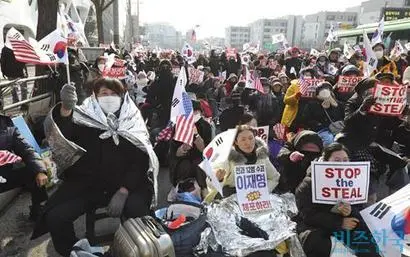
The current New Right in South Korea is a combination of remnants of colonial collaborators, converted Juche-faction members, colonial historiography, and neo-liberalism. They entered the core of the power structure under the Yoon Suk Yeol government. The author interprets Yoon's act of replacing all heads of historical institutions in 2024 as a move aimed at achieving visible results in the U.S.-Korea-Japan alliance in 2025, which marks the 60th anniversary of the normalization of Korea-Japan diplomatic relations.
The South Korean New Right believes that a U.S.-China war is inevitable and recognizes that a trilateral alliance between the U.S., Korea, and Japan is necessary. The Yoon Suk Yeol regime has already sided with Japan on issues of forced labor and "comfort women," and has agreed to share North Korean ballistic missile intelligence with Japan. Now, the only gifts left to give Japan are the joint management of Dokdo or permitting Japanese warships to dock at Dokdo. Looking back at how the emergency martial law was declared one month before the start of 2025, all the timing aligns in a frighteningly precise manner.
The author majored in history during undergraduate and graduate studies and has worked as a National Assembly aide and in NGOs. Although not a professional scholar, the book is noteworthy for its timely focus on current political realities. While it may lack theoretical depth or sophistication, the writing is concise and easy to read, making it suitable as an introductory text. It would be appropriate for those who want to quickly grasp the current state of South Korea’s New Right.