

[비즈한국] At this year's stage for the world’s largest electronics and information technology (IT) event, every company was shouting about artificial intelligence (AI). If last year was recorded as the first year of generative AI commercialization, this year’s buzzword is the practical application of AI. ‘CES 2025’ focused on application fields, showcasing how AI will connect daily life, from autonomous vehicles, PCs, and smart homes to wearable devices, healthcare, and next-generation TVs. We examine the key announcements and new products you need to watch.
NVIDIA Unveils New GPUs, Robot AI, and Personal Supercomputers
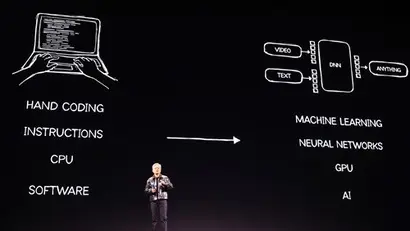
Immediately after the doors of CES 2025 opened, the world's attention turned to NVIDIA CEO Jensen Huang. Delivering a keynote speech on the 6th (local time), one day before the official opening, Jensen Huang officially announced the next-generation graphics processing unit (GPU).
“This GPU is truly a beast.” The GeForce RTX 50 series, the next-generation PC GPU, is built on the NVIDIA Blackwell architecture, 5th generation Tensor Cores, and 4th generation RT Cores. The RTX 5090, the fastest GeForce RTX GPU released to date, features 92 billion transistors and possesses an AI computing processing capability of over 3,352 trillion operations per second. This is up to twice the performance of previous models. The prices for the RTX 5090, RTX 5080, and RTX 5070 are $1,999, $999, and $549, respectively.
Immediately following the announcement, a debate ensued on social media: 'Can a $549 RTX provide performance on par with the existing $1,599 RTX 4090?' Lars Weinand, a senior technical product manager at NVIDIA, explained in a briefing with US IT media outlet The Verge, “Using neural rendering and DLSS 4, you can reach performance levels that were previously only possible on the RTX 4090,” adding, “This does not mean the RTX 5070 can beat the RTX 4090 in every aspect and every configuration.”

Foreign media evaluated NVIDIA’s new GPU announcement as “surprising, but not the only news.” NVIDIA is expanding its territory beyond chips into robots, autonomous vehicles, and proprietary AI models. The key buzzwords are ‘Cosmos’ and ‘Personal AI Supercomputer’.
NVIDIA is launching Cosmos, a foundational AI model that can be used to train humanoid robots, industrial robots, and autonomous vehicles. Unlike language models that learn how to generate text by studying vast amounts of books and articles, Cosmos is designed to generate images and 3D models of the physical world. Jensen Huang said, “We have taught AI to understand the physical world.” In fact, Cosmos was trained based on 20 million hours of real video footage of humans walking, moving their hands, and manipulating objects. IT media outlet Wired reported, “Researchers and startups are hoping that this type of foundational model can provide more sophisticated functions to robots used in factories and homes.”
There is also high interest in the $3,000 personal AI supercomputer that anyone can use. NVIDIA’s new desktop, ‘Digits,’ is the size of a small book but contains a superchip capable of processing large-scale AI programs. According to NVIDIA’s roadmap, sales will begin this May. While this reflects confidence that it can replace data centers, Wired evaluated, “The top versions of proprietary models kept in massive data centers owned by Microsoft and Google (such as OpenAI’s ‘GPT-4’ and Google’s ‘Gemini’) are likely to be larger and more powerful than what Digits can handle.”
“AI Announcements Are Everywhere”
CES 2025, held in Las Vegas from the 7th to the 10th, made it clear that AI is no longer limited to smartphones and computers. Products that make life more convenient, such as AI-based personal fitness assistants, smart vision glasses for the visually impaired, autonomous kitchen robots, AI cybersecurity systems, and adaptive AI education bots, drew attention.

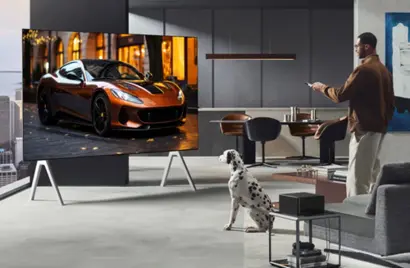
While skepticism about AI TVs—asking "how smart does a TV really need to be?"—is considerable, the ambitions of Samsung and LG remain firmly fixed on the TV. Five new lineups, including Samsung Electronics' premium model Neo QLED 8K QN990F, incorporate anti-reflection technology and Samsung Vision AI features. These include 8K upscaling, frame-by-frame HDR remastering, adaptive sound, color boosting, and an AI mode that automatically optimizes pictures and sound based on the content on the screen. The 2025 TV lineup introduced by LG focused on brightness, wireless connectivity, and AI. Following the ‘LG Signature OLED M’ (2023), a wireless OLED TV that eliminated all wires except for power, the newly unveiled M5 enables wireless audio and video transmission at up to 144Hz without any loss in image quality. AI Pro optimization modes for image and sound are also provided.
Ambition is also visible in the home AI sector. Samsung has made the sale of its home robot 'Ballie' official for the first half of the year. Ballie, first introduced by Samsung in 2020, had its updated version revealed last year, and a retail launch for general consumers has been scheduled for this year. It has a rounded shape and is equipped with features like a projector. Other than the fact that it can control smart devices and perform sophisticated interactions by combining Vision AI and chatbot functions, specific details such as functions, release date, and price have not been disclosed.
LG has announced the release of a mobile AI home hub by the end of this year. Attention is also focused on whether they can generate revenue through 'Q9' and 'ThinQ ON,' which were unveiled at CES last year and IFA 2024, the largest electronics exhibition in Europe, respectively. Lee Hyang-eun, Executive Director of the CX Division at LG Electronics' Home Appliance & Air Solution (H&A) Company, said during a briefing on the 8th, “The Q9 is scheduled to be released late this year, and we expect to generate revenue through subscription fees and solution costs from the MX platform.”

The future of the automotive industry, including autonomous vehicles, is also drawing attention. With the advancement of autonomous driving technology, AI is expected to play a crucial role in improving automatic control and obstacle detection. Toyota announced that its next-generation vehicles will feature autonomous driving functions equipped with NVIDIA’s Drive supercomputer and a safety-oriented operating system. The robotaxi market opened by Google is also expected to gradually expand. At CES 2025, Waymo (a subsidiary of Google), Zoox (an autonomous driving subsidiary of Amazon), and Intel announced their own autonomous vehicles. While the limitations of commercialization were discussed following setbacks like Apple’s development cancellation last year, the consensus is that momentum is being secured as President-elect Donald Trump reviews the deregulation of autonomous driving.