

[비즈한국] Band music was once considered the exclusive domain of hardcore enthusiasts. However, it has suddenly found itself at the center of mainstream popularity. Not only are band tracks dominating the top spots on major music charts, but even the song "Sudden Shower," performed by the fictional band Eclipse in the drama 'Lovely Runner' (starring Byeon Woo-seok), has achieved massive popularity. This phenomenon invites us to consider a new horizon and future for our music culture.

Originally, a "band" refers to a concept that encompasses not only the performers and singers but also the production and directing team behind the stage. In Korea, however, the term has been used to group together the vocalists and instrumentalists. Typically, the word "band" evokes images of rock bands. Because of this, it was naturally associated with rebellious codes and an underground aesthetic. The music was often heavy or gritty, the hairstyles were intentionally unrealistic, and the attire was heavy enough to give off an unconventional, imposing vibe. The lyrics, too, were more likely to carry social messages than simple love songs. In terms of subculture, it was enough for them to find satisfaction and a sense of accomplishment in creating their own music community.
At the same time, this made it difficult for casual fans to approach them. Amid the attention given to numerous audition programs, there were attempts to revive band music, such as KBS 2TV's 'TOP Band,' but it proved to be a difficult task. It seems that movements seeking communal values and alternative musical identities failed to resonate with the general public. Looking at the current band music fever, one wonders if the previous failures were a misdiagnosis of changing popular music tastes.
The core of today's band music craze is the "idol band." An idol band is not the typical indie band one might imagine, but a music group trained and managed by an agency. This isn't the first time they have appeared. While groups like Jaurim, YB, Crying Nut, Buzz, M.C The Max's Moon Child, and LUCY gained mainstream attention as indie bands, the Hans Band drew eyes as a girl group band back in 1998. However, they were not strictly "idol bands" in the modern sense.
In 1999, Click-B emerged with an idol band concept, but it didn't last long. AOA aimed to be a band-based girl group in 2012 but soon shifted into a dance group, and Wonder Girls drew attention with a band-themed concept in 2015 but discontinued it shortly after. The most notable recent girl band is QWER, which debuted in 2023. They represent a new look for idol bands.
As an example of an idol band recognized for its sustainability, one can point to DAY6, which debuted in 2015. They started as the first agency-managed boy band under JYP Entertainment. While they are like other K-pop idols in that they are discovered and fostered by an agency, they aim to be "autonomous idols"—a type of singer-songwriter group that does not rely heavily on stage performance. While previous bands divided members into vocalists and instrumentalists, DAY6, who produced hits like "You Were Beautiful" and "Time of Our Life," features members who are all both vocalists and instrumentalists, and they write their own music and lyrics. Like other K-pop idols, they also possess producing capabilities.
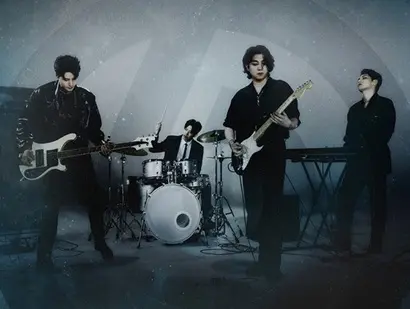
They can be called "all-rounders." Unlike bands of the past, their musical vibe is bright, lyrical, and even upbeat. They do not lean toward a specific genre, and their range is wide and diverse. A key characteristic is that their style cannot be pinned down to just one category. One thing they all share is that they belong to the "easy listening" category. Unlike traditional band music, they sing songs that are comfortable to listen to repeatedly, fitting the era of mobile social media. This makes their vocal tone and singing ability highly important.
The popularity of band music can also be traced to fatigue with K-pop music. K-pop generally leans toward hip-hop bases or electronic dance music. Both command the stage, but in terms of voice and sound, they can be distracting or overly flashy. In particular, the delivery of lyrics is often lost. Furthermore, parts are increasingly subdivided, making them difficult for the average listener to sing along to. It leans too heavily on "music to be watched," neglecting "music to be listened to." Band music offers a way to overcome these limitations. Beyond a sense of refreshment, it seems to provide healing through an analog sensibility. There is a reason why band music is frequently used in Japanese animation OSTs; it is not simply because it appears in Japanese animation that it is preferred.
I find myself reflecting on the meaning bands hold in our society. Band music has always sought alternatives. In that sense, it has opened a new horizon beyond the deficiencies and uniformity of K-pop. We can also think of the value of integration. What is important in a live performance is the harmony and collaboration of the members. That itself realizes a social, communal value. In an era where discourse on "every man for himself" is rampant, band music offers a special meaning and value for youth culture.
The author, Kim Heon-sik, has been walking through and navigating the forest of popular culture phenomena since his 20s, driven by the expectation that there is a way to make the world a better place through culture. Even in the 21st century, where artificial intelligence and quantum computers are active, he continues to walk the same path with that same belief.