

[비즈한국] Cross Finance Korea, an online investment-linked finance (P2P lending) company that faced a settlement crisis of approximately 70 billion won last year, has entered rehabilitation proceedings. Cross Finance originated as an in-house venture of Koscom, a financial IT company and subsidiary of the Korea Exchange, and is currently owned by major shareholders Koscom and the Inzi Group. Cross Finance primarily dealt in "pre-settlement of card sales" loan products, but it faced a large-scale settlement failure after a payment gateway (PG) company misappropriated funds. While Cross Finance claims it is making efforts to repay, concerns remain that recouping investments will be difficult.
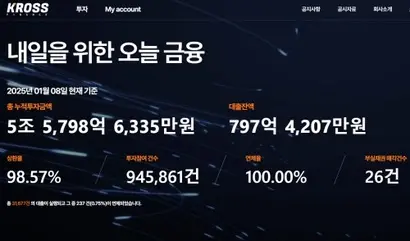
On December 18, 2024, the Seoul Rehabilitation Court commenced rehabilitation proceedings for Cross Finance Korea. This occurred approximately 20 days after the company filed for rehabilitation on November 28. Once Cross Finance submits a rehabilitation plan by the end of March, a decision on whether to approve the plan will be made between June and December.
On the 3rd, Cross Finance stated, "Due to civil lawsuits filed by some investors, provisional attachments have been placed on the main creditor bank's loan accounts," adding, "If further lawsuits and attachments proceed, normal business operations will be impossible. We filed for rehabilitation to preserve our value as a going concern." Furthermore, they emphasized, "Funds for loan repayments are managed independently from company assets, so initiating rehabilitation will not have any impact on investor assets or repayments."
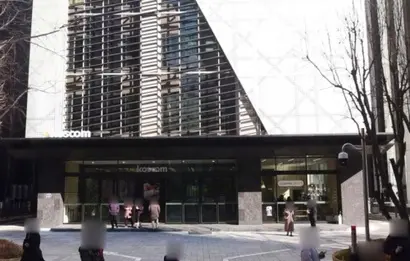
Cross Finance started in 2017 as "Korea Bill Brokerage," the first in-house venture of the Korea Exchange subsidiary Koscom. In 2021, it officially registered with the Financial Services Commission as an online investment-linked finance business and changed its name to Cross Finance Korea. The major shareholders are Koscom and the Inzi Group, a manufacturer of automotive, semiconductor, and electronic components. As of 2023, Koscom's stake (common stock) was 33.52%, and the Inzi Group held 40.40% (Cymerics160980 29.92%, Inzi Display037330 5.24%, Utech Solution 5.24%).
Cross Finance specialized in financial services for small and medium-sized merchants, focusing primarily on pre-settlement products for card sales. These products are loans collateralized by credit card sales receivables. Because card company settlements are generally guaranteed, these had been considered relatively safe P2P products.
The structure of the product is as follows: When a credit card sale occurs at a small merchant, the card company pays the sales proceeds after 2 to 11 days. Merchants in need of cash take out a loan through a pre-settlement company before receiving the payment. The pre-settlement company applies for a loan from the P2P firm using the sales receivables as collateral, and the P2P firm transfers the funds raised from investors to the merchant through the pre-settlement company. Proceeds settled by the card company are paid in the order of primary/secondary PG company → secondary PG company sales agency → merchant, with the loan repaid by the secondary PG company.
The incident occurred at Lumen Payments, which acted as the secondary PG company. On August 2, 2024, Lumen Payments failed to pay Cross Finance a portion of the credit card sales receivables, and three days later, it failed to pay the majority of the receivables. Believing that Lumen Payments had misappropriated the settlement funds, Cross Finance reported the company and its CEO, Kim In-hwan, to financial authorities and law enforcement on August 6–7, 2024.
During the prosecution's investigation, it was revealed that Lumen Payments CEO Kim In-hwan and others had established paper companies to create false sales receivables and then secure pre-settlement loans to siphon off funds. The amount they defrauded from Cross Finance reached 72 billion won.
To make matters worse, due to the fallout from the "TMON/WeMakePrice crisis," Cross Finance has also defaulted on repayments for "Seller Loan" (shopping mall pre-settlement) and "Logistic Loan" (logistics company pre-settlement) products. Cross Finance is currently trying to recover investor funds by filing for provisional attachments and civil/criminal lawsuits against borrowers, but there is still a long road ahead.
In the criminal case against Lumen Payments and CEO Kim In-hwan, the company and its relevant sales agencies were cleared of fraud charges by the court on December 6, 2024. The trial regarding CEO Kim's fraud charges is ongoing, and he has admitted to most of the allegations. Additionally, Cross Finance stated, "We have completed the primary provisional attachment on receivables related to card sales pre-settlement, but the recovered amount is far too low compared to the damages."
It remains uncertain whether the rehabilitation process will be completed successfully. Ahn Chang-hyun, a lawyer at Law Firm Daeyul specializing in corporate rehabilitation, noted, "To succeed in rehabilitation, a company must earn money or secure funds to repay its debts, but it is uncertain whether all damages can be recovered." He added, "The nature of online investment-linked finance means there are many stakeholders, which is another hurdle. One of the conditions for rehabilitation is creditor consent. Two-thirds or more of unsecured creditors must agree, and it is not easy to persuade them when many stakeholders are involved, as with P2P lending. If rehabilitation fails, the company could face bankruptcy."
As Cross Finance has stated it is not considering liquidation or bankruptcy, it appears that action from its investing companies is necessary. Lawyer Ahn suggested, "There is a plan to attract external capital to persuade creditors," adding, "Methods include DIP (Debtor-in-Possession) financing, where funds are lent to a company already in rehabilitation, or raising funds through M&A."
Meanwhile, victims of the non-settlement crisis have demanded that financial authorities and major shareholder Koscom investigate the truth and prepare countermeasures. They argue that as the major shareholder, they should take responsibility for Cross Finance dealing in problematic loan products and provide a plan for victim relief. Koscom and the Inzi Group have not taken any specific action since the crisis began. However, immediately after the incident, Cross Finance explained, "Our major shareholders also invested in the delayed repayment products and suffered losses. The total overdue amount is 22.3 billion won."