

[비즈한국] Following the Fukushima nuclear disaster in 2011, South Korea was placed on high alert due to concerns that leaked radiation could impact the country. In April of that same year, the Korea Institute of Nuclear Safety (KINS) announced that trace amounts of radioactive iodine had been detected across all regions following tests on airborne dust from 12 local monitoring stations. As public anxiety grew, the Ministry of Environment decided in 2014 to begin regular surveys of radioactive substances in major rivers and lakes nationwide.
However, an investigation by BizHankook has confirmed that radioactive iodine has been continuously detected in the Han River basin. Radioactive substances were found at 12 locations within the Han River area, including Jungnangcheon, Noryangjin (near the Han River Bridge), and Tancheon (near Samseong Bridge) in Seoul. In particular, Tancheon and Jungnangcheon have shown detections of radioactive iodine every year.
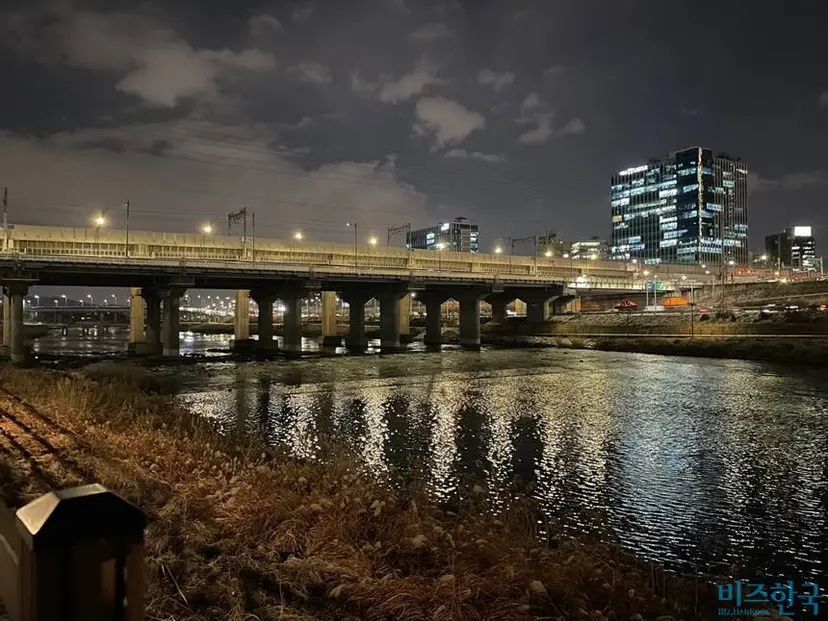
Detected in Han River Since 2016
The Ministry of Environment began regular investigations into radioactive materials in public water bodies in 2014. The National Institute of Environmental Research (NIER), under the ministry, surveys public waters biannually for radioactive substances like cesium (Cs-134, Cs-137) and iodine (I-131). As of 2024, there are 90 designated rivers and lakes across the country subject to these radioactive substance surveys.
BizHankook's analysis of the periodic measurement results for the Han River basin revealed that radioactive iodine has been detected every year since 2016. The 12 locations where radioactivity was detected span administrative districts including Seoul, Gyeonggi-do, Gangwon-do, and Chungcheongbuk-do. The peak value was 0.732 Bq (becquerel) per liter, measured in Mukheoncheon in Hwado-eup, Namyangju-si, in November 2017.
For comparison, the maximum value of radioactive iodine detected by KINS across 12 regions in 2011 was 0.000000764 Bq per liter. At the time, KINS explained that this was an extremely trace amount, approximately 1/1400th of the radiation exposure from a single X-ray scan.
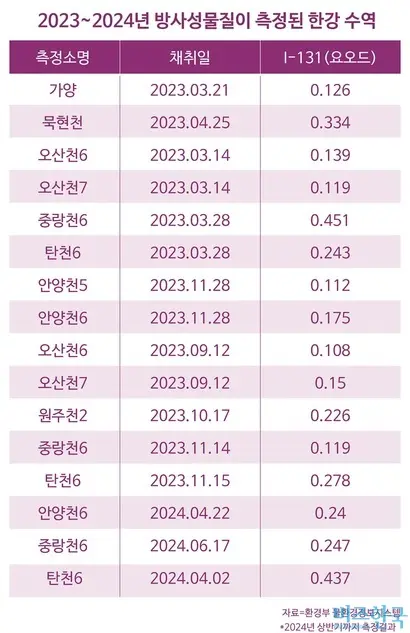
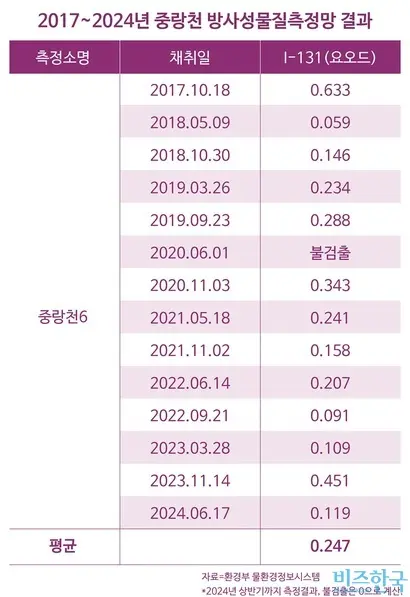
Between 2023 and the first half of 2024, radioactive substances were detected at a total of 9 locations in the Han River basin. The highest level was 0.437 Bq/L, found in Tancheon in Samseong-dong, Gangnam-gu, Seoul.
Tancheon and Jungnangcheon, in particular, showed iodine detections every year. From June 2016 to April 2024, the average iodine level in Tancheon (with two instances of non-detection) was 0.223 Bq/L, while from October 2017 to June 2024, the average level in Jungnangcheon (with one instance of non-detection) was 0.247 Bq/L.
Monitoring Only, No Action?
The fact that radioactive iodine has been detected in the Han River since the Ministry of Environment began regular surveys in 2014 has not been widely known. An official from the Seoul Research Institute of Public Health and Environment stated, "This is the first time I've heard that radioactivity was detected in the Han River. It is not something we monitor at this institute. I am not aware of the situation and will need to look into it."
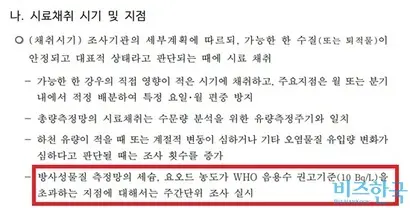
The core issue is the complete absence of standards for radioactive water quality. In other words, surveys are being conducted without any criteria for what constitutes a danger. While the Ministry of Environment maintains that it follows the World Health Organization (WHO) recommended limit (10 Bq/L), there is no legal enforcement mechanism. An official from the Seoul Metropolitan Government's Office of Waterworks noted, "There are cases where some radioactive substances appear in our jurisdiction, but there are no legal regulations."
The NIER, which is responsible for measuring radioactive substances in public waters, also acknowledges that they conduct surveys but have no established standards. Even if iodine is detected annually, there are no measures to take. An official from the NIER explained, "There are currently no standard limits for radioactive substances in water quality. We are monitoring preemptively following the Fukushima accident. We use the WHO drinking water guidelines as a baseline. Internally, if we find a location where detections persist after a period of non-detection, we investigate the cause. However, since radioactivity falls under the jurisdiction of the Nuclear Safety and Security Commission (NSSC), the NIER has no authority to notify local governments or impose regulations."
The NSSC also stated that it is not involved in measuring radioactive substances in rivers. An official from the NSSC clarified, "There are no water quality standards for radioactive substances in general rivers. It is not under the NSSC's purview."
Experts point out that establishing standards is urgent. Lee Jung-yoon, head of Nuclear Safety and Future, criticized the situation: "The reason they don't set radioactive standards seems to be because there would be no countermeasures available if the limits were exceeded. If a river is contaminated, it is difficult to remediate artificially. Persistent detection of iodine means it is leaking from somewhere; the cause must be found and addressed."
Lee Seung-jun, a professor of Food Science and Technology at Pukyong National University, pointed out, "The purpose of measuring water quality is to see if it exceeds limits. Currently, we have data, but no standards, meaning there is no way to take action even if there is a problem. The Ministry of Environment has been measuring since concerns about radioactivity arose, but we must conclude that no countermeasures have been prepared. Establishing standards is the most urgent task."
Kim Ik-joong, a former professor at Dongguk University College of Medicine, said, "The reason water quality standards for radioactive materials vary by country is that the concentration of radioactive materials and risk are directly proportional. Countries set their own management standards, but for safety to be guaranteed, the level should be 'zero.' Persistent detection of iodine in rivers is because high-concentration iodine used in thyroid cancer treatments is being excreted by patients. Ironically, exposure to this iodine (I-131) can cause thyroid cancer. Iodine has a short half-life. The solution should be to extend the post-treatment isolation period for patients."