

[비즈한국] The retail industry is accelerating the opening of corporate-run supermarkets (SSM). GS Retail007070 has announced plans to open its 1,000th GS The Fresh store by 2027, while Lotte Shopping023530 will begin expanding its Lotte Super franchise business starting this year. Within the industry, there are concerns that the growing number of miniaturized SSM outlets will lead to increased conflict with convenience stores.
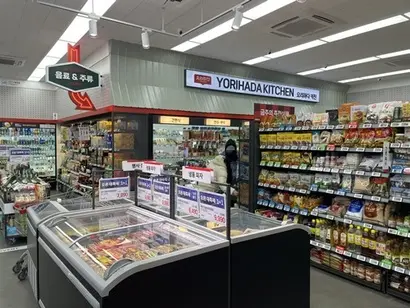
SSM store count increased by 4.6% in one year
According to the status of major retailers released by the Ministry of Trade, Industry and Energy, SSMs (6.8%) saw the highest sales growth among offline sectors as of last November compared to the same month the previous year. Although smaller in scale compared to hypermarkets, SSMs, which stock fresh food, are increasing their sales volume by opening stores one after another in densely populated residential areas.
The number of SSM stores, which stood at 1,131 in November 2023, increased by 4.6% to 1,184 one year later. This is the highest store count growth rate among all offline retailers. This stands in contrast to hypermarkets and department stores, where the number of stores has entered a downward trend, and convenience stores, where the growth rate in store count remains in the 1% range due to market saturation.
GS Retail, the leader in the SSM industry, opened more than 90 GS The Fresh stores last year alone. Currently, the number of GS The Fresh stores has reached approximately 520. Last July, Jung Chun-ho, head of GS Retail’s Super Business Division, celebrated the opening of the 500th GS The Fresh store, stating, "We will open the era of 1,000 GS The Fresh stores by 2027."
An industry insider commented, "GS Retail is applying a franchise model similar to that of convenience stores to SSMs as well. They have lowered the barrier to entry by having the headquarters cover initial investment costs, with the headquarters and store owners sharing the monthly profits." The insider added, "However, if you operate this model, the profit remaining for the franchisee is very small. Nevertheless, people are lining up to open supermarkets, tempted by the low startup capital."
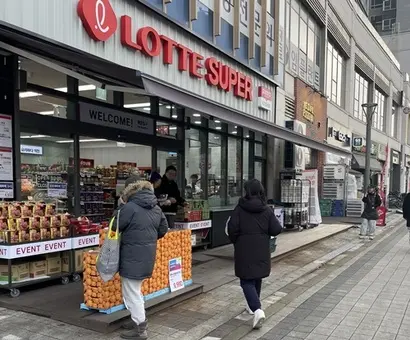
This year, even Lotte Shopping is showing signs of expanding its SSM franchise business. Lotte Shopping began restructuring its offline stores in 2020, reducing the number of Lotte Super stores from over 500 to 356 as of the third quarter of last year. Of those, direct-run stores account for about 60% (176 supermarkets, 28 CS Distribution stores). With the cleanup of underperforming stores now complete, Lotte Shopping says it will begin its Lotte Super franchise business in earnest starting this year. A Lotte Shopping representative stated, "We are preparing the franchise business to improve profitability. Since the franchise model requires investment from store owners, we plan to operate stores that are smaller in scale than existing ones."
Stores similar in format to the Lotte Super Hanam Mangwol branch, which debuted late last year, are expected to be chosen as the new standard. The Lotte Super Hanam Mangwol branch, which opened in Hanam, Gyeonggi-do, is a small store of about 50 pyeong, characterized by expanded fresh food and deli sections. A Lotte Shopping representative said, "We plan to finalize and launch the new franchise model within the first quarter, and the Hanam Mangwol branch is a test store for this purpose. We plan to open new stores after reviewing the overall commercial area and performance. It is highly likely to be similar (to the Hanam Mangwol branch)."
Lack of protection as they are not classified as the same business
Convenience store franchisees are the ones sighing deeply over the aggressive expansion of SSMs. As SSMs miniaturize their stores to expand their franchise operations and attempt to open in densely populated residential areas, the number of stores located in close proximity to existing convenience stores is increasing. Convenience store owners complain that their sales have dropped significantly due to an SSM moving into their vicinity.
The convenience store right next to the newly opened Lotte Super Hanam Mangwol branch is also facing concerns about declining sales. A local business owner, Mr. A, said, "Lotte Super moved into the space where Olive Young used to be. The convenience store owner didn't even know a supermarket was moving in right next door," adding, "I know they are having a hard time because sales dropped after the supermarket opened."
Recently, SSMs have become the primary threat feared by convenience store franchisees. One convenience store owner said, "Previously, I was worried about other convenience store brands moving in nearby. Now, the scariest thing is the supermarket (SSM). Since they carry almost the exact same products as a convenience store at cheaper prices, the impact on my sales is enormous."
Another owner lamented, "I didn't know at all that an SSM was moving in right next door until a customer told me. Since it's not a location with high foot traffic, sales weren't high to begin with, but with a supermarket moving in next door, sales have plummeted. Now, it really feels like I’m just running a cigarette shop."
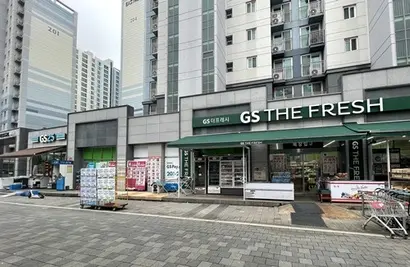
In the case of GS Retail, conflicts with GS25 franchisees erupted during the expansion of GS The Fresh stores. Convenience store franchisees voiced their complaints as GS Retail opened GS The Fresh stores within commercial areas already served by GS25.
One GS25 franchisee said, "Sales dropped significantly after GS The Fresh moved in nearby. GS The Fresh closes twice a month, and on those days, my convenience store's sales increase by more than 40% compared to the previous week. That means I am losing that much revenue to GS The Fresh." They added with a sigh, "I raised the issue with headquarters, but they said they bear no responsibility. They didn't provide any support for the sales decline. I reported the proximity issue of GS The Fresh to the Fair Trade Commission, but received a response that convenience stores and SSMs cannot be considered the same industry."
Under the Franchise Business Act, it is considered a violation for a franchisor to open its own or a subsidiary's direct-run or franchised store in the same industry within a franchisee's business territory during the contract period without a justifiable reason. However, convenience stores and SSMs are not classified as the same industry, so they cannot be legally protected. This is because they only share a portion—not all—of the products sold and have differences in operating hours, among other factors.
With Lotte Shopping signaling an expansion of its SSM franchise business this year, there are predictions that the conflict between SSMs and convenience stores will intensify. There is also growing concern that instances of Seven-Eleven—a convenience store chain operated by Lotte subsidiary Korea Seven—and Lotte Super opening in the same commercial areas will increase.
Seo Yong-gu, a professor of business administration at Sookmyung Women's University, advised, "Cannibalization is inevitable in this situation. They should devise a strategy to minimize cannibalization by adjusting the product assortments of convenience stores and SSMs to ensure they overlap as little as possible."