

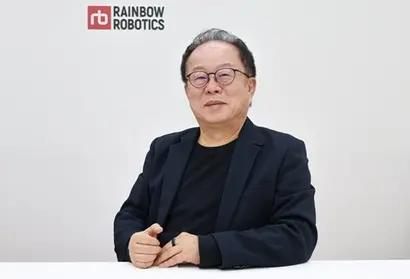
[비즈한국] Professor Oh Jun-ho, KAIST honorary professor, the father of Korea's first humanoid robot ‘Hubo’ and founder of the robotics firm Rainbow Robotics277810, is joining Samsung Electronics005930. Samsung Electronics completed an additional acquisition of shares in Rainbow Robotics on December 31 of last year, incorporating it as a subsidiary. Rainbow Robotics is a company Professor Oh established by forming a development team with his students in a small laboratory. Although it has shown sluggish financial performance since going public in 2021, it is considered a promising company in the high-growth robotics sector. Samsung Electronics plans to build a future robot development portfolio through Rainbow Robotics. As the company’s AI-based intelligent robot strategy is expected to gain momentum, all eyes are on the synergy Professor Oh will drive in his new role as head of Samsung Electronics’ Future Robot Task Force.
Character
Professor Oh Jun-ho first made a name for himself as the ‘Father of Hubo.’ His childhood, which led to the creation of Korea’s first bipedal humanoid robot, was far from ordinary. Born in Seoul in 1954, Professor Oh had a keen interest in everyday machinery such as sewing machines and various hospital medical equipment. He would frequent junk shops around Sinchon, Seoul, examining radio components, military transceivers, and broken phonographs, often taking them apart himself. His father, the late Professor Oh Ki-hyung, an honorary professor at Yonsei University, and his mother, Kim Hyun-ja, former president of the Korea Women's Political Federation and a two-term National Assembly member, supported the young Professor Oh's curiosity and passion.
After a school life devoted to exploring and building mechanical and electronic/electrical knowledge, Professor Oh entered the world of engineering in earnest upon entering university. A graduate of Daedeok High School, he earned his bachelor's and master's degrees in mechanical engineering from Yonsei University and worked at the Korea Atomic Energy Research Institute for two and a half years. He later went abroad to study systems and automatic control at the University of California, Berkeley. Automatic control and CNC (Computer Numerical Control) technology are the fundamental disciplines for handling precision weapons like rockets, as well as factory automation and various robots. After receiving his doctorate in mechanical engineering, he returned to Korea and was appointed as a professor at KAIST in 1985 at the age of 31.
Career
He dived into humanoid robot production in 2001. At that time, engineers around the world were focused on the bipedal robot ‘ASIMO’ from Japan’s Honda. ASIMO was introduced three years after Honda developed the world’s first humanoid robot, ‘P2,’ in 1997. In Korea, which lacked basic robotic technology, Professor Oh, fueled by the conviction that “we can do it too,” pooled research funds from fellow professors. In less than a year, he built the body of the humanoid robot ‘KHR-1,’ and in 2003, he developed ‘KHR-2,’ an experimental model of the more evolved Hubo, complete with hands, a head, and a casing.
In 2004, the first Korean bipedal humanoid robot, ‘Hubo,’ was born. While the previous two robots were experimental models, Hubo was the first official, complete robot. Although ASIMO was developed over 15 years at a cost of approximately 300 billion won, Hubo was developed in just three years for 1 billion won. It could move its five fingers independently to play rock-paper-scissors and possessed voice recognition capabilities. It paved the way for Korea’s robot development capabilities by continuing its lineage with ‘Albert Hubo’ and ‘Hubo FX-1’ in 2005. Hubo 2 was the first robot developed for research to actually reach commercial sales worldwide.
Over the 20 years that robots evolved, Professor Oh’s internal and external standing also grew. At the university, he served as head of the Technology Transfer & Exchange Center, head of the New Technology Startup Support Group (2004–2005), distinguished professor (2011–2015), executive vice president (2013–2015), chair professor (2015), and director of the Robot Research Institute (2016), and currently remains an honorary professor. He received the Presidential Citation at the Robot Industry Awards (2012), the Order of Science and Technology Merit (2015), the Ho-Am Prize in Engineering (2015), and the Korea Engineering Award (Presidential Award) in 2022.

Capability
Rainbow Robotics is a specialized robotics firm founded in 2011 by core researchers who led the development of Hubo under Professor Oh’s leadership. It was a spin-off from the Hubo Lab at KAIST. The request from foreign research institutions to purchase Hubo triggered the founding. Lee Jung-ho, CEO of Rainbow Robotics, is also an original member who joined the lab in 2002. The robot, which has evolved several times, won an overseas challenge (DRC-Hubo) and participated in the torch relay for the 2018 PyeongChang Winter Olympics. The company, which holds technologies in bipedal robots, collaborative robots, and ultra-precision pointing mounts, was listed on the KOSDAQ in February 2021 after three attempts.
The driving force behind pioneering the humanoid robot field in a barren land and enabling competition with global companies in future industrial sectors is, above all, the passion of Professor Oh and his research team. In an interview with a government media outlet in the past, Professor Oh stated, “Our goals were clear, and we prepared thoroughly for the technology from the early stages of development. We established a firm principle of not following the same path as others.”
Critical
Since its listing, Rainbow Robotics has been evaluated as having slower-than-expected growth. It has frequently been labeled as a company that barely managed to go public after failing twice. Although it was considered a leader among robot-related stocks, its share price has remained lackluster. Its operating profit, which was 1.3 billion won in 2022, shifted to a deficit of 44.5 billion won in 2023. However, this deficit arose during the accounting process for derivatives and did not involve an actual outflow of cash.
The stagnation in sales performance across the robotics industry has also dampened investment sentiment. High interest rates and a decrease in new orders from global industrial robot companies have led to valuation burdens. Park Se-min, an analyst at SK Securities, diagnosed that “while the growth potential of the robot market is explosive, stock prices can experience high short-term volatility based on supply and demand factors whenever it is confirmed that the visibility of revenue realization is low.”
Challenges
Professor Oh is retiring from Rainbow Robotics to join Samsung and step up as a robot business planner for Samsung Electronics. On the 31st of last month, the day before the new year, Samsung Electronics exercised its call option to become the largest shareholder of Rainbow Robotics. Samsung Electronics newly established a Future Robot Task Force under its Device Experience (DX) division and appointed Professor Oh as its head. This move is interpreted as a strategic step to secure technological competitiveness against global firms such as Tesla, which plans to deploy 1,000 of its ‘Optimus’ humanoid robots in its factories by next year, and Nvidia, which has announced the launch of small computers for humanoid robots in the first half of next year.
Samsung intends to combine its AI and software technology with Rainbow Robotics’ robot technology to accelerate the development of intelligent, high-end humanoids. Attention is also focused on the role of Professor Oh, who will concurrently serve as head of the task force and a management advisor to Samsung Electronics. Leveraging Samsung Electronics’ global sales infrastructure will also be advantageous for overseas market expansion.
Interest is also focused on how Samsung Electronics’ need for competitive robot technology and Rainbow Robotics’ need for large-scale capital—for things like establishing massive production systems—will create synergy. Samsung Electronics plans to utilize Rainbow Robotics’ collaborative robots, dual-arm robots, and autonomous mobile robots for task automation in manufacturing and logistics. These robots can learn and analyze situational data and environmental variables occurring in the field through AI algorithms to significantly improve work performance. There are also predictions that the direction of future cooperation and business strategy between Samsung Electronics and Rainbow Robotics will be focused on strengthening foundational technologies like AI rather than just the development of humanoid robots themselves. It is widely assessed that securing mobility and AI-based autonomous technology is crucial for the commercialization of humanoids.