

[비즈한국] The year 2025, the Year of the Blue Snake, has dawned. Just as the snake is known as an animal with insight and intuition, I hope this will be a year where we can all share a single heart and make wise choices with deep insight. A report has been released that looks back on not just 2024, but the entire past decade of the European startup ecosystem, while also forecasting the future.
The report is titled "State of European Tech 24," published by London-based VC Atomico in collaboration with the global law firm Orrick, HSBC Bank, AWS, and Finland's Slush. Atomico publishes this report every year to diagnose and analyze the state of the European startup ecosystem. This year’s edition provides a long-term view of how the ecosystem has grown over the last 10 years and examines how it will evolve over the next decade.
Key Pillars of the Ecosystem: Talent, Capital, and Ambition
For an ecosystem to succeed, it requires three core pillars: talent, capital, and ambition. While the last element, 'ambition,' is difficult to quantify, "State of European Tech 24" quantified it based on the number of 'unicorn companies' (referred to as '$B+' in the report) and the goals of founders.
Europe is now home to over 300 unicorn companies. Public understanding of 'entrepreneurship' has improved, and the appeal of a startup career has increased. 41% of the founders surveyed responded that their goal is 'environmental and social contribution' rather than 'financial success.' This is evidence that the ambition of founders is being exercised at a higher level.
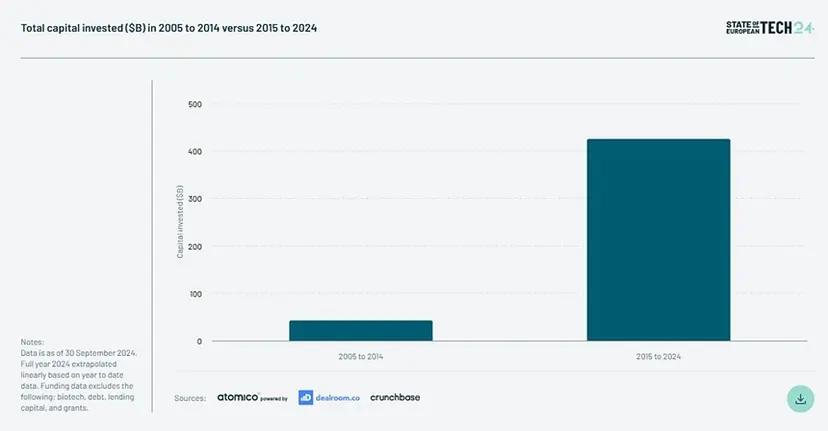
Since 2015, all three elements have grown across Europe. One of the biggest changes is that while figures were pathetic compared to the U.S. just 10 years ago, they are now on a comparable level. First, Europe has attracted more than 10 times the venture capital since 2015, reaching approximately $426 billion (621 trillion KRW) to date. It is analyzed that in 2024 alone, it reached a scale of approximately $45 billion (65 trillion KRW).
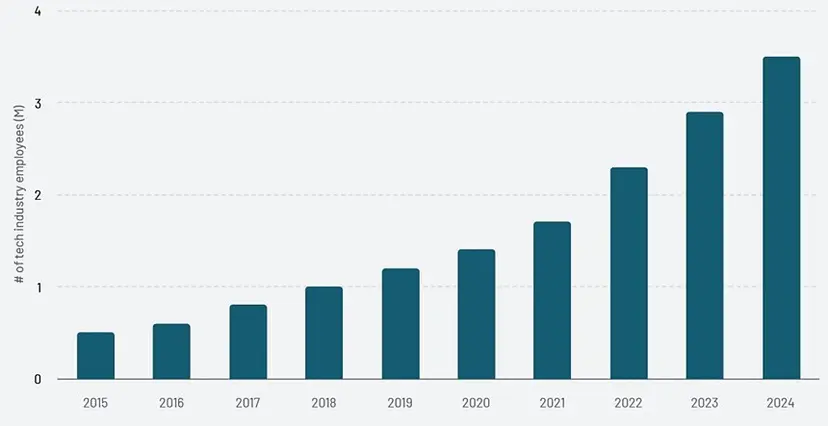
Next, the tech talent pool in the tech ecosystem has reached approximately 3.5 million people. In the past 10 years alone, about 3 million new jobs have been created in this sector. Tech jobs are growing at an average annual rate of 24%, a level comparable to that of the U.S.
The Leading Countries for European Startups: UK, Germany, and France
In particular, the UK, Germany, and France remain the major tech hubs of Europe, standing out in sectors such as fintech, climate tech, and artificial intelligence (AI). The UK holds over 140 unicorn companies, followed by Germany with 24 and France with 14.
So, what kind of exit results have companies achieved in the European tech ecosystem so far? Over the past 10 years, nearly $1 trillion (1,459 trillion KRW) in value has been realized in Europe through IPOs and M&As. However, the speed of exits is slower than the speed at which companies are founded or grow into unicorn companies with a valuation of $1 billion (1.459 trillion KRW) or more. To date, only 15 European countries have experienced exits of $1 billion or more, which shows that it takes a long time for high-valuation European companies to secure liquidity.
Exits have primarily been centered on companies from Western European countries. While it has expanded to Poland in the east and Italy in the south, the regional distribution is not even. Nearly half of the exits worth over $1 billion in the past decade took place in the UK. A prime example is the acquisition of IHS Markit by S&P Global, a very important event in the tech ecosystem. In 2020, U.S. financial services firm S&P Global acquired the UK financial information company IHS Markit for $44 billion (64 trillion KRW). In 2023, there was the case of ARM, a semiconductor and software design company based in the UK, realizing a $65 billion (94 trillion KRW) IPO.
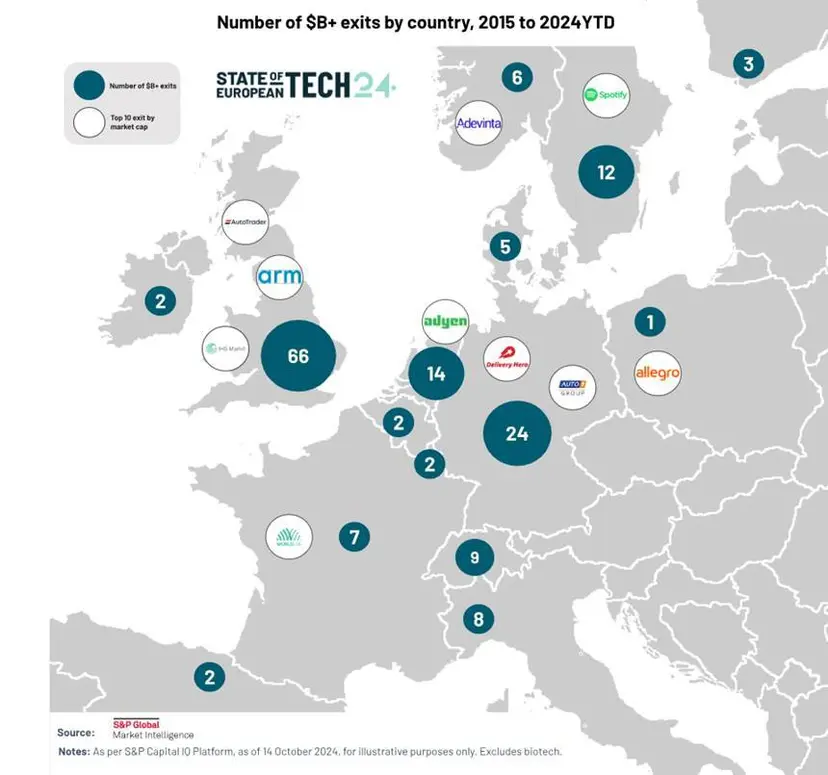
Following that, Sweden's Spotify went public via a direct listing in 2018, recording the third-largest exit in Europe. In Germany, the food delivery platform Delivery Hero listed on the Frankfurt Stock Exchange in 2017, and the online used car trading platform AUTO1 did so in 2021. AUTO1's exit was the seventh-largest in Europe over the past decade. Although not well known in Korea, the Polish e-commerce platform Allegro also listed on the Warsaw Stock Exchange in 2020. This was the largest IPO in the history of the Warsaw Stock Exchange and became one of the top 10 exit companies in Europe.
Future Challenges: Lack of Capital and Regulation
Despite these achievements, the European tech ecosystem is suffering from a shortage of growth capital. While infrastructure is sufficient in many European countries for early-stage startup investment, funds remain scarce as startups grow and scale up. Of the $9 trillion managed by European pension funds and insurance companies, only 0.01% is invested in venture capital. As a result, European startups are facing situations where they must relocate to other regions such as the U.S. or Asia.
Furthermore, Europe's regulatory environment and complex administrative procedures are pointed out as major factors hindering corporate expansion and scale-up. About 47% of survey respondents identified regulation and policy as the main obstacles hindering the potential of the European tech ecosystem. Klarna, a leading European fintech startup, also chose the U.S. rather than Europe for its IPO, due to regulations, policies, and access to growth capital. As many European tech companies choose the U.S. market, Europe is experiencing an outflow of capital and talent. Although integrated into the EU, the differing legal systems applied in each country make cross-border business operations difficult.
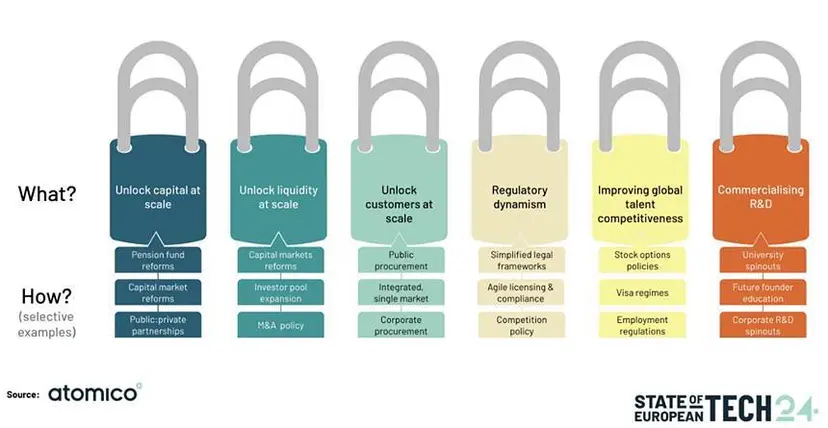
Many European countries are making policy efforts to solve these problems. The UK's Mansion House Reforms are a good example. This is a legislative initiative to encourage venture capital investment from pension funds, aiming to invest about 75 billion pounds (136 trillion KRW) in European startups by 2030. Germany plans to improve the environment for startup growth and capital raising by investing about 12 billion euros (18 trillion KRW) by 2030 through the WIN initiative. France plans to expand venture investment from pension funds through the Tibi initiative and inject over 5 billion euros (7 trillion KRW) of additional capital into startups annually. At the EU level, efforts are being made to integrate the startup ecosystem within Europe and strengthen global competitiveness through regulatory simplification. These changes are expected to supply new capital to the European startup environment.
The introduction of a '28th Regime' model has also been proposed to simplify the legal framework for the entire Europe to act as a single market. This refers to an integrated legal framework for the European tech ecosystem, designed with the aim of harmoniously integrating the regulations of the 27 EU member states. This system would operate in parallel with existing national laws, aiming to provide standard rules for startups and innovative companies to make it easier to operate businesses within the EU.
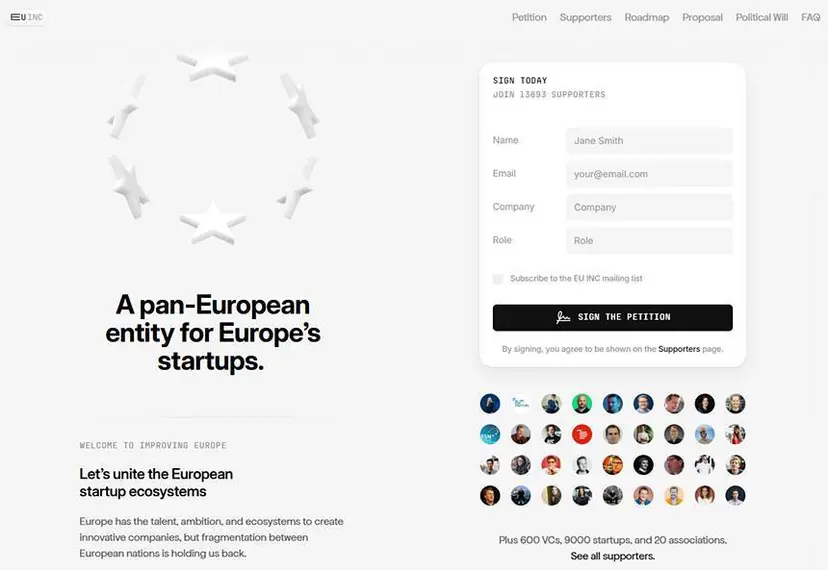
In the case of the U.S., where laws differ by state, leading to confusion in business operations, the 'Delaware C-Corp' serves as a standardized corporate structure. This system played an important role in enabling startups to grow quickly and secure global competitiveness in the U.S. Taking this as a mirror, European founders and investors launched the EU Inc. petition movement for the 2025 European Commission work program last October. The core idea is to allow the entire company incorporation process to be conducted online and to establish regulations that can be operated in common across Europe.
At the beginning of the year, it is a time when everyone makes New Year's plans and ties their shoelaces again to execute them. The Korean startup ecosystem also needs to consider not just plans for the year, but how to grow and survive with a long-term perspective over the next decade.
Over the next 10 years, the European tech ecosystem is expected to create approximately $5 trillion (7,290 trillion KRW) in value. This is expected to make a significant contribution to Europe's GDP. By 2034, the European tech ecosystem is highly likely to grow to a scale of approximately $8 trillion (11,664 trillion KRW) and create 150,000 new jobs, establishing itself as a global technology leader. Where will Korea be by then?
The author, Lee Eun-seo, majored in law in Korea and studied theater in Berlin. She is settled in Berlin, a city of art and a European startup hub, growing along with the city, and leads 123factory, which connects the Korean and German startup ecosystems.