

[비즈한국] State-run banks were once called "God's workplaces," but the term has become a relic of the past as employees, dissatisfied with pay lower than that of private financial institutions, have been leaving. Ultimately, the Industrial Bank of Korea024110 (IBK) held its first-ever solo general strike to demand that the government and the bank improve their working conditions. As both labor and management remain divided even in negotiations held after the strike, attention is focused on whether IBK President Kim Sung-tae, who has entered the final year of his term, can resolve the labor conflict before his tenure ends.
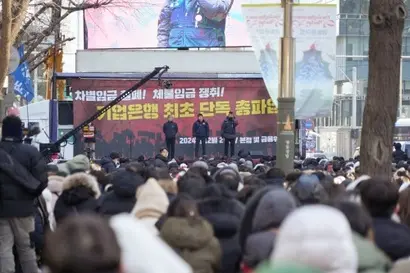
The IBK labor union (Korean Financial Industry Union, IBK Chapter) launched its first general strike on December 27, 2024, the last Friday of the year. According to the union, approximately 85% of its total members (about 7,000 people) participated. On that day, union members closed the bank doors early, gathered in front of the head office to hold a rally condemning the government and management, and held street marches.
The IBK union is demanding the elimination of wage discrimination and the payment of overdue wages. The union argues, "Although we are a state-run bank, we compete with commercial banks. Our methods of generating profit and our duties are the same, yet because we are a public institution, we receive wages 30% lower than those at commercial banks." According to figures for the average wage at financial institutions in 2023, the average wage at the four major commercial banks (KB Kookmin, Shinhan, Hana, and Woori) was 116 million won, while at IBK, it was 85 million won.
The union attributes this wage gap to a lower-than-industry-average wage increase rate and the non-payment of special performance bonuses. This is rooted in a structure where the Ministry of Economy and Finance and the Financial Services Commission dictate the budget, including labor costs, and a total labor cost cap that prevents the distribution of excess profits and performance bonuses. The union has demanded that the government and the bank introduce a profit-sharing system and pay out in full, in cash, the 6 million won per person in unpaid overtime (compensation leave) that has accumulated.
The bank did not accept these demands. In the wage and collective bargaining talks that began in October 2024, the union proposed a 2.8% wage increase, full cash payment for overtime, the introduction of a profit-sharing system, the establishment of holiday bonuses and deputy allowances, and a pilot program for a 4.5-day workweek, but the bank rejected them, citing the need for approval from the Ministry of Economy and Finance and the Financial Services Commission. For the wage increase, the bank proposed 2.5%, in line with government guidelines, leaving the two sides at a stalemate.
Negotiations held after the general strike also failed to reach an agreement. In additional talks on December 29, 2024, when the bank demanded the union agree to a deal and end its struggle in exchange for the wage increase difference, the union strongly protested, calling it "blackmail." As a result, negotiations broke down, and the year ended without a resolution. The union maintains that it will continue to fight for its original demands while retaining its right to take industrial action.
There is a possibility of a turning point in negotiations as the 18th labor union will officially launch at the delegates' conference on the 10th. However, a union official stated, "Management and the government have not changed their positions. We would negotiate if a proposal came, but since there is no feedback, we will maintain our existing demands," adding, "We are considering second and third general strikes depending on the situation after the new union chairman takes office."
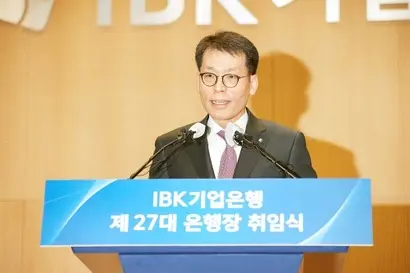
It remains to be seen whether IBK President Kim Sung-tae, now in the final year of his three-year term, can resolve the labor-management conflict by actively engaging in dialogue with the new union leadership. As the fourth president in history to rise from within the ranks of IBK, eyes are on whether he can mend the rift and conclude his term on a high note.
President Kim, who took office in January 2023, is set to complete his term on January 2, 2026. Although he faced the negative event of the first solo strike during his tenure, it is unlikely to impact his potential reappointment, as it is rare for state-run bank presidents to serve consecutive terms.
In his recent New Year's address, President Kim congratulated union chairman-elect Ryu Jang-hee but did not include a message regarding improvements to working conditions. Instead, he mentioned "fair personnel management that employees can relate to" and "diverse career development opportunities." President Kim expressed his willingness to engage in dialogue, stating, "I will do my best to communicate sufficiently with not only the labor union but also the employees so that they can feel pride in a dynamic organizational culture and carry out their assigned tasks with vitality."
Externally, IBK has grown to a size comparable to commercial banks. It achieved solid results last year, recording its highest-ever performance. Its cumulative net profit for the third quarter of 2024 was 2.1977 trillion won. This is similar to that of Woori Bank (2.5244 trillion won) and KB Kookmin Bank (2.6179 trillion won), and significantly higher than that of NH NongHyup Bank (1.6561 trillion won).
However, concerns regarding the deterioration of asset quality persist. As the economic downturn persists, delinquency rates related to loans to small and medium-sized enterprises (SMEs) and the non-performing loan ratio (the ratio of loans with collection issues to total loans) have risen. Furthermore, interest income, the bank’s main source of profit, is on a downward trend (from 5.5957 trillion won in the first three quarters of 2023 to 5.4470 trillion won in the same period of 2024 on a separate basis).
Jeong Ho-jun, an analyst at Korea Ratings, predicted, "Since 2023, IBK's financial soundness has deteriorated due to the increased repayment burden on borrowers caused by high interest rates and the stagnant real economy," adding, "Although base interest rate cuts began in October 2024, the deterioration in soundness will likely continue unless the real economy recovers and the business environment for SMEs improves."