

[비즈한국] There is a Korean saying that goes, "A burnt child dreads the fire," meaning that someone who has been deeply shocked or hurt by an event feels aversion even when seeing something similar. In South Korea, which endured a long civil war sparked by North Korea's invasion, the word "North Korea" remains a source of trauma. Recently, however, an unexpected pro-North Korea controversy has erupted over a font, with the Hangul character 'ㅌ' at the center of the dispute.
Following President Yoon Suk-yeol’s declaration of martial law late last year and the subsequent impeachment turmoil, protests for and against impeachment have been taking place across the country. Amidst this, some in the conservative camp have claimed that certain gothic title fonts used on protest signs denouncing the current conservative administration are primarily used in North Korea. They base this claim on the shape of the consonant 'ㅌ'.
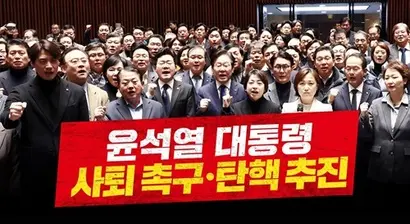
'ㅌ' is formed by adding a horizontal stroke to 'ㄷ'. There are generally two ways to implement this: ① adding the horizontal stroke inside the 'ㄷ', or ② drawing the horizontal stroke separately above the 'ㄷ'. The problem, according to the critics, is that the second method is the one primarily used in North Korea. Therefore, they argue that anyone using a font that features this version of 'ㅌ' is associated with North Korea and threatens South Korean security. While it might sound plausible at first glance, this is merely a symptom of being overly immersed in conspiracy theories.
There are various options in Hangul design. Even for the same character, there are several elements, such as whether to lay the tick down or stand it up (ㅊ/ㅎ), or whether to connect the two consonants or divide them with a stroke in the middle when creating double consonants (ㅃ). The 'ㅌ' in ① and ② are also just one of these design options. Hangul designers decide which form to choose based on the concept and production environment when creating a font. Both forms of 'ㅌ' existed even before the division of the country. However, South Korea, which guarantees freedom of expression, does not enforce either choice despite having standards. Conversely, North Korea tends to use only specific forms due to its rigid social structure. The fact that the font industry in North Korea is underdeveloped and lacks the capacity to produce a variety of fonts likely plays a part in its design limitations.
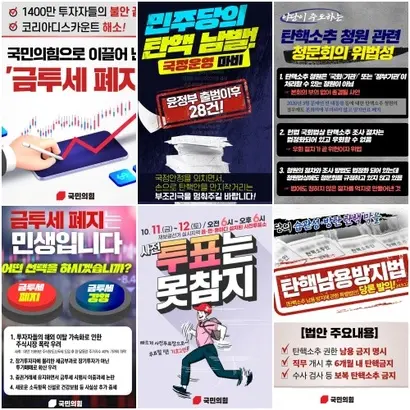
Therefore, the shape of 'ㅌ' is not the exclusive property of any specific group. This is evident just by looking at political party promotional materials. Both conservative and progressive parties have used the 'ㅌ' with the horizontal stroke drawn separately above the 'ㄷ' on flyers and banners. If the claim that political affiliation can be distinguished by the shape of 'ㅌ' were true, then both the ruling and opposition parties would be pro-North Korean forces, and South Korea would have long ago become a communist state. If we follow this logic, would all media outlets that use words like "Joseon" or "democracy"—which are part of North Korea's self-proclaimed state name—be following North Korean orders? It’s laughable enough to make a spy passing by chuckle.
A representative font that uses the 'ㅌ' with a separate horizontal stroke above the 'ㄷ' is "Sandoll Gyeokdong Gothic." This font, currently at the center of the controversy, was also used on protest signs. Interestingly, early promotional materials for Gyeokdong Gothic featured the 1971 presidential campaign poster of Park Chung-hee as an example of its concept. While this holds no political significance, if one were to draw a comparison, Gyeokdong Gothic is not a "North Korean" font but rather one that symbolizes the economic growth and industrialization achieved by South Korea. Do those who take issue with the shape of 'ㅌ' realize that they are so deep in far-right conspiracy theories that they are even denying the achievements of the conservative camp?
Conspiracy theories breed constant distrust. Once immersed in a conspiracy theory, no matter how rational the counterarguments are, it only accelerates a cycle of endless suspicions, confirmation bias, and delusions. Now is the time to step away from these suspicions and adopt a cool-headed perspective. Instead of raising issues that are a waste of time, it is time for productive discussions to strengthen our true liberal democratic system. The way to win against the confrontation with North Korea is not to suspect a few strokes of a font. It is to solidify the roots of democracy by punishing those who attempted to put the nation at risk through a de facto pro-presidential coup—the declaration of martial law.
Who is Han Dong-hoon, the writer?
A font designer. He is interested in all fields related to letters, including writing, calligraphy, and designing and teaching typography. He currently designs various corporate exclusive fonts and commercial fonts at the font studio AlignType. He has contributed to magazines such as "Monthly Design" and the quarterly "Design Review," and conducts font design lectures on both online and offline platforms. In 2021, he published the essay collection, "The Universe in Letters."