

[비즈한국] The South Korean real estate market is considered unique even on a global scale. The real estate policies created by the tangled web of the government, political circles, and various stakeholders are so surreal that they are often described as a "surrealist work of art" in their own right.
However, questions are constantly being raised as to whether this "work of art" is intended to calm market anxiety, protect genuine homebuyers, and promote housing stability, or if it is merely aimed at political posturing and short-term effects.
Various regulatory policies—such as loan restrictions, price ceilings on new apartments, the three rental laws, and land transaction permit zones—are, contrary to their initial intent, causing side effects and exacerbating market chaos. Furthermore, those who suffer the most from this are the vulnerable in the market who were meant to be protected.
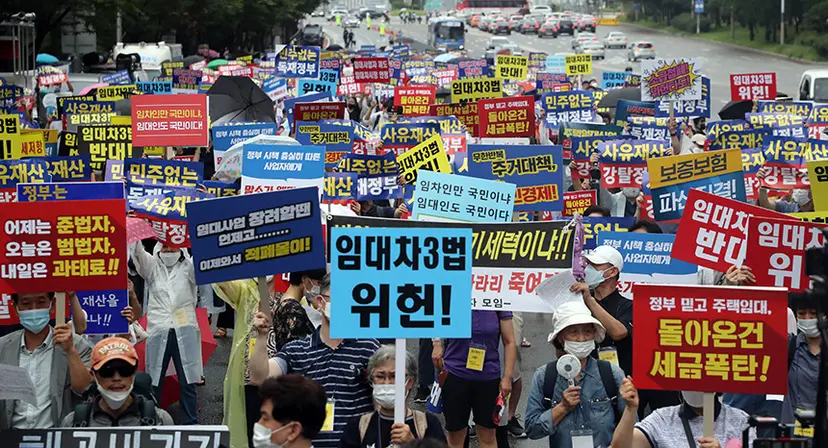
Let's examine the policies by category.
First, who exactly are loan restrictions for?
Loan restrictions were introduced to manage household debt. In reality, however, they act as the biggest burden on genuine homebuyers. In particular, regulations like the Debt Service Ratio (DSR) make it difficult for actual occupants to purchase homes through loans. This naturally shifts demand toward the jeonse (lump-sum deposit) market, ultimately leading to the side effect of skyrocketing jeonse prices.
Recently, even as benchmark interest rates are falling, banks have been raising their spread rates, increasing the burden of loans. While this appears to be a measure to maintain bank profit structures, it places a double burden on genuine homebuyers. Loan restrictions may look like a mechanism for market stability on the surface, but in reality, they have the side effect of further restricting access to the real estate market.
The price ceiling system for new apartments is acting as a policy that invites speculative demand.
The price ceiling system was introduced to stabilize real estate prices. However, this system highlights the scarcity of new apartments and stimulates speculative demand, such as interest in pre-sale premiums. Due to the application of the price ceiling, reconstruction and redevelopment projects are delayed, and as supply shortages worsen, the prices of existing apartments have actually risen.
Another problem with the price ceiling is regional imbalance. In some areas, the system reduces price competitiveness and dampens demand, while in popular areas, intense competition ensues, deepening market distortions. This has even led to the coined term "lotto housing." Such phenomena stimulate speculative psychology and create even higher barriers for genuine homebuyers.
It is also questionable whether the two rental laws are truly protecting tenants.
The two rental laws were introduced to protect tenants. The reality is quite the opposite. The price cap on lease renewals and the right to request contract extensions have created a structure that is excessively unfavorable to landlords, which has resulted in a sharp drop in available jeonse properties. The shortage of jeonse listings has accelerated the shift toward monthly rent, further increasing the housing cost burden on ordinary people.
Furthermore, as landlords become reluctant to renew jeonse contracts and instead sell their properties or convert them to monthly rent at the end of the contract term, the options available to tenants have further diminished. In this way, the two rental laws have degraded into legislation that inflicts greater harm on tenants.
The most controversial regulation is that concerning multiple-home owners. They are essentially the suppliers of most rental housing, yet the policies are merely stifling supply in the rental market.
To be frank, the government's policy to regulate multiple-home owners is highly political. However, this policy has resulted in driving these suppliers of rental properties out of the market. Excessive imposition of acquisition taxes, capital gains taxes, and property taxes on multiple-home owners has caused them to withdraw from the rental market. This led to a shortage of rental supply, fueling the rise in jeonse and monthly rent prices.
Regulating multiple-home owners is fundamentally a policy that ignores the supply and demand balance of the real estate market. When rental supply decreases, the ones who suffer most are ultimately the tenants. The goal of stabilizing housing for the public, which was supposedly the objective behind regulating multiple-home owners, has missed the mark completely.
The regulation I understand the least is the use of land transaction permit zones to control housing transactions. Since the administration of President Roh Moo-hyun, because a direct "housing transaction permit system" carries too much risk of being ruled unconstitutional, they are using the land transaction permit system as a loophole to enact regulatory measures. It is a cowardly and devious regulatory tactic.
While the land transaction permit system was originally introduced to prevent speculation and stabilize the market, it has morphed into a loophole to suppress housing transactions in practice. Because the term "housing transaction permit system" triggers significant debates over unconstitutionality, they apply the land transaction permit system to bypass this, effectively blocking housing transactions.
This system claims to prevent land transactions disguised as housing trades, but in reality, it severely restricts housing transactions, infringing on the property rights and freedom of contract of genuine buyers. The requirement to obtain permission from a local government for a transaction fundamentally infringes excessively on private property rights and directly violates the rights guaranteed by the Constitution and the free operating principles of the market.
The market distortions caused by these various real estate regulations—which exist only in South Korea—are only aggravating the suffering of genuine homebuyers. While regulations may aim for short-term effects, in the long term, they undermine market trust and lead to inefficiency.
So, what should be done about the South Korean real estate market? We must reduce excessive government intervention and move in a direction that respects the autonomy of the market.
Specific alternatives are as follows:
First, regulatory easing and phased abolition. To stabilize the real estate market, regulations must be eased in stages. This gives market participants time to adapt to the new environment while providing an opportunity to restore market autonomy.
We must expand supply. The key to market stability is supply. We need to ease regulations on reconstruction and redevelopment, expand public housing, and increase housing supply through balanced regional development.
We must strengthen the transparency of information. The real estate market suffers from high information asymmetry. We should support market participants in making sound decisions by providing transparent information. I am aware that there were attempts to manipulate statistical figures and that these are currently being tried in court. Such things must never happen again.
The market should operate like a market. The real estate market is not just an economic issue. It is a matter directly linked to the lives of citizens and is closely related to the stability of the national economy. Regulations may be effective in the short term, but in the long term, they lead to market distortion and distrust. The government and policymakers must now escape the "trap" called regulation and move toward respecting the market. True stabilization of the real estate market is possible only when the market functions like a market and policies function like policies.
Kim Hak-ryeol, head of the Smart Tube Real Estate Research Institute, known by the pen name "Pashong," previously served as the team leader of the Real Estate Research Division at Gallup Korea. He manages and hosts the Naver blog "Pashong's World Exploration" and the YouTube channel "Stue TV." His authored books include "The Power of Gyeonggi Real Estate (2024)," "Absolute Principles of Seoul Real Estate (2023)," "The Future of Incheon Real Estate (2022)," "Kim Hak-ryeol's Absolute Principles of Real Estate Investment (2022)," "Future Map of South Korean Real Estate (2021)," "From Now On, Only Places That Will Rise Will Rise (2020)," and "South Korea Real Estate User Manual (2020)."