

[비즈한국] The number of public health doctors, who fill gaps in regional healthcare by being deployed to medically underserved areas such as rural farming and fishing villages, is steadily declining. Amid this trend, a large number of medical students who took a leave of absence to protest the government's plan to increase medical school admissions have opted for active-duty military service or social service duty, which is expected to further hit the supply of public health doctors. In this regard, the Ministry of Health and Welfare has yet to offer any clear countermeasures.
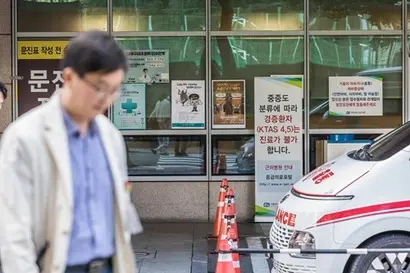
The Korean Public Health Doctors Association (KPHDA) stated that, based on data estimated by the Military Manpower Administration from January 1 to October 31 last year, 1,194 medical students were slated for active-duty enlistment and 139 for social service duty. By year, these figures were 116 in 2021, 138 in 2022, and 162 in 2023, representing a nearly 10-fold increase compared to the previous year. An increase in active-duty enlistments means fewer personnel will be available to serve as public health doctors after obtaining their medical licenses. The KPHDA urged the government to discuss the system at the state level, citing the accumulation of inefficiencies due to government indifference toward the public health doctor system and the persistent uncertainty sparked by the government's lukewarm attitude toward resolving the current medical crisis.
According to Ministry of Health and Welfare data, the number of public health doctors has been on a downward trend over the past decade. Only 255 new medical public health doctors were added last year, about half the number from the previous year. Looking at the annual trend, the number of medical public health doctors, which stood at 2,239 in 2015, dipped below 1,000 starting in 2019, recording 1,213 last year. Specifically, the numbers are 2,239 in 2015, 2,090 in 2016, 2,116 in 2017, 2,002 in 2018, 1,960 in 2019, 1,901 in 2020, 1,862 in 2021, 1,714 in 2022, 1,434 in 2023, and 1,213 in 2024.
While the government has noted the "declining numbers" regarding public health doctors, progress in discussing causes or response measures has been slow. Looking at Ministry of Health and Welfare press releases, the phrase "supply and demand countermeasures" only appeared for the first time in 2023. At the time, the ministry identified the proportion of female students and students who have already completed military service within limited medical school quotas, as well as the burden of long-term service compared to active-duty soldiers, as causes for the decline. They stated, "We will prepare improvement measures based on accurate analysis of the causes of the decline in public health doctor applicants and mid-to-long-term projections, and consult with related ministries such as the Ministry of National Defense." However, the following year's materials contained no additional content, only operational countermeasures such as expanding itinerant medical services at local clinics and temporarily allowing non-face-to-face treatment at public health centers and clinics. It appears there have been no discussions with relevant organizations like the KPHDA since then. A KPHDA official stated, "We have never received a request for cooperation regarding cause analysis or projections from the Ministry of Health and Welfare last year."
The medical community argues that poor working environments and treatment are the causes of the decline in public health doctors. They also point to issues that existed even before the medical crisis, such as wage arrears and a service period that is more than double that of active-duty soldiers. According to the operational guidelines for the public health doctor system, they receive a "work activity allowance" based on itinerant and substitute treatment, public health projects, research performance, and work performance evaluations. However, this allowance has been frozen since 2018. The KPHDA argues that the allowance, which has remained at 900,000 won for about six years, should be raised to 1 million won, taking into account inflation and civil servant wage increases.
Lee Sung-hwan, president of the KPHDA, said in a phone call with Biz Hankook, "When we cited civil servant wage increase rates and inflation as grounds for a raise, the ministry only responded by saying, 'The burden on local governments becomes too large.' However, local governments only bear about 10 million won in work activity allowances per year to hire one doctor, so they seem to have sufficient capacity. We conveyed our opinions again this year, but it seems the government is not very interested in the survival of the public health doctor system."
During the medical crisis, wage arrears at some medical institutions also became an issue. According to a survey conducted by the KPHDA following the deployment of public health doctors to large teaching hospitals last May, 59% of dispatched doctors responded that they had experienced "inconvenience regarding allowance payments." When asked about the reasons, 60% cited "payment delay," 30.4% said "the allowance was paid but delayed," and 18.4% said "certain allowance items were not received." Among these, the institutions shifted responsibility to local governments, further fueling the dissatisfaction of the public health doctors.
Since announcing its mid-to-long-term projection plan in 2023, the government has only been applying stopgap measures. At a Central Disaster and Safety Countermeasures Headquarters meeting in November, the government announced a plan to improve the public health doctor dispatch system. The plan includes excluding assignments from non-connected islands (12 cities/counties, 42 islands) and triple-vulnerable areas for childbirth, emergency, and pediatric care (22 counties), and prioritizing dispatches within the same province to support patient treatment in more familiar environments.
Recently, the Ministry of National Defense has been pushing a plan to classify some medical officer candidates as "not selected for active duty" through a revision of its instructions, causing controversy. The plan intends to withhold the enlistment of some candidates by classifying them as "not selected for active duty," assuming that a potential shortfall in military doctors may occur later because many trainees—who would typically serve as military doctors or public health doctors—are resigning. Initially, a plan to convert the over-selected military officer candidates into public health doctors was discussed, but the government blocked it.
Park Dan, head of the emergency committee for the Korean Intern Resident Association, criticized the move on Facebook on the 21st of last month: "According to Article 10 of the instructions, it is specified that excess personnel after the selection of military doctors should be classified as supplemental public health doctors. The government is trying to waste medical human resources by hastily revising this. They used to say the shortage of public health doctors was a problem, so why are they changing laws and principles to neglect the regional healthcare gap now? Shouldn't they be selecting a large number of public health doctors to save rural healthcare at the very least?"
The KPHDA plans to focus on "shortening the service period" for public health doctors this year. Lee submitted a report to the Korean Medical Association (KMA) today that includes the grounds for shortening the service period and countermeasures for the reduction in personnel. Lee said, "It is currently under review (by the KMA) and is scheduled to be published in the form of a report."