

[비즈한국] Last year, 3 out of every 10 employed people were found to be living off short-term jobs with less than 36 working hours per week. As the economy faces a "hiring chill" due to factors such as declining economic growth, the quality of employment is plummeting to its worst level. Last year, the number of people in short-term jobs of less than 36 hours a week exceeded 9 million for the first time since statistics began to be tracked in 1980.
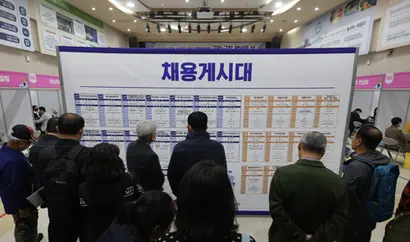
In addition, the number of workers in temporary positions rather than secure, regular jobs has reached a six-year high, signaling a deterioration in job quality. With political uncertainty rising—particularly following President Yoon Suk-yeol's declaration of martial law last December and the subsequent impeachment process—there are growing concerns that the quality of jobs will worsen even further as the economy is expected to deteriorate this year.
According to Statistics Korea on the 3rd, there were 9.025 million people employed for less than 36 hours per week last year (January–November), making up 31.5% of the total workforce. It was the first time that the number of such workers exceeded 9 million, and also the first time that the proportion of these workers surpassed 30% of total employment.
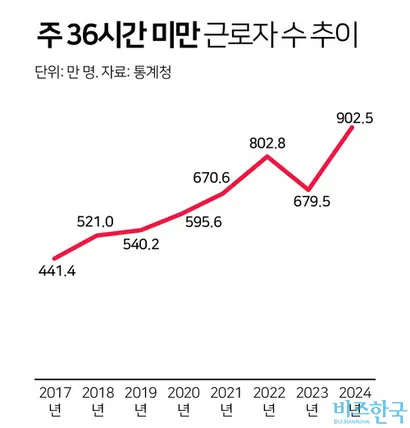
Considering that the proportion of those working less than 36 hours a week was 9.7% in 2000, this figure has more than tripled in 24 years. Given that 36 hours is the general standard used to distinguish between short-term and full-time workers, the data indicates that high-quality jobs are shrinking while short-term positions—which are relatively poor in terms of wages and working conditions—are on the rise.
By gender, the number of short-term workers employed for less than 36 hours a week increased for both men and women. For men, the number reached 3.906 million last year, approaching 4 million and marking an all-time high. For women, the number was higher at 5.119 million, surpassing the 5 million mark for the first time in history. Specifically, 40.4% of all employed women (12.681 million) were short-term workers, highlighting the worsening employment situation for women, who are often more vulnerable in the job market.
Amid severe economic hardship last year, there was also an increase in the use of "ultra-short-term" workers—those working less than 15 hours a week—who do not require employers to provide paid annual leave, weekly holiday allowances, severance pay, or various insurance benefits. Business owners are increasingly favoring these ultra-short-term part-timers to minimize their economic burden. Last year, the number of people working less than 15 hours a week reached 1.761 million, a 10.1% (61,000) increase from 1.6 million in 2023. They accounted for 6.2% of the total workforce, hitting record highs in both size and proportion.
Workers employed for less than 15 hours a week are excluded from various labor benefits and are not eligible for conversion to regular full-time status after two years, leaving them in a blind spot regarding labor rights. The trend of rising ultra-short-term labor has been accelerating recently. The number of workers under 15 hours a week, which was 436,000 in 2000, doubled over 15 years to reach 866,000 by 2015. It then crossed the 1 million mark to reach 1.095 million in 2018, and three years later, in 2021, surpassed 1.51 million with 1.512 million. Last year, the number was on the verge of breaking through the 1.8 million mark.
Beyond jobs with short weekly hours, the number of temporary workers with contracts of less than one year also increased. The number of such temporary workers stood at 4.806 million last year, up 4.1% (189,000) compared to 2023 (4.617 million). After peaking at 5.124 million in 2016, the number of temporary workers fell below 5 million in 2017 (4.992 million) and continued to decline to 4.851 million in 2018, 4.795 million in 2019, and 4.483 million in 2020. While it rebounded to 4.678 million in 2022, it decreased again in 2023. However, the increase last year demonstrates an overall decline in job quality driven by economic downturn.