

[비즈한국] In recent memory, there hasn't been a piece of content that has divided opinions as sharply as 'Squid Game 2'. Despite harsh criticism, it took the No. 1 spot in 93 countries within two days of its release and maintained its global top ranking. However, this doesn't necessarily mean that users have responded with overwhelming enthusiasm. It is worth summarizing why this happened, as it could become a touchstone for future K-content strategies.
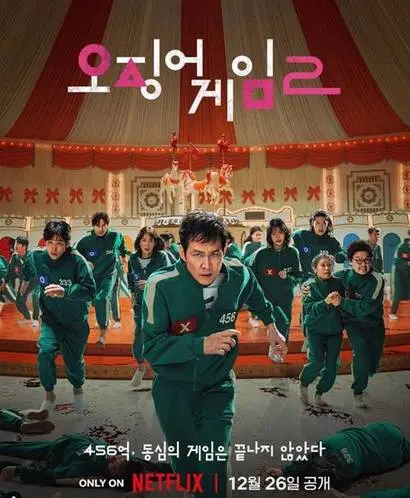
First, it is necessary to look at the fact that the original 'Squid Game' was never planned with a second season in mind. As is well known, director Hwang Dong-hyuk’s pitch for 'Squid Game' was thoroughly ignored in Korea. It is unrealistic to expect a project that was once rejected by domestic production companies and broadcasters to have even considered a second season. Furthermore, the season system was not well-established in Korea at the time.
Therefore, when Netflix decided to invest in the production, director Hwang had no choice but to accept the offer unconditionally. He could not have imagined that a 25 billion won production budget would generate 1 trillion won in revenue. (This is why it later became a prime example of an unfair contract.) Netflix, having tasted such incredible cost-effectiveness, was never going to just stand by. Season 2, which was not in the original plan, was produced with Netflix's full-scale support. However, this became a double-edged sword, forming the backdrop for the harsh criticism poured onto 'Squid Game' Season 2.
The number of characters increased significantly in Season 2. This is understandable. Because Season 1 poured so much passion into the story, most of the participants were eliminated, with the exception of Seong Gi-hun (played by Lee Jung-jae). Only the 'Ddakji' man (Gong Yoo) and the detective (Wi Ha-jun) could be "recycled," meaning all other roles had to be filled with new faces. There was speculation that the twin sister of the North Korean defector Kang Sae-byeok would appear, but director Hwang chose new faces instead. Moreover, perhaps due to the increased production budget, a large number of top-tier actors joined the cast. When this happens, the weight of each character increases, which can cause the story to branch out into side plots. Fans of the previous work hope for Seong Gi-hun's revenge and the reveal of the Front Man's true identity, but it becomes difficult to focus on these core elements.
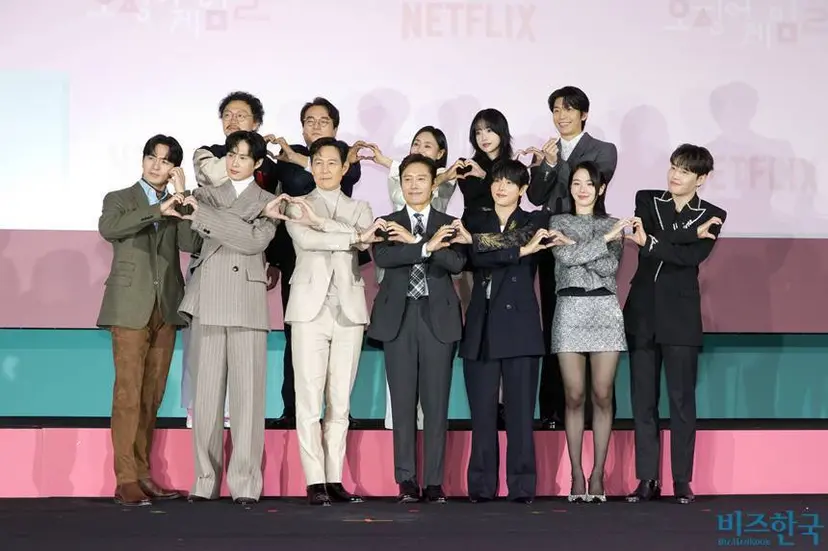
However, such criticism is only valid if one expects the story to be resolved or concluded in Season 2. Director Hwang split the narrative, dividing Season 2 from the upcoming Season 3. As the first half, Season 2 may be perceived as dull because the main story has yet to fully unfold. But by the time you finish episode 7 of Season 2, you become curious about what comes next. It was designed so that if you binge-watched Season 2, you would have no choice but to watch Season 3. Naturally, a final evaluation of the drama will only be possible after Season 3 is released. Furthermore, as the episodes progress toward episode 7, the narrative focuses and concentrates, compressing the cast and allowing the dramatic effects to truly emerge.
That said, Season 2 displayed many elements of a conventional Korean drama. What does this mean? For one, the composition is not very dense, the scene direction is not compact, and the dialogue is not highly implicit. Apart from the quality of the work, it contains elements of general mainstream drama, which can be interpreted as an intention to move away from the Western-centric genre style. Because of this, while it may receive harsh criticism from Western critics, it has the potential to expand its reach in other regions. It becomes more popularly accessible for sharing emotions. 'Squid Game' is a drama series, not a movie. From this perspective, expert analysis cannot fully align with viewer evaluations.

Additionally, the 'Squid Game' brand of gamification is still alive. In any case, gamification in 'Squid Game 2' lived up to fans' expectations and multiplied the dramatic effect of the narrative development. Beyond 'Red Light, Green Light,' it is clear that the new games introduced in Season 2 and those set to appear in Season 3 will become hot topics. This is because the phenomenon of 'dopaming' (dopamine farming) through participation and achievement, moving across online and offline boundaries, is expected to continue.
To ensure this, 'Squid Game' Season 3 must be released in 2025. Releasing it in the summer rather than at the end of the year could create a greater synergy with Season 2. In any case, the 'Squid Game' series is walking a new path, much like the character Seong Gi-hun in the show. However, the level of support and encouragement will vary depending on the fan base (core fans vs. light fans). If it can secure more of a core fan base, it will signify a further expansion of the 'K-model'.
Author Kim Heon-sik has been walking through or navigating the forest of pop culture phenomena since his 20s, with the expectation that there is a way to make the world a better place through culture. He continues on this path with the same belief even in the 21st century, where artificial intelligence and quantum computers are at the forefront.