

[비즈한국] When the commercials start while watching a drama or the news, viewers instinctively reach for the remote. The same goes for live competition shows that use ads to stall for time between ranking announcements. Viewers flip through channels to avoid these commercials. This viewing pattern of changing channels to dodge ads is called "zapping." Broadcasters have come up with a trick to hold onto these fleeing viewers: displaying promotional images on the black screen that briefly appears during channel changes to force-feed ads. Although it only lasts for a second or two, it is popular with small and medium-sized advertisers looking for "cost-effectiveness," as it allows for repeated exposure at a relatively low cost.
There are growing complaints about this "zapping ad" (channel switching ad) that anyone who uses cable TV has likely experienced. Even though self-regulation for this "zapping time" regulatory blind spot was introduced nearly a decade ago, the uncomfortable viewing environment remains unchanged. Critics point out that since cable TV’s primary customer base consists of the elderly, leaving it up to users to opt-out of these ads does not sufficiently guarantee their rights as viewers.
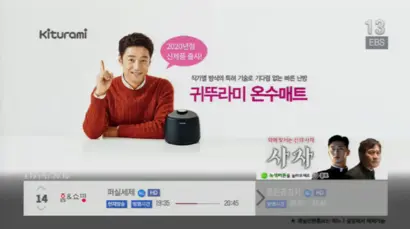
Establishing a Niche in Cable TV through 'Cost-Effectiveness'
The world of TV advertising is evolving. Zapping ads are a new concept in advertising that was commercialized a decade ago by the domestic ad-tech venture Zapple. They identified the 1-2 seconds of transmission delay—the black screen that appears when changing channels—as a "wasteland" ripe for exploitation and developed technology to fill it. In 2014, the Ministry of Science, ICT and Future Planning (now the Ministry of Science and ICT) selected the Zapple consortium’s channel-switching ad service as a pilot project under its Smart Media Service development initiative and supported its commercialization. The consortium included cable operators CJ HelloVision and C&M (now D'LIVE). Although Zapple, which suffered from financial difficulties, filed for bankruptcy and closed its doors late last year, zapping ads are still utilized as a major advertising product on cable TV.
Zapping ads combine the high attention-grabbing nature of TV commercials with the benefits of digital media-based targeting. Advertising agencies that handle zapping ad products for regional cable TV describe them as follows: "The repeated forced exposure results in high visibility. If you keep pressing the remote to flip through many channels at once, the ads can persist for up to 10 seconds. It’s an effective ad format for promoting events and brand awareness." Another agency official added, "It is very cheap for a digital broadcast ad. Because the cost is based on the number of impressions, it is economical for advertisers. While initially there were fewer advertisers using local cable compared to nationwide broadcasts, it is a growing trend."

'Is It Dismissed for Being Short?': Limitations of Self-Regulation in Protecting Viewer Rights
What is it like from the viewer's perspective? Since cable MSOs (Multiple System Operators) like t-broad and C&M introduced zapping ads 10 years ago, there have been concerns about increased viewer inconvenience. Even today, complaints persist. A salaryman identified as 'A' expressed his frustration, saying, "When I visit my parents' house in my hometown and turn on the TV, ads suddenly pop up between channels. Recently, I got sick of seeing advertisements for senior mobile plans for two days straight. I’m thinking about looking into which cable providers do this and switching their service provider."
Zapping ads, which use communication networks to pre-store ad images on set-top boxes and display them, are not a type of advertisement defined by the current Broadcasting Act. When the business first launched, there was no department in the Ministry of Science, ICT and Future Planning or the Korea Communications Commission (KCC) that oversaw it. Broadcasters, seizing on this regulatory void, began the service without notifying viewers of the introduction of new ads.
Following consumer complaints and concerns raised by civic groups, the 2015 National Assembly audit pointed out that there were no means to regulate these new variants of advertising, such as zapping ads. Subsequently, the Ministry and the KCC introduced a self-regulatory proposal: inserting a notice in the ad image stating, "Channel switching ads can be disabled in Menu > Settings," and implementing a procedure to block channel-switching ads upon the request of new subscribers or those filing service requests.

However, it is widely assessed that the limitations of self-regulation are clear. Because cable TV’s main customer base is the elderly, they often lack the ability to handle tasks like changing settings on their own. The rate at which they switch to other services like IPTV due to dissatisfaction is also relatively low. Online, there are persistent cases of users sharing how to change the settings, or children of elderly subscribers—like the aforementioned Mr. A—comparing prices and contemplating switching providers. This is why some interpret the results as having effectively opened a market rather than protecting viewers.
There are also criticisms that the service structure is irrational, given the nature of paid broadcasting for which users pay a fee. Han Seok-hyun, director of the Citizens’ Media Center at the Seoul YMCA, explained, "It’s a familiar pattern: they insert ad services in a defenseless situation first, and when problems arise, they offer restrictive measures as if there were a choice. While it seems like they are giving you a choice, I don't see it as a legitimate form." He added, "Since it is a paid broadcasting service, there should be benefits for customers who accept senior ad exposure at the contract stage. It would be appropriate to get consent for ad exposure from the customer from the beginning and allow them to decide on differential pricing or whether to sign up."
It appears that neither the Ministry of Science and ICT nor the KCC has a department or staff in charge of this. They are passing the buck to each other, citing the lack of legal grounds and unclear oversight authority. A KCC official explained, "There have been a few complaints regarding this. We guide users to seek solutions through their provider's service center. However, this is a difficult area for the KCC to handle, as our mandate is to regulate advertising under the Broadcasting Act." The responsibility is increasingly leaning toward the Ministry of Science and ICT, which oversees new types of advertising, but the Ministry does not even have clear designated personnel for it. An official from the Ministry of Science and ICT replied, "It seems to be a matter under the KCC's jurisdiction."
In a situation where even the environment to monitor and manage the status of self-regulation is not properly established, similar types of ads have been newly introduced recently. It is a service aimed at IPTV households that only triggers when entering specific affiliate channels; however, since the basic principle is similar to zapping ads, viewer dissatisfaction is expected.
Han Seok-hyun noted, "One of the main complaints viewers have about paid broadcasting is the slow channel switching speed, so it is natural that putting ads into this zapping time increases dissatisfaction." He added, "Although the environment for the paid broadcasting industry is not easy, this is likely to backfire as it increases factors for churn. Policymakers need to ponder how long and to what extent they will relax regulations on new types of advertising."