

[비즈한국] The JTBC drama 'The Tale of Lady Ok' depicts the fierce survival story of its protagonist, Gu-deok, also known as Ok Tae-young (played by Lim Ji-yeon). The show has drawn attention from the very beginning due to its fast-paced narrative and content that deviates from the typical political maneuvering or royal palace struggles found in traditional period dramas. What stands out most is that the protagonist is a slave, the lowest rank in the Joseon Dynasty’s social hierarchy. While there have been dramas like 'The Slave Hunters' (Chuno), which focused on slave hunters tracking down runaways, or 'Maids,' featuring a nobleman’s daughter reduced to a servant overnight, most historical dramas have centered on royalty or high-ranking aristocrats. Given this, 'The Tale of Lady Ok' is quite unconventional from the very start.
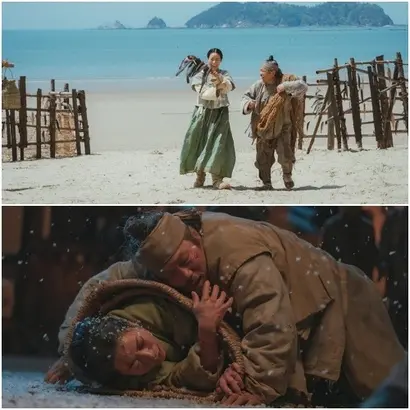
True to its tagline, "The fate of a slave carried in a flowered sedan chair," the first few episodes of 'The Tale of Lady Ok' quickly showed how Gu-deok, a lowly slave girl living like a maggot, becomes Ok Tae-young, a noblewoman and an *oejibu* (a lawyer of the Joseon Dynasty). The pacing is rapid: in the first episode, Gu-deok (Lim Ji-yeon) escapes her master’s house, meets Ok Tae-young (Son Na-eun)—a noblewoman returning from the Qing Dynasty—and becomes her adopted daughter. After an unfortunate accident, she wakes up being mistaken for Ok Tae-young. By episode two, she confesses that she is not the real Ok Tae-young, gains the trust of the family’s matriarch, Lady Han (Kim Mi-sook), and begins living under the name Ok Tae-young. Similarly, the backstory of Song Seo-in (Choo Young-woo), the young nobleman who was one of the reasons Gu-deok had to escape, is revealed: he discovers he is actually the illegitimate son of a *gisaeng* and becomes Cheon Seung-hwi, a low-ranking professional storyteller, all within the first two episodes.
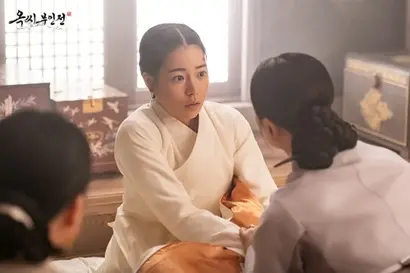
Furthermore, in the third episode, Ok Tae-young shares her unconventional secret with Seong Yun-gyeom (Choo Young-woo, playing dual roles), the eldest son of the Cheongsu-hyeon magistrate Seong Gyu-jin (Seong Dong-il), who shares a face with Cheon Seung-hwi, and they enter into a marriage. By episode four, Seong Yun-gyeom is forced to leave home after caring for LGBTQ+ children, which lands him in danger of being labeled a rebel. By the end of episode four, the Seong family begins its collapse as Magistrate Seong Gyu-jin is dismissed for failing to capture the rebels, loses his assets and family, and dies of shock. However, by episode six, through Ok Tae-young’s resourcefulness, the false accusations are cleared, the family is restored, and the younger brother-in-law, Seong Do-gyeom (Kim Jae-gyeom), passes the state examination with the highest honors. Events that would typically span the entire series or at least several episodes are resolved quickly in 'The Tale of Lady Ok.' With incidents constantly unfolding, there is no time to be bored, naturally leading to high immersion.

Of course, it’s not just the snappy pacing that makes this drama compelling. The way Gu-deok, as the *oejibu* Ok Tae-young, performs her duties strangely aligns with the spirit of the current age, striking a chord with viewers. Living a life where everything—her name, her status, and her husband—is fake, she doesn't settle for the comforts of her deception. Instead, she stands on the side of fellow slaves and commoners with grievances. When her close friend, the servant Baek-i (Yoon Seo-ah), dies unjustly, she risks her life to uncover the truth, and when Baek-i's mother Mak-sim (Kim Jae-hwa) is sentenced to ten strokes of the cane for allegedly insulting a nobleman, she steps forward to take the punishment instead. This is partly because she vividly remembers her own life as Gu-deok, but it is also a clear depiction of solidarity with the weak.

Ok Tae-young’s continued solidarity with the marginalized is evident throughout. She rescues children from a nobleman who was kidnapping them to work in an illegal gold mine, and upon learning that her husband was secretly protecting LGBTQ+ children, she argues on their behalf. While some viewers initially reacted negatively to the queer narrative—questioning why one of the male leads had to be LGBTQ+—'The Tale of Lady Ok' is significant in that it tackles queer themes head-on, rather than just teasing them as modern dramas often do, and explicitly declares them to be vulnerable members of society who remain unprotected. In an era where solidarity between groups that seemed to have no intersection is being witnessed on streets everywhere, 'The Tale of Lady Ok' offers much food for thought.

When Ok Tae-young, working as an *oejibu*, states, "As human beings, everyone should be judged equally before the law regardless of their status or circumstances," it reminds us once again of the simple, concise truth that everyone must be equal before the law. Especially in light of the unprecedented martial law situation in December 2024, the subsequent impeachment motion, and the series of events leading to the first-ever arrest warrant for an incumbent president following repeated refusals to appear for questioning, it forces us to reflect on whether everyone is truly equal before the law.
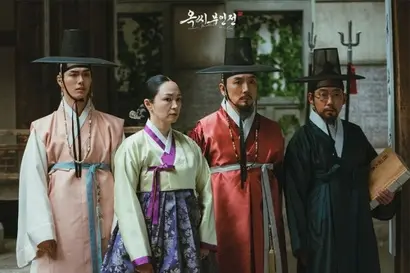
A 16-episode series, 'The Tale of Lady Ok' has passed its halfway point with the eighth episode. The ending of episode eight heightens immersion once again, as Lady Song (Jeon Ik-ryung), who dreams of revenge against Ok Tae-young, puts her in a situation where she risks being widowed and losing her freedom of action. As 'The Tale of Lady Ok' reinterprets the novel 'Yuyeon-jeon,' written by Baeksah Yi Hang-bok, which is based on the 1542 French "Martin Guerre" impersonation case and a similar fake-husband incident that occurred in the Joseon Dynasty during King Seonjo’s reign in 1607, a key point to watch in the latter half is which identity—the slave Gu-deok or the noblewoman Ok Tae-young—she will ultimately choose, and who she will choose between the identical-looking Song Seo-in/Cheon Seung-hwi and Seong Yun-gyeom.
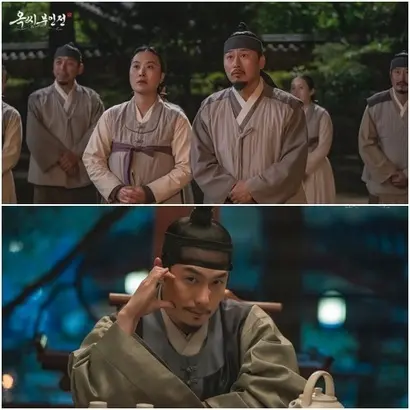
Lim Ji-yeon, who enjoyed a second heyday as Park Yeon-jin in 'The Glory,' has taken the lead role, pushing the ratings from 4.2% in the first episode to 9.5% by the eighth. Coincidentally, from January 6th, Cha Joo-young—'stewardess Hye-jeong' from 'The Glory'—is returning as the lead in the drama 'Won-kyung,' and Song Hye-kyo, who played Moon Dong-eun in 'The Glory,' is also set to appear in the movie 'The Black Nuns' at the end of January. As Lim Ji-yeon leads the charge, it is quite exciting to see which actor from 'The Glory' will steal the public's heart more.
About the author, Jung Soo-jin:
I have covered and written about films, travel, and pop culture across various magazines. I don't want to fall behind trends, but I've become an "old soul" who predicts the obvious clichés in the next scenes while watching the latest dramas. I am trying to regain my edge by drifting through the vast world of OTT, and my current wish is for a unified OTT subscription plan.