

[비즈한국] The economy abhors the word "uncertainty." Since the declaration of emergency martial law, political uncertainty has continuously plagued our economy. As political instability heightened following Acting President Han Duck-soo's refusal to appoint a Constitutional Court justice on the 27th, the won-dollar exchange rate in the Seoul foreign exchange market briefly surpassed 1,480 won during intraday trading, and the KOSPI index collapsed below the 2,400 mark. Due to fine-tuning by foreign exchange authorities, the exchange rate closed the weekly session at 1,467.5 won, up 2.7 won from the previous day (as of 3:30 PM). The KOSPI ended the day at 2,404.77, down 1.02% from the previous trading day.
As political turmoil deepens, the economy as a whole is freezing over. It appears that not only investment sentiment but also consumer sentiment has significantly withered. According to data received from Shinhan, KB, Samsung, and Hyundai Card by the office of Rep. Kim Hyun-jung of the Democratic Party of Korea, a member of the National Assembly's National Policy Committee, the combined revenue of the four card companies from the 1st to the 20th of this month was 28.2045 trillion won, a decrease of approximately 2% compared to the same period last month. In particular, the decline in revenue for restaurants and entertainment establishments was notable. The Composite Consumer Sentiment Index (CCSI) for December, released by the Bank of Korea on the 24th, also fell to 88.4, down 12.3 points from November. This is the largest drop in about two years since the COVID-19 pandemic.
On top of this, the tragic Jeju Air089590 disaster, which resulted in 179 deaths, is expected to further dampen consumer sentiment. In the wake of the tragedy, a national mourning period has been declared until January 4 of next year, and there are movements to cancel scheduled events and marketing activities.
Furthermore, the Trump administration, set to launch in January next year, is expected to add to the uncertainty of our economy. Park Seok-joong, a research fellow at Shinhan Securities, predicted, "Policy shifts at the beginning of Trump's term are highly likely to begin with tariff hike threats focused on China," adding, "This could lead to a direct counter-response from China, potentially causing risks such as re-igniting inflationary pressure, a slowdown in trade volume, and supply chain instability." He also emphasized, "While these risks are predictable, there is a lack of assets to hedge against them. In a situation where risk-averse sentiment stimulated by rising interest rates is causing instability across stocks, bonds, and alternative assets, a balance between risk and safety must be prioritized."
Experts analyze that with a combination of slowing exports, domestic economic stagnation, and political uncertainty, the domestic economy is plummeting to an unfathomable depth. Ultimately, they argue that now is the time to increase the portion of safe foreign assets rather than investing in domestic risky assets.
If so, is it safe to invest in the dollar, a representative safe asset? One foreign exchange dealer remarked, "Even God doesn't know the dollar." This means it is that difficult to predict. Moon Hong-cheol, a researcher at DB Financial Investment, forecasted, "Under political uncertainty, we need to leave room for the won-dollar exchange rate to rise for the time being, disregarding fundamentals," adding, "It will take quite some time for the turbulent period—characterized by political uncertainty, Trump’s trade pressure, and Federal Reserve policies—to calm down and for the exchange rate to stabilize."
What about US stocks? As the domestic stock market struggles, an increasing number of investors are turning their attention to US stocks. Kim Sung-hwan, a senior researcher at Shinhan Securities, said, "Negative news regarding the fundamentals of the US stock market is rare," but added, "The fourth quarter was excellent as solid fundamentals combined with the Federal Reserve's interest rate cut stance. However, rising interest rates could eventually act as a burden on the stock market." He added, "The US stock market may waver briefly at the beginning of the quarter as expectations for interest rate cuts are adjusted, but the upward trend will be maintained if earnings remain solid."
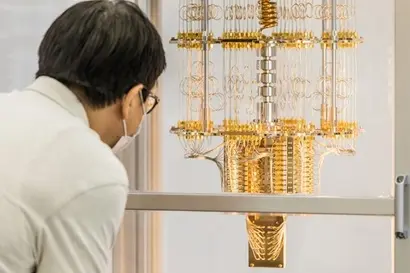
In particular, following the AI-related stock theme, quantum computers, which are considered a tool to resolve the stagnation of AI technology development, have recently emerged as the next theme, causing quantum computer-related stocks to soar in the US market. Senior Researcher Kim advised, "It started with the AI rally, spread to an 'everything rally' centered around the presidential election, and in December, it shifted to a market led by themes and mega-cap stocks. However, typically after the inauguration in January, the influence of themes weakens and earnings drive the market," adding, "Rather than jumping on themes, it is necessary to focus on big tech and large/mid-cap AI stocks with strong earnings momentum."