

[비즈한국] Despite the rising rate of self-employed business closures, the number of franchise outlets continues to hit all-time highs. In particular, many franchises operate their own internal loan programs, drawing in many prospective entrepreneurs who lack sufficient capital. However, because some franchise loan products come with significantly high interest rates, voices of concern are emerging within the industry, urging prospective owners to make their decisions with extreme caution.
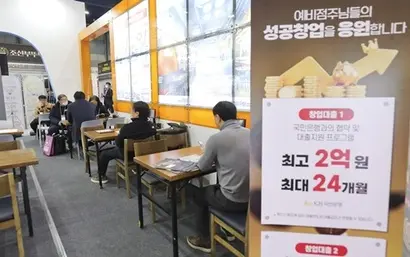
'Enticed' Prospective Entrepreneurs Short on Capital
Prospective entrepreneur "A" recently went for a franchise startup consultation. "The brand only allows franchises with a floor space of 100 pyeong (approx. 330㎡) or more, so the cost was a burden, but they told me I could use the headquarters' loan program for the shortfall. I was shocked, however, to hear that the interest rate for the loan was 18% per year," A said. "The head office employee explained that because the store generates good revenue, I could still make a significant profit even after paying the interest, but I gave up on the franchise because the high-interest loan felt too burdensome."
Brand "B," which caught A’s attention, is considered to have some of the highest startup costs in its sector. While a competitor selling the same type of menu requires 2.5 million won per pyeong in startup costs, Brand B requires 7 million won, which is about three times higher. With an expansion strategy centered on large-scale stores, a single location requires an initial investment of approximately 800 million to 1.2 billion won.
Even with such expensive startup costs, there is a line of prospective entrepreneurs hoping to open a Brand B franchise. Industry insiders analyze that the loan products operated by the headquarters play a major role in this. One industry source confided, "Prospective entrepreneurs who are shut out of bank loans and have low credit ratings still want to start a business but worry about funding. When the headquarters steps in to lend them a significant amount of money, they become enticed and begin preparations."
Another industry source added, "Franchise loan products operated by banks have strict screening criteria and the loan amounts are not very large. The atmosphere is such that people who have difficulty starting a business due to insufficient capital end up choosing places that offer internal franchise loans."
The concern is that the interest rates on these in-house loan products are quite high. A representative from Brand B, which operates an 18% annual interest rate loan product, explained, "Because we use private lending programs, the rates are high. While bank loans typically offer rates of 5–7%, because bank loan limits aren't being met, the franchise industry is forced to use private lenders, which results in the high interest rates."
The situation is similar for other franchise brands. A representative from Brand C explained, "Initial startup costs are expected to range from a minimum of 300 million to 1 billion won depending on store size. The shortfall can be covered using the headquarters' loan program at any time," adding, "The loan interest rate is set at 13% per year."
The interest rates for franchise loan products are similar to or higher than the average interest rates of private loan companies. According to the "First Half of 2024 Private Lending Status Survey" released by the Financial Supervisory Service, the average interest rate for private lenders in the first half of this year was 13.7%.
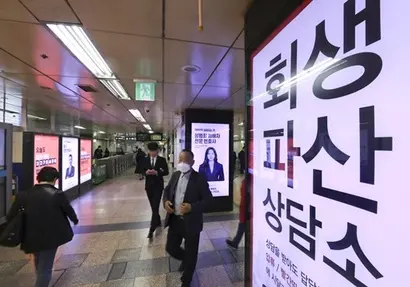
Even With Good Sales, Interest Burdens Lead to Store Closures
Franchise headquarters emphasize "guaranteed high revenue" and persuade prospective owners that they should move forward even if it means bearing the interest burden. A Brand B representative said, "Monthly revenue is over 300 million won, and 15–20% of that can be kept as net profit. Although there is a burden regarding the loan, many people want to open a franchise, so securing a good location is important. Most franchisees use the headquarters' loan program to secure funding." A representative from Brand C also explained, "Because monthly revenue is high, the loan portion can be sufficiently covered. Many franchisees are operating without issues."
The industry expresses deep concern over prospective entrepreneurs choosing high-interest loan products without much thought, fueled by anticipation. One industry source explained, "Franchises that use private loans are nothing more than 'a beautiful apricot that is rotten on the inside.' They use private loans excessively to increase the number of locations immediately, but the burden eventually falls entirely on the franchisees. In cases of brands that use private loans, it is common for franchisees to put their stores up for sale because they cannot handle the interest burden, even if the store is busy."
Another industry source pointed out, "Some franchises generate profit by lending company capital to franchisees at high interest rates. Entrepreneurs who have difficulty getting loans due to credit issues have no choice but to use these high-interest products, but in the end, there is no profit left for the franchisee."
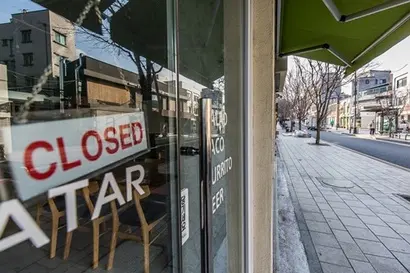
According to the Korea Enterprises Federation, 986,000 businesses closed last year. This is the highest figure since 2006, when comparable statistics began to be compiled. It is estimated that the number of closed businesses will be higher this year than last. According to the Korea Federation of SMEs, 1.3019 trillion won in Yellow Umbrella mutual aid payments for business closures has been paid out as of last month, an increase of 10.1% compared to the same period last year (1.182 trillion won).
One self-employed business owner complained, "Business is so bad I want to quit, but there’s no one looking to take over the space, so I can't even close the shop. I’ve put the shop on the market, but I'm still operating for now. I haven’t closed the doors yet, but half of the shops in the neighborhood have 'For Lease' signs up."
With revenue declines continuing due to the consumption slump, projections suggest that the interest burden for the self-employed will only grow heavier next year. As self-employed individuals are being pushed to the brink, there are calls for the need to alleviate the burden of loan interest, but word is that finding realistic alternatives is not easy. A representative from the Korea Franchisee Association explained, "Organizations like KAMCO (Korea Asset Management Corporation) tried to conduct a survey on the state of loans for the self-employed by collecting cases from those struggling with debt, but there was almost no response. This is because people view debt as a personal shame and do not want to reveal their difficulties publicly. That is why it is difficult to develop policies, such as easing standards for those struggling with loan delinquencies."