

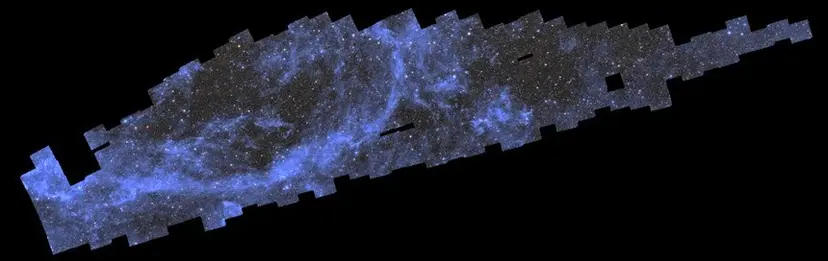
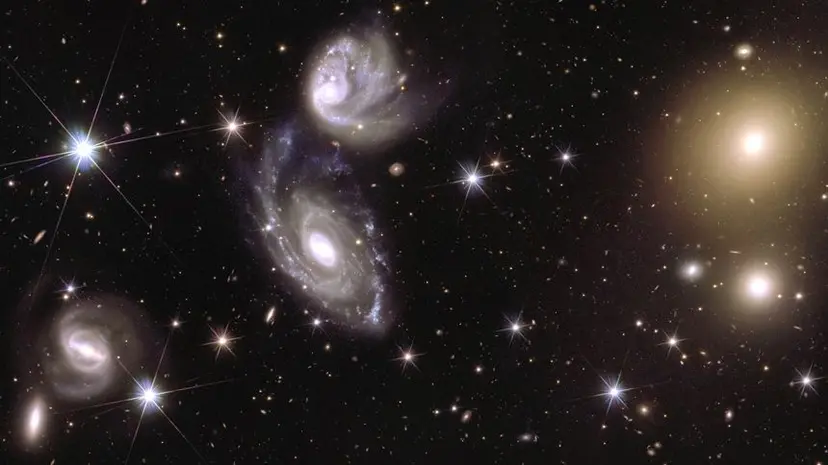
[비즈한국] In October 2024, the ESA released a remarkable photograph. At first glance, it looks like an unrecognizable image with strange shapes. However, it is packed with over 100 million galaxies, stars, and celestial objects. The Euclid space telescope, launched in July 2023, began its first observations to create a three-dimensional map of countless galaxies within a range of 10 billion light-years. The image above is just a tiny fragment of the cosmic map completed from that initial observation data. This represents a mere 1% of the entire cosmic map to be completed, yet it contains over 100 million celestial objects! It is expected that nearly 10 billion objects will be captured once the entire map is finished.
As its name suggests, the Euclid space telescope studies the geometry of the universe. It is mapping the entire sky, excluding regions obscured by the dust disks of our Milky Way and solar system. Euclid differs significantly from the more familiar Hubble and James Webb space telescopes. It views the universe through a relatively smaller aperture; while it may be slightly less powerful in terms of resolution, it can capture a much wider field of view at once, covering vast swathes of the sky. Ultimately, Euclid plans to map one-third of the entire night sky.
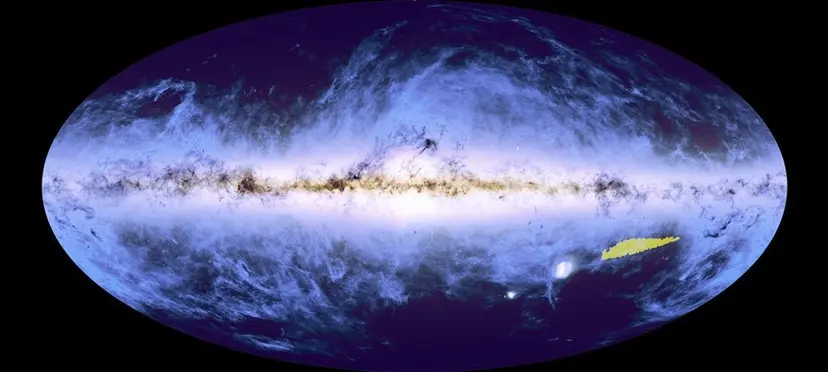
Through this, it is creating a three-dimensional map of matter in the universe, showing how galaxies are distributed from the near to the distant universe. In particular, Euclid observes how much space is bent and distorted by dark matter permeating the cosmos. Rather than relying on traditional gravitational lensing—where light is bent by a single massive galaxy cluster—it detects weak gravitational lensing throughout the universe caused by the low-mass dark matter spread across space. By doing so, the Euclid space telescope will determine how much space-time is curved and provide clues to estimate the proportions of dark matter and dark energy.
The Euclid space telescope has overcome various solitary challenges. There were even constant, fatal issues that raised concerns that the mission might end in failure. Problems arose right from the moment Euclid reached its target orbit.
Space telescopes move through space at high speeds, meaning the direction the mirrors point must also change rapidly. To clearly capture the faint light from distant celestial objects, the telescope must precisely maintain its aim while controlling its orbit. On Earth, one can use GPS satellite signals to determine current location and orientation, but that is impossible in deep space. Instead, it uses the stars themselves as guides. Like sailors navigating the dark seas centuries ago, it uses constellations to orient itself. It identifies specific, bright stars in the sky as "guiding stars" to fix its direction.
However, as soon as Euclid reached its target orbit, a problem occurred with the sensor tracking these guiding stars. Euclid could not follow the stars properly, and they kept drifting out of view. Photos taken at the time show the guiding stars trailing in long streaks instead of staying fixed in one spot. Fortunately, this issue was resolved by patching the software that controls the telescope's attitude.
Afterward, Euclid successfully captured its first professional images. Among the released first images were various views, including the famous Horsehead Nebula and the Perseus Cluster, which contains numerous galaxies. Euclid showcased photos with a different charm than those of James Webb or Hubble, raising expectations for more high-quality observation data in the future.
However, another problem emerged just a few days later: a small amount of ice had condensed inside the telescope's optical sensors. Astronomers suspect that some water vapor from the air entered the telescope during the assembly process on Earth.
In fact, moisture infiltration is a persistent, critical issue when assembling space telescopes. Assembly environments maintain a relative humidity of around 50% to minimize the risk of sparks and fires from electronics. Furthermore, some water droplets can be trapped within the plastic insulation used to protect equipment from the extreme cold and solar heat of space.
Unfortunately, Euclid was launched with some water trapped in its instruments. In the vacuum of space, these droplets rapidly condensed and, crucially, froze onto the telescope's highly sensitive sensors. Astronomers estimate that the ice layer was only a few dozen nanometers thick, about the length of a single strand of DNA. Yet, even such a small amount of ice can have a fatal impact on sensitive instruments, potentially preventing the acquisition of observation data altogether.
Various solutions were discussed. One suggestion was to point the telescope toward the Sun for about 96 hours to warm its internal temperature. However, heating all the instruments at once to remove the ice carried the risk of deforming the equipment itself, making it an unwise strategy. Instead, astronomers attempted to heat individual components one by one, allowing the water to evaporate slowly. Fortunately, this attempt was successful. The temperature of one of the mirror assemblies inside Euclid rose from -143 degrees to -113 degrees in just a few minutes. Euclid's instrument sensitivity improved by 15% compared to before the issue occurred. Since then, no further problems have been identified.
After such hardships, the now-stabilized Euclid space telescope began its full-scale cosmic mapping in earnest after March of this year. Euclid observes the sky in 40,000 steps, aiming at a specific direction for 75 minutes at a time, gradually filling in the map of the entire universe.
In October 2024, Euclid released its first observation data, covering just 1% of the entire map. While it is a small fragment, it covers an area of the sky large enough to be filled by 500 full moons. If you zoom into the photos, you can truly feel the sharpness of the resolution with which it captured the light of countless stars and galaxies.
Nearly 30 years have passed since the Hubble Space Telescope’s historic first deep-field observation. Now, along with the James Webb Space Telescope, Euclid, and the soon-to-be-launched Nancy Grace Roman Space Telescope, a variety of space telescopes are targeting the universe with different wavelengths of light, filling in the empty corners of our cosmic map. The ESA plans to release the second batch of observation data around April 2025, about five months from now. We can look forward to seeing how many more massive pieces will be added and how the cosmic puzzle will come together.
References
https://www.euclid-ec.org/euclid-successfully-de-iced-gains-15-sensitivity/
https://www.esa.int/Science_Exploration/Space_Science/Euclid/Operations_begin_to_de-ice_Euclid_s_vision
https://www.esa.int/Science_Exploration/Space_Science/Euclid/Euclid_s_sight_restored
https://www.esa.int/Science_Exploration/Space_Science/Euclid/Zoom_into_the_first_page_of_ESA_Euclid_s_great_cosmic_atlas
About the author, Woong-bae Ji: Loves cats and the universe. After watching 'Galaxy Express 999' as a child, he dreamed of sharing the beauty of the universe. Currently, he researches galaxy evolution through interactions at the Yonsei University Galaxy Evolution Center and the Near-Universe Laboratory, and engages in various science communication activities through lectures and writing. He is the author of books such as 'The Dating Observatory,' 'Thinking About the Universe All Day,' and 'Stars, the Science of Light.'