

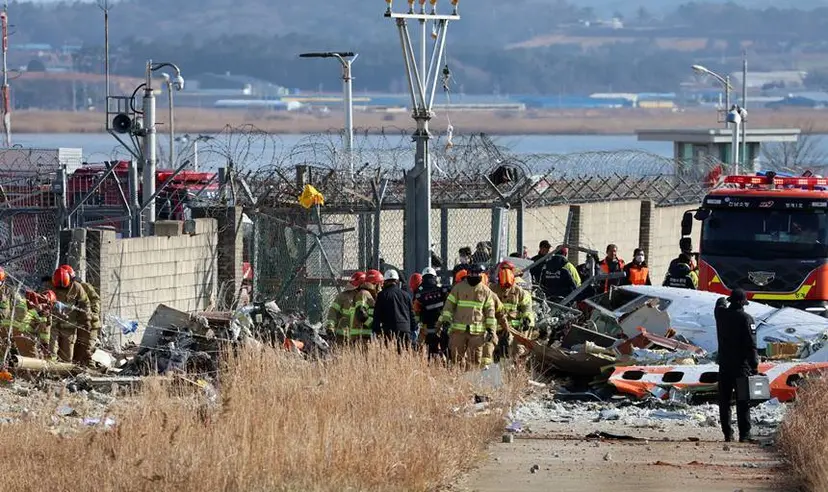
[비즈한국] The prosecution has immediately responded to the passenger plane disaster at Muan International Airport. On the 29th, the Supreme Prosecutors' Office announced that it had formed an accident response headquarters, stating, “We have issued instructions to cooperate with relevant agencies to provide prompt support for victims and their bereaved families, and to thoroughly investigate the cause of the accident.” The response headquarters includes 16 prosecutors from three teams, including the Criminal Division 3 and the Public Investigation Division of the Gwangju District Prosecutors' Office, as well as the Criminal Division 2 of the Mokpo Branch. In the legal community, it is being suggested that if ‘negligence’ or ‘illegal acts’ are uncovered during the Ministry of Land, Infrastructure and Transport’s investigation, the prosecution may launch an official investigation.
Currently ‘support-focused,’ but…
The prosecution, centered around the accident response headquarters, plans to work closely with police, fire authorities, and other relevant agencies to focus on: identifying victims and conducting autopsies; thoroughly investigating the cause and truth of the accident; and providing active support to victims and their bereaved families. This is also the standard initial response protocol for mass casualty incidents. In principle, the prosecution’s final verification is required when deaths occur, and they intend to cooperate with police and other entities to ensure the best possible support for the victims and their families.
However, the legal community suggests that the prosecution’s role may change depending on the ‘identification of the cause.’ The primary investigation is conducted by the Ministry of Land, Infrastructure and Transport and the Aviation and Railway Accident Investigation Board (ARAIB); if illegalities are revealed during this process, the prosecution could be brought in for a formal investigation.
According to the Ministry of Land, Infrastructure and Transport, the flight requested landing clearance at 8:54 AM. Three minutes later, at 8:57 AM, it received a ‘caution bird activity’ notification from the control tower, and two minutes after that, the pilot declared a Mayday. Four minutes later, at 9:03 AM, the plane collided and caught fire during an emergency landing. Testimony from witnesses and surviving crew members, as well as text messages sent by passengers before the accident (“They said a bird got stuck in the wing”), serve as evidence supporting the possibility of a bird strike.
However, questions remain regarding the landing gear failing to deploy during landing, as well as the attempt to re-land after a short turn at a low altitude. It must also be determined whether any mechanical defects stemmed from poor maintenance or if the aircraft was being operated under excessive strain.
As of the end of the third quarter of this year, Jeju Air’s average monthly aircraft operation time was 418 hours. This is higher than other low-cost carriers (LCCs) such as T'way Air (386 hours) and Jin Air (371 hours). Aircraft operation time is calculated by dividing the total hours flown for revenue by the number of aircraft in the fleet, meaning they had a more intensive flight schedule. Jeju Air, the operating carrier, has denied allegations of poor maintenance and excessive flight scheduling.
For now, the Ministry of Land, Infrastructure and Transport has collected the plane’s black boxes (Cockpit Voice Recorder and Flight Data Recorder), which will be the keys to identifying the cause of the accident. However, since parts of the flight data recorder are damaged, recovery and decoding will likely take a significant amount of time. Furthermore, because investigations must be conducted from multiple angles—including flight path records, communication logs, and interviews with air traffic control personnel—it is expected to take at least several months to fully grasp the details of the accident.
Attorney A, a former prosecutor, noted, “Usually, when a major disaster occurs, it is customary for the investigation to serve as a ‘cleansing’ process to find the cause,” adding, “However, unlike the Sewol Ferry or Itaewon disasters, there were no issues with the rescue response in this incident, so they will likely focus on verifying responsibilities regarding aircraft maintenance and operations.”
Highest death toll ever… Potential for lawsuits over insurance payouts
This disaster has surpassed the scale of the 1993 Asiana Airlines crash in Haenam, which was previously the deadliest. At that time, an Asiana passenger plane attempting to land at Mokpo Airport crashed into a mountain in Haenam, Jeollanam-do, resulting in 66 deaths and 44 injuries. This is why the legal community is paying close attention to the possibility of conflicts over ‘insurance payouts.’
According to an announcement by the Financial Supervisory Service on the 29th, the aircraft involved in the accident was covered by aviation insurance worth $1.03651 billion (approx. 1.5257 trillion KRW). The liability coverage limit is set at $1 billion (approx. 1.472 trillion KRW), and the hull coverage limit for the aircraft itself is $36.51 million (approx. 53.7 billion KRW). The policy is held by five insurance companies led by Samsung Fire & Marine Insurance000810, and these five companies have reinsured 99% of the risk with overseas reinsurance firms.
Insurance companies plan to pay out claims to the bereaved families of the deceased as soon as they are finalized, and provide prompt medical expenses to the injured. The financial authorities have also decided to set up a rapid compensation center at the Korea Life Insurance Association and the General Insurance Association of Korea to assist with the application and payment of individual insurance policies, such as travel insurance.
Attorney B, a former judge, analyzed, “While there shouldn’t be any issues with executing insurance payouts for those who lost their lives in this accident, there is a possibility that the compensation for the aircraft may not meet Jeju Air’s expectations, or that overseas reinsurers might contest the cause and liability of the accident,” adding, “This disaster seems more likely to expand into civil litigation (insurance-related lawsuits) than into criminal (investigative) proceedings.”