

[비즈한국] The 2024 'Korea Wealth Report' published by KB Financial Group105560 Research Institute provides concrete insights into how high-net-worth individuals in Korea view real estate, respond to it, and establish investment strategies. The report meticulously analyzed the real estate investment patterns and shifting trends among the wealthy, who hold assets worth 1 billion KRW or more, and the results offered significant implications for gauging the future direction of the real estate market. In this column, based on the 2024 Wealth Report, we intend to analyze the current investment perspectives and strategies of South Korea's real estate-rich individuals and explore new opportunities arising from changes in the real estate market.
The proportion of real estate assets among the wealthy remains high, and it continues to be preferred as a core asset.
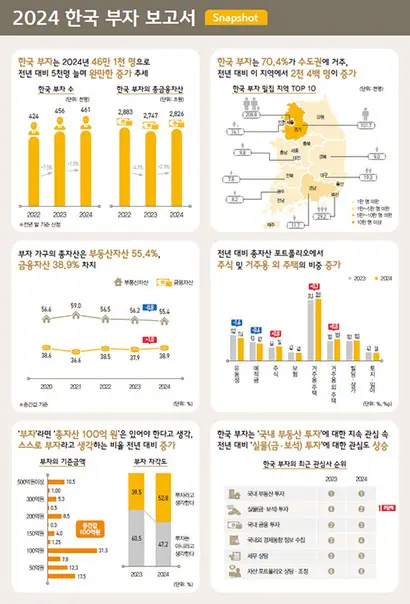
For high-net-worth individuals in Korea, real estate remains the central pillar of their asset portfolios. According to the 2024 report, approximately 55.4% of the total assets of the wealthy are concentrated in real estate, a figure that has decreased slightly compared to the previous year. However, it still accounts for a higher proportion than financial assets such as stocks and bonds, and is recognized as a stable and predictable means of generating returns.
In particular, 'ultra-high-net-worth individuals (with 30 billion KRW or more)' show a prominent tendency to own or manage large-scale commercial real estate through corporate entities to maximize asset management efficiency. This is interpreted not only as a tax-saving measure but also as a strategic choice for stable asset management. Furthermore, the report shows that real estate in premium areas such as Seoul's 'Gangnam 3-gu' (Seocho, Gangnam, and Songpa districts) as well as Yongsan and Banpo remains the primary investment destination for these individuals.
Changes in Investment Inclinations: Coexistence of Stability and Challenge
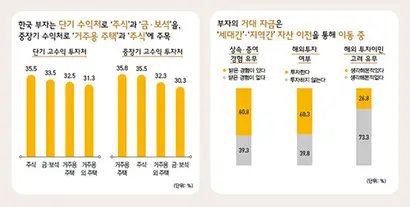
The investment inclinations of the wealthy are gradually diversifying. According to the report, about 60.8% of the wealthy highly value their own real estate investment knowledge and prefer strategic investments based on data analysis and market research. At the same time, about 24.5% of all wealthy individuals are showing a more aggressive investment stance than before, seeking out new market opportunities.
For example, some high-net-worth individuals are turning their eyes to alternative investment assets such as commercial real estate REITs, which help generate stable cash flow while diversifying risks. The report points out that this trend is becoming more pronounced, especially at a time when medium- to long-term economic uncertainty is increasing.
① Increase in asset management through corporate entities
According to the report, ultra-high-net-worth individuals are actively pursuing the establishment of corporations for real estate ownership and management. This provides structural advantages for managing large-scale projects efficiently, as well as tax benefits. However, as there is a possibility that government regulations on corporate-owned real estate will be strengthened, a response strategy for this is necessary.
② Concentration on metropolitan real estate
More than 70% of Korea's wealthy reside in the metropolitan area and are concentrating their investments in luxury apartments and commercial real estate within this region. In particular, the Gangnam area of Seoul remains the most preferred investment destination among the wealthy. However, investments concentrated in the metropolitan area leave behind the challenge of regional risk diversification.
③ Expansion of real estate alternative investments
Recently, interest in alternative assets such as REITs, ETFs, gold, and jewelry has been increasing among the wealthy. This can be seen as a strategy to diversify asset portfolios rather than relying on traditional real estate investments. In particular, it is noteworthy that high-net-worth individuals are securing stable returns through commercial real estate REITs.
The report specifically illustrates the investment attitudes of high-net-worth individuals. For example, one ultra-high-net-worth individual purchased a commercial building located in Gangnam-gu and converted it into a corporate entity to maximize operational efficiency. He leased some space in the building to startups to generate stable rental income and utilized the remaining space for his own business operations.
Another case is a mid-sized real estate investor who purchased residential real estate in a provincial metropolitan city and participated in a public REIT. He discovered investment opportunities in the regional real estate market, through which he diversified his portfolio and secured stable returns.
Emergence of New Strategies: Corporate Utilization and Regional Investment
What strategies will the wealthy choose in 2025?
① Tax optimization through incorporation
High-net-worth individuals are showing a tendency to actively utilize incorporation in relation to real estate investment. This is a strategy that can simultaneously secure tax efficiency and transparency in asset management.
② Expansion to regions outside the metropolitan area
The wealthy need to move away from concentration in the metropolitan area and explore the growth potential of provincial metropolitan cities. In particular, commercial real estate and new development projects in major cities such as Daegu, Gwangju, and Busan are evaluated as promising investment destinations.
③ ESG and sustainable investment
The report also notes that sustainable development and eco-friendly real estate projects are becoming increasingly important investment factors for high-net-worth individuals. This is connected to social responsibility regarding real estate investment and is a key strategy for securing a competitive advantage in the future market.
Let's summarize the changes in Korea's wealthy and the future of the real estate market.
The 2024 Wealth Report by the KB Financial Group Research Institute shows important changes in the real estate investment attitudes and strategies of Korea's wealthy. The wealthy still view real estate as a core asset and are trying to maximize asset value through it. However, new strategies such as asset management using corporations, expansion of alternative investments, and diversification of investments into the provinces are emerging. These changes indicate a significant direction for the entire real estate market and will serve as an important indicator for predicting future market trends.
Kim Hak-ryul, head of the Smart Tube Real Estate Research Institute, known by his pen name 'Pashong', previously served as a team leader at the Gallup Korea Real Estate Research Division. He operates and hosts the Naver blog 'Pashong's World Exploration' and the YouTube channel 'Stu TV'. His books include 'The Power of Gyeonggi-do Real Estate (2024)', 'Absolute Principles of Seoul Real Estate (2023)', 'The Future of Incheon Real Estate (2022)', 'Kim Hak-ryul's Absolute Principles of Real Estate Investment (2022)', 'Future Map of Korean Real Estate (2021)', 'From Now On, Only Places That Will Rise, Rise (2020)', and 'Instruction Manual for Korean Real Estate (2020)'.