

[비즈한국] We currently refer to existing top-tier fighters like the F-35, F-22, and J-20 as '5th-generation fighters.' It is widely accepted as common knowledge that 5th-generation fighters achieve one-sided victories in aerial combat against previous-generation aircraft. Against this backdrop, China recently unveiled the flight of a 6th-generation fighter that surpasses these, known as the '36011.' We analyzed what this fighter is and what its significance entails.
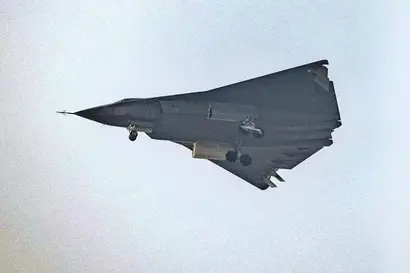
On the 26th, the day after Christmas, several photos and videos emerged primarily on the Chinese social media platform Weibo. They depicted an unidentified fighter flying alongside a J-20S stealth fighter in Chengdu, China. Many experts are suggesting that this aircraft is a prototype of the world's first 6th-generation fighter to be unveiled.
This mysterious prototype, assigned the tail number '36011,' possesses characteristics typical of a 6th-generation fighter. Long-range flight, ultra-high-performance stealth capabilities, and the integration of advanced electronic warfare equipment have been mentioned, though most of these remain mere conjecture. However, it is noteworthy that unlike China's past methods of imitating American fighter designs or blending Russian and American concepts, this time they have adopted a unique and intriguing design.
The first point of interest is the plane's shape. The fighter features a tailless, diamond-like configuration, which is the most effective shape for reflecting radar waves. While removing the tail wings significantly improves stealth performance, it creates difficulties in directional control. The 36011 appears to have solved this by equipping the main wings with 10 flaps.
Flaps are devices used to adjust lift during takeoff, landing, and maneuvering, and are standard on almost all aircraft. However, the use of 10 small flaps, some of which function as air brakes, is a very unique approach for the 36011. This appears to maximize stealth performance while compensating for the disadvantages of a tailless design. As a result, it is estimated that the probability of radar detection is significantly lower than that of 5th-generation fighters.
The second point to examine is the size and landing gear of the aircraft. The 36011 flew alongside the J-20S and appears to be similar in size or slightly larger. The fuselage looks thicker, and the landing gear design is highly unusual. The landing gear of this fighter features two tires on each of the three struts, and notably, the two main landing gear units are arranged in a tandem configuration. This suggests that the 36011 is not merely an air-superiority fighter, but a fighter-bomber with long-range strike capabilities. If this assessment is correct, the 36011 is highly likely to be the 'JH-36' fighter-bomber, intended to replace the JH-7.
Finally, it is worth noting that it is the world's first 'three-engine fighter.' Existing fighters typically use single or twin engines, but the 36011 is equipped with three jet engines. The engine air intakes are positioned with two on the lower part of the fuselage and one on the top. This design has never been used in an actual flight until now.
Why were three engines necessary? As the number of engines increases, thrust rises, but it is a difficult design choice due to concerns over weight and fuel efficiency. One possibility is that China may have opted for three engines because it has not yet developed the 'Adaptive Cycle Engine,' a core technology for 6th-generation fighters. This engine, which provides optimal fuel efficiency based on speed and altitude, is considered an essential element for 6th-generation aircraft.
The three engines of the 36011 may operate selectively depending on the situation, similar to the engine management system in hybrid vehicles.
In summary, the 36011 fighter is a type of fighter-bomber that may perform missions such as striking stealth fighters or hypersonic missiles deployed in Guam or Japan from mainland China. Although it uses engines at the technological level of a 5th-generation fighter, the 36011 can be considered the first 6th-generation fighter ever revealed to the world.
The United States will surely not let this challenge go unanswered. While the U.S. produced and flew the 'NGAD technology demonstrator,' a 6th-generation fighter prototype, between 2018 and 2020, its actual flight appearance has not yet been disclosed.
In the case of 5th-generation fighters, there was a 20-year gap between the first flight of the American YF-22 in 1990 and the Chinese J-20 in 2011. However, the fact that this gap has narrowed to just 4 to 6 years for 6th-generation fighters demonstrates how rapidly China's national defense and aerospace technology has advanced.
China's unveiling of a 6th-generation fighter is sending shockwaves through the global defense industry and the aerospace technology sector. Moving forward, it will be crucial to observe how the U.S. responds to China's new fighter.