

[비즈한국] Concerns are rising as the launch schedules of domestic private space launch vehicle companies are being postponed one after another. This is due to difficulties in areas such as delays in parts supply and hardware management. The companies plan to focus all their efforts on launches next year after addressing these issues.
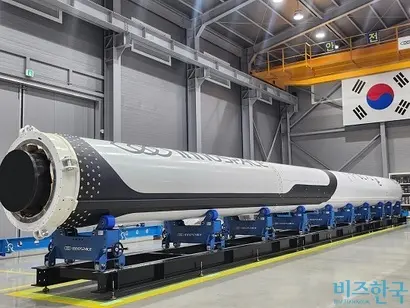
According to the industry, Innospace, the first domestic company in the aerospace sector to successfully complete an initial public offering (IPO), has postponed the launch of its satellite launch vehicle 'Hanbit-Nano' from March to July of next year. The primary causes are delays in securing electric pump parts for the launch vehicle and the construction of a new test site. However, experts assess that there are no issues with the company's launch competitiveness, as the delays stem from external variables rather than technological problems. Innospace plans to secure alternative suppliers for key components and utilize both domestic and international supply chains to reduce its dependence on single-source suppliers.
The new test site is slated to be prioritized as an 'integrated stage-certification test (comprehensive combustion) facility.' Stage-certification tests serve as the final hurdle for ground testing before a launch vehicle is deployed, conducted while the vehicle is secured on a vertical test stand. As Innospace is currently a loss-making company, the success of its first commercial launch is of paramount importance. The company is determined to prepare more thoroughly during this period of delay to ensure a successful launch on its next attempt.
Perigee Aerospace had aimed for a test launch this year, but postponed its efforts after a fire occurred during final testing of the launch vehicle. It plans to attempt its test launch again next year, aiming to be the first private company to conduct a domestic launch. Perigee analyzed that the prolonged exposure of major hardware to the marine environment for over five months while stored in the port and on the Mobile Launch Platform (MLP) had a significant impact, and it also estimated that a poor contact in the ignition components occurred. Next year's launch is also expected to be conducted from a Mobile Launch Platform (MLP).
Unastella, a startup developing Korea's first crewed space launch vehicle, also attempted to launch its test vehicle, 'Una Express No. 1,' from the Yeompo Village coast in Oenarodo, Goheung, South Jeolla Province, on the 22nd of last month. However, the launch was aborted as the engine ignition was delayed and the flight termination system failed to engage, preventing takeoff. Since Unastella managed to preserve most of the launch vehicle without damage, it plans to make another attempt in the first half of next year.
Small launch vehicles are considered the optimal choice for small-scale operators to enter the space industry due to their low costs, rapid launch cycles, and diverse launch options (locations and orbits). However, a problem exists in that while there are many satellites waiting to be sent to space, there is a severe shortage of transport vehicles. Despite this market potential, while over 140 global companies have challenged the small launch vehicle market, only companies like Rocket Lab and Firefly Aerospace in the U.S. have succeeded. These companies also suffered repeated failures due to technical defects early on, but achieved technical independence with support from institutions such as NASA and major U.S. defense contractors like Boeing and Northrop Grumman.
Arguments are being made that South Korea should also increase relevant support, but the reality is moving in the opposite direction. With the budget cut this year, about half of the budget for the small launch vehicle sector was slashed. It has not been reflected in next year's budget, either. An official from the Korea Aerospace Research Institute (KARI), who attended a small launch vehicle technology exchange workshop on the 16th, explained, "The budget for our country's small launch vehicles was around 7 billion won last year. However, it was cut by about half in 2024, causing difficulties not only for researchers but also for companies."
The National Space Committee, which supports the space industry, has currently lost its momentum due to the martial law situation. It is impossible for the President, who serves as the committee chair, to attend, and the status of the heads of major ministries—who are ex-officio members—also remains uncertain. An industry official emphasized, "Support for private-use launch sites, launch pads, assembly stands, and the development of private engines is essential for private launch vehicle development, but this has not been reflected in the budget," adding, "Securing testing facilities and support through a supplementary budget is urgently needed."