

[비즈한국] Political turmoil, including President Yoon Suk Yeol’s declaration of emergency martial law and the subsequent passing of his impeachment motion, is taking a toll on the South Korean economy. As foreign investors flee in anxiety, the exchange rate has surged to levels seen during the global financial crisis, and stock prices have remained weak day after day. In response, Deputy Prime Minister and Minister of Economy and Finance Choi Sang-mok, the commander of the economic team, is emphasizing the "fundamentals" of the Korean economy daily, focusing on minimizing the impact of political chaos on the economy.
In fact, the current situation is in a much better state than past economic crises in terms of foreign exchange reserves, the proportion of short-term external debt, and national credit ratings. However, some point out that if the current political turmoil surrounding President Yoon’s impeachment persists, South Korea could fall into an economic crisis, potentially leading to a downgrade in its national credit rating or a decline in economic growth, similar to the case of France.
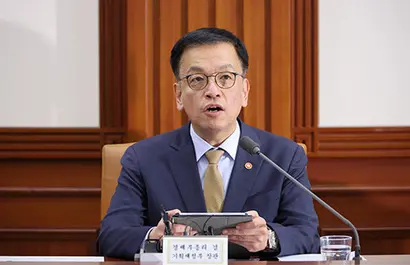
At a "Macroeconomic and Financial Issues Meeting" held at the Korea Federation of Banks on the 10th, Deputy Prime Minister Choi noted, "Compared to the robust fundamentals and external soundness of our economy, there is an aspect of overreaction." In particular, he emphasized that there is sufficient capacity to respond, highlighting foreign exchange reserves—the ninth largest in the world—in response to exchange rate instability caused by the exit of foreign investors. On the 18th, he held a joint foreign media briefing with the Minister of Foreign Affairs at the Press Center, stating, "We will prioritize managing external credibility, continue to operate a 24-hour monitoring system for financial and foreign exchange markets, strengthen incentives for foreign investment, and increase the international community's understanding of Korea's robust economic fundamentals through briefings on the Korean economy."
Deputy Prime Minister Choi’s emphasis on "robust fundamentals" stems from the judgment that the current movements in the financial market are excessively unstable compared to the actual state of the Korean economy. In fact, looking at the country's external soundness indicators, the situation is relatively stable compared to past crises.
Looking at the first quarter of 1997, when the country was heading toward national bankruptcy during the Asian Financial Crisis, foreign exchange reserves stood at $29.1 billion, while external debt reached $153 billion. Among this external debt, short-term debt was $74.2 billion, meaning the short-term external debt ratio hit a staggering 48.5%. The ratio of short-term debt to foreign exchange reserves was also 351.0%. It was a situation where the country lacked the capacity to pay off debts that were rapidly reaching maturity.
As a result, national credit ratings assessed by the world’s three major credit rating agencies plummeted. Moody’s downgraded South Korea’s credit rating from A1 to A3 in November 1997, followed by consecutive downgrades to Baa2 and Ba1 in December. S&P lowered the rating from AA- to A+ in October 1997, then to A- in November. Subsequently, it downgraded it to BBB- and B+ in December. Fitch also lowered its credit rating from A+ to A in November 1997, and then consecutively to BBB- and B- in December.
In 2008, when the global financial crisis erupted, foreign exchange reserves had increased, but concerns were raised due to the high proportion of short-term debt within total external debt. Foreign exchange reserves in the fourth quarter of 2008 were $201.2 billion, about seven times higher than during the 1997 crisis. However, the proportion of short-term debt in total external debt was 47.2%, exceeding the 30% range that had been maintained after the national bankruptcy crisis. Also, the ratio of short-term debt to foreign exchange reserves was 74.0%, which was higher than the previous 30-40% range. While this raised fears of a recurrence of the financial crisis, a currency swap agreement with the United States thankfully prevented it from escalating into a full-blown crisis. Thanks to this, the credit ratings of the three major agencies were maintained without change.
During the first quarter of 2020, when the economic damage from COVID-19 began in earnest, the proportion of short-term debt once again became an issue. Foreign exchange reserves stood at $400.2 billion, twice the amount during the global financial crisis. However, as short-term debt increased, the proportion of short-term debt in total external debt rose from 28.8% in the fourth quarter of 2019 to 30.9% in the first quarter of 2020. The ratio of short-term debt to foreign exchange reserves also increased from 33.1% to 38.0% during the same period. However, even then, the issue was resolved without major incident, thanks in part to a currency swap with the U.S., and the credit ratings of the three major agencies remained intact.
The current situation, marked by President Yoon Suk Yeol’s emergency martial law and the impeachment crisis, shows external soundness indicators that are somewhat better than during past crises. As of the end of November, foreign exchange reserves stood at $415.4 billion, and the proportion of short-term debt in total external debt was only 22.6% as of the third quarter. The ratio of short-term debt to foreign exchange reserves is also being maintained at 37.8%, which is low compared to the past.
An official from the economic sector pointed out, "Current external soundness indicators are better compared to past crises, but if political chaos is prolonged due to partisan fighting over President Yoon’s impeachment, foreign investors’ anxiety could increase, potentially causing the exchange rate to soar further. Additionally, the economic growth forecast, which has already fallen to the mid-1% range, could drop to the 0% range, causing the economy to deteriorate rapidly."