

[비즈한국] Amid global delays in the supply of fighter jet engines, South Korea's defense industry has thrown its hat into the ring for the localization of aircraft engines. Domestic companies with engine technology, such as Hanwha Aerospace012450 and Doosan Enerbility034020, are expected to jump into aircraft engine development in line with the Defense Acquisition Program Administration's (DAPA) roadmap for advanced aircraft engines. Successful engine development would allow for diverse military and civilian applications, while also easing supply chain concerns and fostering a robust engine industry ecosystem.
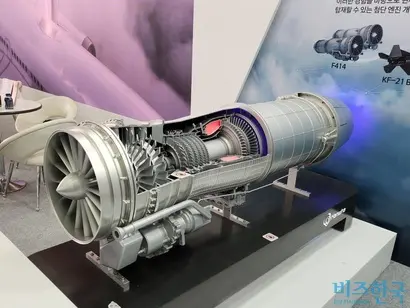
According to DAPA, the aircraft engine roadmap, currently targeted for completion next year, is known to encompass an overall development plan including technological levels, project direction, and strategies for securing currently unavailable technologies, by gathering opinions from the Agency for Defense Development (ADD), the defense industry, and experts.
DAPA previously announced a plan to develop a 15,000-pound (lbf) thrust-class aircraft engine by 2030. This is at a similar level to the F414-400 engine from U.S.-based General Electric (GE), which is used in the "Korean Fighter" KF-21 scheduled for mass production in 2026. The goal is reportedly to create an engine that, while similar in thrust, improves fuel efficiency by 10–15%. Furthermore, DAPA also plans to push for the simultaneous development of a 10,000 lbf-class engine for unmanned aerial vehicles (UAVs) to achieve the implementation of 6th-generation fighter concepts—currently being developed by advanced nations like the U.S., Russia, and Europe—using domestic technology.
Following the announcement of the aircraft engine roadmap, a feasibility study for the aircraft engine development project will commence. If passed, subsequent procedures will follow, including project approval and budget allocation through the Defense Acquisition Program Promotion Committee. DAPA is reportedly considering both independent development through domestic technology and joint development with leading overseas companies.
Currently, all engines powering the manned and unmanned aircraft in the South Korean military's fleet are foreign-made. Even the supersonic advanced trainer T-50 and the light fighter FA-50, developed by South Korea, use GE's F404 engine. The KT-1, developed before the T-50, utilized the PT6A-62 turboprop engine from Pratt & Whitney (P&W) of the U.S. The KF-21 also uses GE's F414-400 engine. Although Hanwha Aerospace produces the KF-21 engine under license from GE, it is by no means an engine developed by Korea.
Aircraft engine manufacturers like GE have recently been facing supply chain setbacks, such as delaying engine deliveries. This fall, the delivery of fighter jet engines to the Indian Air Force was postponed by more than two years, and deliveries of aircraft engines to South Korea are also being delayed.
Attention is focused on which company will take charge of the "system integration" of the aircraft engine. The system integrator manages all processes, including system design, development, production, testing, and integration. They also engage in direct communication with ordering agencies like the Ministry of National Defense and DAPA, participating in key decision-making.
Companies with engine technology, such as Hanwha Aerospace and Doosan Enerbility, are expected to participate in the development of the 15,000 lbf-class domestic aircraft engine. Hanwha Aerospace is embarking on independent development using its know-how from having built over 10,000 engines, including those for guided missiles, aircraft auxiliary power units, and the F414. Hanwha Aero is currently focusing on material research, having already developed 17 out of the approximately 64 types of materials required for independent development of advanced engines.
Doosan Enerbility is the fifth company in the world to successfully develop power-generation gas turbines independently. The company plans to leverage its experience with gas turbines, which share similar technological foundations and operating principles with aircraft engines. At its regular shareholders' meeting in March this year, Doosan Enerbility added "manufacturing, maintenance, sales, and service of aircraft engines and various engine/propulsion system auxiliary parts" to its articles of incorporation, officially launching its aircraft engine business. Additionally, in December, it signed a memorandum of understanding (MOU) with Korea Aerospace Industries (KAI) to develop a 15,000 lbf-class engine for manned and unmanned aircraft.
Experts emphasize that the development of domestic aircraft engines is essential for "securing superiority in air power" and for the "derivation potential of engines." Currently, only five countries—the U.S., the U.K., France, Russia, and China—possess the technology to build engines for fighter jets.
Military engines can also be used for civilian aircraft. The CFM56 engine, used in civil aviation, was derived from the F101 developed by GE. Developed by CFM International, a joint venture between GE and France's Safran, it is a turbofan jet engine used in B737 and A320 aircraft as well as military transport planes. An industry insider explained, "Recently, not only military aircraft engine deliveries but also those for civilian airliners are being delayed. The global supply chain is facing increasing setbacks due to unstable raw material procurement and parts supply delays. If localization is successful, it could foster an industrial ecosystem by creating various engine-related companies, so urgent localization is required."