

[비즈한국] The 'era of defense robots' is rapidly approaching. Starting with the completion of the 'Multi-Legged Robot for Counter-Terrorism Operations' project—built entirely with domestic technology—this year, and followed by the scheduled completion of the multi-mission multi-legged robot platform project next year, the military is expected to begin utilizing AI robots in earnest.
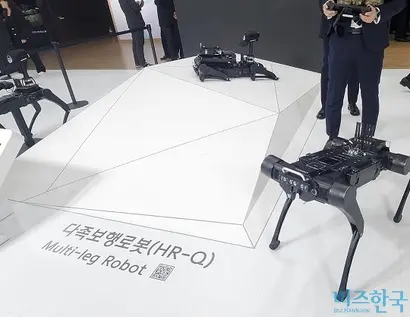
Domestic defense companies are accelerating the development of unmanned robotic systems to prepare for an increasingly realistic future battlefield. According to the Defense Acquisition Program Administration, the development of the multi-legged walking robot for counter-terrorism operations was completed in August of this year, and it has been deployed to the Army for trial operations. This rapid demonstration project, which began in August 2022, was managed primarily by the Defense Rapid Acquisition Technology Institute and involved companies such as Hyundai Rotem and Rainbow Robotics277810, with support from the Army.
The robot can move on four legs at a speed of over 4 km/h and overcome vertical obstacles such as stairs taller than 20 cm. It can attach and detach various equipment, including day/night cameras and remote-controlled pistols, allowing it to perform surveillance, reconnaissance, and combat missions. The military plans to deploy these robots to the Army Special Warfare Command and one frontline division for six months to verify their performance and military utility before deciding on full-scale adoption.
In December of next year, the technology for a multi-mission multi-legged robot platform is also scheduled to be completed. This project is managed by the Defense Industry Technology Center, with participation from companies including Hyundai Rotem. This robot is capable of remote walking, remote driving, autonomous driving, and towing.
In addition, the remote unmannedization of existing maneuver weapon systems is also underway. The K1 tank remote unmanned technology, developed with Hyundai Rotem selected as the lead research and development agency, involves creating an operator-assistance system that applies real-time fire control technology to enable remote operation and reduce the risk of safety accidents. Hyundai Rotem has been leasing K1 tanks from the Army since July last year to conduct system integration and performance testing, and is proposing a project to apply the secured technology to K1-series tanks for unmanned operation. Ha Tae-jun, a lead researcher at Hyundai Rotem, said, "It would take a long time to develop the K1 tank into a fully unmanned system, so we first transitioned it to a remote-controlled method for development."
LIG Nex1079550 is also busy working to secure a leading position in drones and robots in preparation for the future unmanned battlefield era. Through the completion of its acquisition of Ghost Robotics in July this year, it is full-scale entering the robotics business. Ghost Robotics is already supplying robots to the U.S. Department of Defense and the Department of Homeland Security.
Due to the rapid changes in future combat and security environments, defense-leading nations such as the U.S., China, and Russia are intensifying competition by focusing on the development of AI and defense robots. The U.S. has led research into AI, robotics, and autonomous driving through the Defense Advanced Research Projects Agency (DARPA). Silicon Valley's big tech companies are also participating in these efforts. The U.S. Army is pursuing a 'Defense Robot Project' to develop unmanned attack vehicles capable of ground operations, as well as robotic engineering units for explosive ordnance disposal or the construction of defensive facilities.
China is also in hot pursuit. Through the Academy of Military Sciences (AMS), a research institution of the People's Liberation Army (PLA) similar to DARPA, it has developed a military AI model called 'ChatBIT.' Israel is currently using the 'Lavender program' to identify attack targets via AI systems in the Gaza Strip and is actively deploying unmanned robots for dangerous combat missions.
Compared to the U.S. and China, South Korea has relatively fewer big tech companies, and the military's pace has been somewhat slower. Experts emphasize the urgent need to develop defense robots and apply them to the military. Cha Do-wan, a professor at the Korea National Defense University's Department of Defense AI and Robotics, predicted, "The purpose of war will continue to evolve toward achieving the maximum effect with the minimum effort, and in terms of means, it is shifting toward scientification and unmanned operation. Just as countries are currently divided into those with nuclear weapons and those without, future battlefields will be divided into countries that possess defense robots and those that do not."