

[비즈한국] During the post-World War II era, while the chill of the Cold War still lingered, people were perpetually anxious that an enemy spy plane might pass overhead at any moment. This unease made people look up at the sky more often, and reports of UFO sightings began to flood in during this period. As the craze for UFO stories grew and rumors spread about aliens visiting Earth in spacecraft, serious astronomers also prepared a massive project to search for signals from extraterrestrial civilizations. Frank Drake, a radio astronomer famous for the Drake equation, and Carl Sagan, who spent his life researching the possibility of extraterrestrial life, teamed up to launch SETI, a project dedicated to finding signals from intelligent alien life.
Originally, SETI was not called SETI, but CETI, with the 'C' standing for 'Communication.' The name was filled with the ambitious hope of engaging in direct communication with intelligent alien life. It was also a bit of a pun. 'Ceti' is also the name for a whale; at the time, Carl Sagan believed that studying how whales communicate would make it possible to exchange signals with aliens. However, 'Communication' was a premature dream. Eventually, the first letter was changed from 'C' to 'S,' shifting the focus toward the more passive approach of simply capturing signals coming from space.
Unfortunately, the original SETI project, which began in 1985, ultimately failed. It yielded no results, and the mission has since concluded. However, the expectation that humanity might one day discover signals from an alien civilization has not been crushed. Astronomers following in the footsteps of SETI are now conducting even grander new projects. Through the Breakthrough Listen project, they are using radio telescopes spread across the globe to wait for various radio signals arriving on Earth.
Proxima Centauri, located 4.2 light-years away as our closest neighbor outside the solar system, is a red dwarf that is much dimmer than our Sun. In 2016, astronomers discovered an exoplanet orbiting this star. This planet is situated at a proper distance from its host star, putting it in the 'Goldilocks zone'—a habitable zone where liquid water could exist in oceans on the planet's surface. If luck is on our side, it might have oceans like Earth and could even host life.
However, there are opposing views suggesting that life on this Proxima Centauri planet would be difficult. Since the star itself is dim, the planet must be quite close to the star to maintain a sufficiently warm temperature. This planet is only 0.05 AU away from its host star—just 5% of the distance between the Earth and the Sun! Its orbital period, or the length of a year, is a mere 11 Earth days. While the temperature might be suitable, its extreme proximity to the star means it could be severely exposed to powerful stellar winds and radiation emitted from the star's surface. Therefore, the environment could actually be hostile to life.
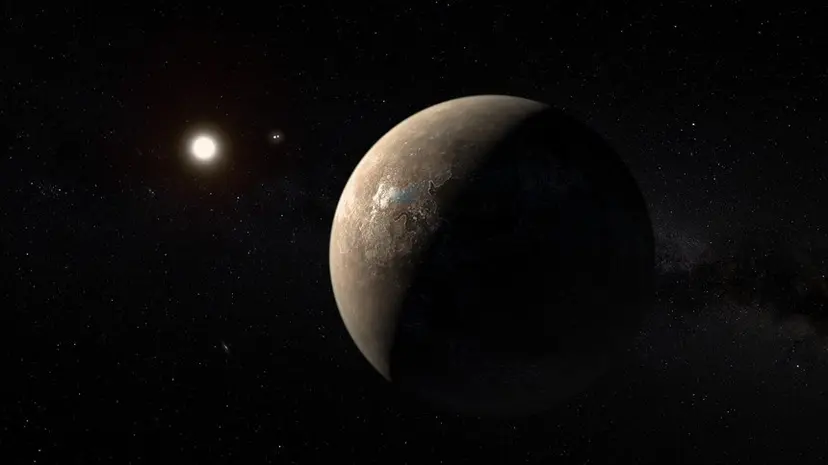
Nevertheless, the Proxima Centauri planet is garnering significant attention precisely because it is a planet in a habitable zone belonging to the very next star over. Compared to exoplanets hundreds or thousands of light-years away, it is much closer, and with some luck, it is a candidate planet that future generations of humanity might attempt to visit.
The Breakthrough Listen project differs in philosophy from the way astronomers typically look for alien life. Usually, astronomers search for 'biosignatures,' which are traces of life on exoplanets. They detect atmospheric molecules in an exoplanet's atmosphere—such as water, oxygen, carbon dioxide, and methane—that are presumed to be the results of biological activity. The James Webb Space Telescope, which is actively observing exoplanets, does the same. In contrast, SETI and Breakthrough Listen go a step further, beyond biological activity, to search for 'technosignatures.' This involves looking for signs of technological traces that should be visible if an intelligent civilization exists. Astronomers hope that alien civilizations, like our own, are also radio-based civilizations that communicate using the fastest thing in the universe: light and radio waves. Therefore, if a highly advanced civilization exists on a planet, we might be able to eavesdrop on the radio signals leaking out from that planet.
For Breakthrough Listen, massive radio telescopes installed across the globe have been mobilized. Among them, the Green Bank Telescope in West Virginia, USA, is where Drake first attempted to find aliens via radio signals in his youth. In the Southern Hemisphere, there is the Parkes radio telescope in Australia and the MeerKAT radio telescope in South Africa. In 2019, astronomers discovered an unusual radio signal coming from the sky near Proxima Centauri.
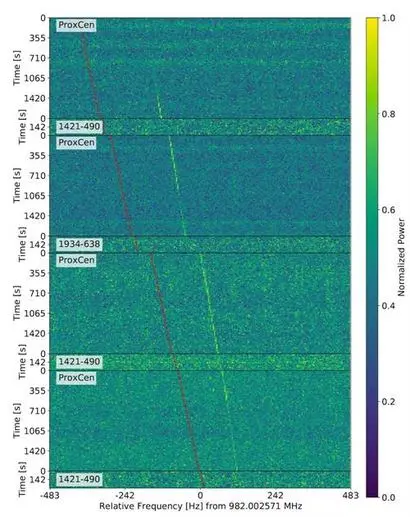
There are several key criteria for distinguishing whether a signal is a common, natural one or something that could be suspected as an artificial civilization. General natural signals are distributed smoothly across a wide frequency band. If a signal arrives strongly within a very narrow, specific frequency range, it can be suspected of being a radio signal intentionally sent by someone.
Furthermore, there is a high probability that an alien civilization would also live on a planet orbiting a star. Therefore, from Earth's perspective, that planet would move closer and further away. This movement of the planet itself creates a Doppler effect, which causes the wavelength of the radio signals emitted from the planet to shorten and lengthen. Thus, if a signal arriving strongly in a narrow frequency band shows a periodic Doppler effect, it can be suspected of being a radio signal coming from a planet orbiting a star. In 2019, a signal that met both of these conditions was captured from the sky toward Proxima Centauri.
Unlike the famous 'Wow! signal,' which excited astronomers and science fiction fans alike when it arrived for 72 seconds on August 15, 1977, and then vanished, this signal was captured continuously for nearly 30 hours. The area from which the signal originated was about half the size of a full moon in the sky toward Proxima Centauri. Astronomers assigned this interesting signal the serial number BLC 1 (Breakthrough Listen Candidate 1), meaning it was the first candidate captured by Breakthrough Listen. And until recently, many media outlets cited BLC 1, leading to somewhat exaggerated reports that astronomers had discovered an alien signal.

Unfortunately, however, further analysis led astronomers to conclude that BLC 1 was not from deep space but rather caused by radio interference originating here on Earth. There is a simple way to verify if this signal truly came from Proxima Centauri: compare whether the signal is captured the same way when the radio telescope is pointed slightly in a different direction. If the signal were truly a radio transmission from a specific star, it should not be received when the star is out of the telescope's field of view.
As a result of follow-up observations of BLC 1, a total of 30 signals showing similar frequencies and patterns were found in other directions of the sky. This meant that BLC 1 certainly did not originate from the star Proxima Centauri, but was a radio signal emitted somewhere on Earth that had scattered and spread through the Earth's atmosphere.
Furthermore, a close analysis of the signal's shape revealed a phenomenon known as a 'frequency comb,' where sharp, strong signals are observed across multiple narrow frequency bands. The name comes from the fact that, when plotted on a graph, the thin, sharp signals at various frequency positions resemble a comb. This is a very common phenomenon found when radio waves interfere with the Earth's atmosphere. So, who is the real culprit that caused the BLC 1 signal that once excited astronomers?
The exact culprit has not yet been identified. Astronomers examined every possibility—errors in the telescope equipment itself, interference by an airplane or satellite that coincidentally passed through the same part of the sky, or leakage from a deep-space probe—but could not find a signal that perfectly matched the shape of BLC 1. Instead, astronomers speculate that there is some radio source near the Parkes Observatory in Australia, where BLC 1 was captured, that emits periodic radio signals. It could be a signal from a nearby broadcasting station or a military base.
Interestingly, the Parkes Observatory, which captured the BLC 1 signal, has a famous 'dark history' that is often talked about in the astronomical community. Since 1998, astronomers at the Parkes Observatory had been catching strong, narrow-band signals at random intervals. At one point, they were hopeful that these were signals being sent by aliens. This signal, which defied explanation at the time, was named the 'Peryton signal' after a mythical monster. However, the identity of the signal, which remained a mystery for nearly 10 years, turned out to be quite anticlimactic: it was radio waves leaking out from a microwave oven used by astronomers working at the observatory. Being hungry, they would open the door in a hurry before the microwave timer had finished, causing some unshielded radio waves to escape and be captured directly by the giant radio telescope.
Looking at these repeated dark chapters, perhaps we are cluttering Earth's skies with too much radio noise. If aliens living tens or hundreds of light-years away were truly sending us a signal, it would have weakened significantly during its long journey. It might be buried deep within the much stronger radio noise generated by Earthlings, making it impossible for us to detect. Perhaps we have already become too advanced to easily find signals from aliens.
The biggest problem with BLC 1 is that after it was first discovered, it was never captured again in follow-up observations. After the signal came in steadily for about 30 hours at the start, it has not been confirmed since. It is a pity, but the dream of Drake and Carl Sagan has yet to be fully realized. Looking at the quiet night sky with no news to be found, we must wait yet again for another interesting signal to arrive.
References
https://www.nature.com/articles/s41550-021-01508-8
Who is the author, Woong-bae Ji? He loves cats and the universe. After watching 'Galaxy Express 999' as a child, he dreamed of sharing the beauty of the universe. Currently, he researches galaxy evolution through galaxy interactions at the Yonsei University Galaxy Evolution Research Center and the Near-Field Cosmology Laboratory. He is also active in science communication, including lectures and writing. He is the author of books such as 'The Observatory for썸,' 'Thinking About the Universe All Day,' and 'Stars, the Science of Light.'