

[비즈한국] University professors across the country have chosen "Doryang-Balho" (跳梁跋扈) as the idiom representing this year. It means "to act recklessly while wielding power arbitrarily." The aftermath of this "Doryang-Balho" politics on the public seems greater than expected. This is because a dark cloud is looming over the domestic economy due to the impeachment crisis following the December 3 emergency martial law situation.
The KRW/USD exchange rate climbed to 1,453.1 won during intraday trading on the 19th, surpassing the 1,450 won mark for the first time in 15 years and 9 months since March 2009, during the global financial crisis. As the exchange rate breaks through 1,450 won, companies are also feeling the tension. There are even rumors that some foreign companies that intended to invest in domestic talent and infrastructure have put their plans on hold entirely.
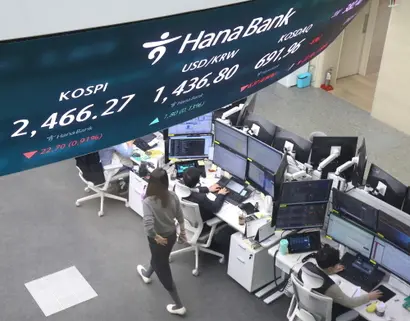
Due to political risks, the prospect of additional interest rate cuts in the first half of next year is also increasing. At last month's Monetary Policy Committee meeting, the Bank of Korea projected a growth rate of 1.9% for next year and 1.8% for the following year, presenting a path that remains below the potential growth rate until 2026; it is evaluated that they have clearly outlined the path for interest rate cuts. Kim Ji-na, a researcher at Eugene Investment & Securities001200, said, "Although it is true that the Monetary Policy Committee's options have narrowed due to recent adjustments in the Fed's rate-cut path and the burden of a high exchange rate, domestic conditions are too complex to hesitate on cuts just by looking at external circumstances."
Experts predict that a high exchange rate will persist for a significant period due to domestic political uncertainty. Experts who previously expected a range of 1,350–1,400 won for the first half of next year are now forecasting that the "1,400 won level will persist." However, they expect the exchange rate to gradually stabilize as political uncertainty is resolved. Moon Da-woon, a researcher at Korea Investment & Securities, predicted, "In addition to political instability, concerns over the weakening of our negotiating power due to the absence of leadership in our government at the start of the Trump administration will act as inherent downward pressure on the won," adding, "As we approach the end of the first quarter (of next year), it will gradually ease along with the orderly resolution of political instability."
For investors focused on domestic stocks rather than dollars, it is only natural to feel fear regarding the rising exchange rate. Kim Byung-yeon, a researcher at NH Investment & Securities005940, said, "The key driver of the KOSPI is the KRW/USD exchange rate," and added, "Policy authorities are struggling as if walking a tightrope." Researcher Kim predicted, "If it approaches 1,500 won in the short term, stock prices will see a spike, but it won't last long."
In particular, bank stocks are one of the sectors heavily affected by the rise in the exchange rate; if the rate rises, bank capital ratios can fall, imposing a financial burden. Choi Jung-wook, a researcher at Hana Securities, estimated, "As the KRW/USD exchange rate becomes entrenched in the 1,430–1,440 won range, a negative impact on bank capital ratios and earnings is inevitable. The exchange rate has risen by more than 130 won in this quarter alone, and given that Hana Financial Group and Industrial Bank of Korea024110 incur foreign currency translation losses of about 8 to 9 billion won for every 10 won rise, foreign currency translation losses of about 100 to 120 billion won will occur in the fourth quarter based on the current exchange rate." Researcher Choi further predicted, "If the KRW/USD exchange rate continues to remain high, it will inevitably act as a burden on the banking sector," adding, "Ultimately, a meaningful rebound in bank stocks will only be possible when the KRW/USD exchange rate stabilizes."
Just two years ago, people were debating whether they should invest in dollars during the 1,300 won exchange rate era, but now it has become a time to worry about breaking through 1,500 won. Because of this, it is said that more investors are taking an interest in dollar insurance or dollar ETFs. However, in the case of dollar insurance, it is not efficient for the purpose of "currency-tech" (FX investment) because the burden increases when paying premiums as the exchange rate rises, and losses can be incurred if the exchange rate falls when receiving insurance payouts.
Experts say "crisis is opportunity." Investment is like a marathon. From a long-term perspective, diversified investment is essential. Researcher Kim Byung-yeon said, "Responding at the index level might be difficult, but it is different for individual stocks," adding, "It is possible to buy in installments while focusing on policy momentum by country."