

[비즈한국] Portugal has recently initiated a move to acquire small multi-purpose submarines to strengthen its maritime security. It is expected that Korea's special vessel companies, Hanwha Ocean042660 and HD Hyundai Heavy Industries329180, will participate in the bidding for this project.
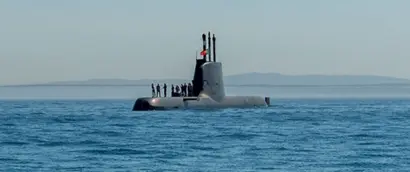
According to foreign media such as Naval News and the Portuguese Navy, Portugal is pushing to introduce two submarines with a displacement of under 1,000 tons. The budget for submarine operations is set at 470 billion won, with plans to introduce them by 2030. The operating budget is reportedly being arranged under the Military Programming Law (LPM).
Portugal's goal in acquiring these submarines is to strengthen its defense and surveillance capabilities for key Atlantic maritime transport routes. They are intended to be deployed primarily for missions linked to NATO, while also being utilized for reconnaissance activities within Portuguese waters.
Located at the edge of the European continent, Portugal oversees a 1.7 million km² maritime zone, including the archipelagos of Madeira and the Azores in the Atlantic Ocean. Its strategic importance is particularly highlighted by its position as a midpoint between Europe and the United States.
One of the main reasons for introducing new submarines is to overcome physical operational limitations. Currently, the Portuguese Navy operates the Tridente-class submarines, Tridente and Arpao, introduced in 2010 and 2011, respectively. Operational activities are constrained because if one vessel enters maintenance, the navy must rely entirely on the other.
Admiral Henrique Gouveia e Melo, Chief of Staff of the Portuguese Navy (CEMA), argued, “If we Portuguese, who possess the Azores, do not actively participate in protecting data, cargo transport, and maritime communication lines, we could diminish our own strategic value within the (NATO) alliance.”
NATO, of which Portugal is a member, is facing threats from Russia and China. Concerns have grown over the need to strengthen maritime security following suspected sabotage of key infrastructure, such as the recent damage to undersea communication cables in the Baltic Sea by Chinese and Russian vessels. Additionally, the Russian vessel Yantar is known to have spent long periods in Portuguese waters and the Mediterranean, where it could be deployed not only for cable cutting but also for the installation of wiretapping devices and other special operations.
It is reported that HD Hyundai Heavy Industries and Hanwha Ocean are closely reviewing the Portuguese submarine acquisition project.
Hanwha Ocean and HD Hyundai Heavy Industries, which have been embroiled in a rivalry over the Korean Next-Generation Destroyer (KDDX) project, recently announced they would form a "One Team" to challenge overseas warship projects. During the 2024 Defense Industry CEO Meeting held at the Conrad Hotel in Yeouido, Seoul, on December 17, Eo Sung-chul, Head of Hanwha Ocean's Special Ship Business Division (CEO), emphasized, "We have a high interest in and will actively pursue 'One Team' cooperation with HD Hyundai Heavy Industries for overseas projects." In response, Joo Won-ho, Representative of HD Hyundai Heavy Industries' Special Ship Business Division (Vice President), also echoed this sentiment regarding defense exports, stating, "We should act as a 'One Team' and work well together."
Hanwha Ocean has accumulated long-term technical expertise and shipbuilding capabilities based on its record of submarine exports. HD Hyundai Heavy Industries possesses the technology to develop and build submarines of various sizes. However, both companies suffered setbacks when they participated individually in the Australian government's new frigate acquisition project. Despite their superior price competitiveness, they were defeated by Germany and Japan, whose companies and governments formed "One Teams" to wage an all-out effort.
Analysts suggest that the "One Team" strategy could further strengthen cost competitiveness. Even in the Australian frigate bid, Hanwha Ocean and HD Hyundai were evaluated as having superior price competitiveness and being on par in terms of technology. An industry official explained, "If HD Hyundai and Hanwha Ocean form a 'One Team' and cooperate in areas where they each have strengths, there will be positive factors in terms of cost competitiveness. If we export submarines to NATO through the Portuguese submarine bid, we will demonstrate competitiveness in the future European submarine market as well."