

[비즈한국] My office in Berlin is located in a co-working space within a massive industrial park that houses about 140 startups, large corporations, research institutes, and public institutions. On December 3rd, around 3:00 PM to 4:00 PM German time, colleagues started visiting my office one by one to ask if my family in Korea was safe. They had seen breaking news that "martial law (Kriegsrecht)" had been declared in Korea. I wasn't familiar with the word "Kriegsrecht" at the time, but since I knew "Krieg" meant war and "Recht" meant law, I knew something major had happened. I immediately checked Korean news outlets and major German media websites to see what was unfolding in Korea.

Major German media outlets were all simultaneously reporting that the South Korean president had declared "martial law," and live footage showed soldiers storming the National Assembly. From that moment on, for about two weeks, I couldn't take my eyes off the news from Korea. It was hard to find peace of mind. Surely, everyone felt the same way in such an unreal situation.
Aside from learning the German word for martial law (Kriegsrecht), picking up terms related to the National Assembly and the Constitution, and realizing that Korea's civic consciousness is more advanced than any other country, the time was filled with cycles of anger, despondency, helplessness, and boiling rage.
By the way, "Yoon" also gained something in Germany. He etched his name into the minds of Germans as a dictator figure, just as much as "Kim Yong-un" (the German pronunciation for Kim Jong-un) in the North (actually, it's four syllables; Germans read it as "Yoon Seok Yeol").
In this climate, it's difficult to write an article promoting innovation and startup activities in Europe. I've been worried about my family and friends in Korea, constantly fearing that a terrifying situation where fundamental human rights are suppressed might return. At the same time, I’ve been contemplating what I can do from here. In the midst of this, what helped me most were the scenes of protests in Korea that I saw on YouTube. I only now realized that Girls' Generation's "Into the New World" has such poetic lyrics, and I felt that through the new generation, society is moving forward slowly but steadily.
Trying hard to believe that crises of democracy or social conflict can sometimes be the starting point for new innovation, I searched for what kind of political tools might help such innovation.
'Civic Tech': Daily Technology for Citizens
In Europe, there has been a movement for years called "Civic Tech"—the use of technology for citizen participation and the resolution of public issues. Civic tech refers to technical solutions that help citizens access and participate in government, public institutions, or social issues more easily. With the development of the internet and digital technology since the early 2000s, the concept of "digital democracy" has evolved, and there have been movements to allow citizens easier access to data through the open data movement.
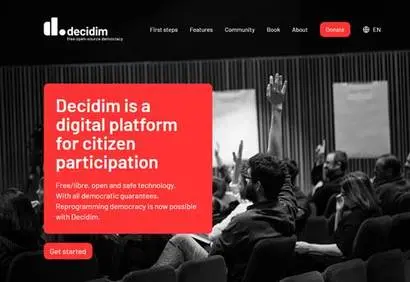
There are cases that have become meaningful technological innovations for society, even without being turned into a startup or company. Spain’s "Decidim" is a prime example of civic tech.
Decidim is a citizen participation platform developed by the city of Barcelona that allows citizens to directly present their opinions and participate in discussions during the policy-making process. Citizens can register their ideas about policies, discuss them with others, and move them toward a vote. Its core functions involve gathering citizen proposals and evaluating policies in key city planning processes, such as the Municipal Action Plan (PAM) and District Action Plan (PAD). Unlike existing inefficient methods of collecting opinions, it is evaluated as having secured trust through a transparent and fair system. It has garnered so much attention that cities like Helsinki in Finland, Kakogawa in Japan, and New York in the US have benchmarked it.
Just as it was in the process of lifting martial law in Korea, whether members of the National Assembly attended the session and where they cast their votes—whether in favor or against—is a matter of concern for all citizens. The technology of VoteWatch Europe, an NGO established in Brussels, Belgium, is a platform that provides attendance and voting information for members of the European Parliament and the Council of the EU.
VoteWatch Europe collects and analyzes the voting records of EU Council members and Members of the European Parliament (MEPs), providing them in graphic and statistical formats. This data is useful for citizens, journalists, NGOs, and stakeholders to transparently understand the EU policy-making process and grasp the policy positions of political groups and national representatives.
VoteWatch Europe operated from 2008 to 2022, collecting and analyzing voting data from the European Parliament and the Council of the EU. This data is still publicly available for research and analysis purposes. The project was led by a team headed by Professor Simon Hix at the European University Institute (EUI), a higher education institution jointly established by EU member states.
'Fact Check' Technology: The War Against Fake News
When political turmoil occurs, misinformation and fake news abound. In Europe, there are startups that provide fact-checking and information verification technology to solve these problems.
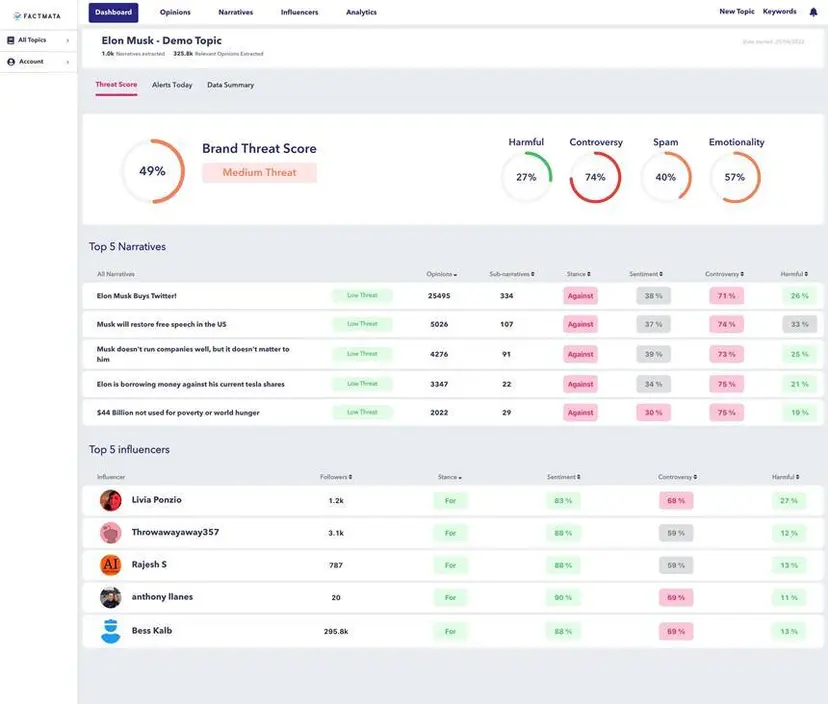
The UK's Factmata provides services that use AI to analyze online information and detect fake news. Factmata is a platform that combines natural language processing (NLP) technology with expert communities to address issues like untrustworthy online content, fake news, and hate speech.
Millions of pieces of content are created on the internet every day, but much of it is biased or misleading. To solve this, Factmata uses AI technology to automatically detect and classify harmful or untrustworthy content. In particular, it is continuously building training datasets where 24 expert communities and over 2,000 journalists and researchers train AI algorithms. In this process, content receives a credibility rating and is comprehensively analyzed through nine signals, including toxicity level, political bias, and clickbait status.
Factmata was acquired by the US-based PR media company CISION in November 2022. Cision is a traditional PR company with about 100,000 clients and plans to bolster its AI-based automation tools by acquiring not only Factmata’s IPQ but also all 7 of its employees, including CEO Antony Cousins.
The British startup Logically is also fighting harmful and problematic online fake news and misinformation by combining AI with human expertise. Founded in London in 2017, Logically now has offices in the US and India. It primarily analyzes news articles and social media posts to evaluate credibility and identify fake news. It works with government ministries regarding national security and public sectors, and provides solutions to protect corporate brand value, boasting various companies as clients.
Government Innovation and Cooperation: Europe's 'GovTech' Trend
To overcome political turmoil, it is also important to increase the administrative efficiency of the government. "GovTech," where artificial intelligence and ICT technology are incorporated into public administrative work, is a global buzzword.
The fact that the martial law situation in Korea ended without major bloodshed was thanks to the fact that we live in the era of YouTube and smartphones. The fact that everyone was in disbelief, thinking, "In 2024, this kind of thing?", suggests that there was that much of a gap between the lives of ordinary citizens and the people leading the country. This is likely why the way the state collects taxes, provides public services, distributes welfare, and maintains safety still falls far short of the current level of digitalization. Citizens are very accustomed to consumer app experiences using Uber, KakaoBank, and Google. Naturally, there is bound to be fundamental questioning regarding the way public services are provided.
According to a 2018 report by the consulting firm Accenture, about $400 billion (575 trillion won) has been invested in the GovTech sector. In Europe, 22 billion euros (33 trillion won) is invested in GovTech every year, a significant portion of which is spent on cutting-edge technology.
Denmark’s NemKonto and NemID are important examples of GovTech. These two are core digital systems introduced by the Danish government to streamline digital administration, and 95% of the total population uses them. NemKonto is a standardized bank account system used by the Danish government and public institutions when transferring payments to individuals or companies; all public payments such as tax refunds, subsidies, pensions, salaries, and unemployment benefits are automatically paid through NemKonto. It is highly convenient because one only needs to designate an existing account as their NemKonto.

NemID is a digital identity authentication system that supports secure logins to online services or digital signatures. Since 2022, MitID, the successor system to NemID, has been introduced to provide a higher level of security. NemKonto and NemID were already introduced in 2005 and can be considered the original versions of GovTech.
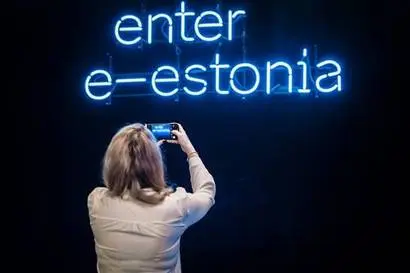
Estonia has built a highly advanced e-government infrastructure that provides almost all public services through a blockchain-based identification system. Estonia is considered the gold standard for the best-digitized government.
In Europe, the EU has stepped up to foster GovTech startups that cooperate with each government to digitize public services. In particular, the European Interoperability Act (IEA), which came into effect in April 2024, is promoting technological cooperation between various governments. To this end, the EU launched the GovTech Connect project to strengthen cooperation between SMEs and public/private institutions and accelerate innovation. In addition, 26 organizations from 18 countries are participating in the GovTech4All project to conduct pilot projects such as data sharing, personal regulatory assistance tools, and innovative procurement.
I considered ending this column with a hopeful remark that "political turmoil causes social anxiety, but can also be a new opportunity for technological innovation." However, I still feel uneasy about whether the impeachment will be upheld or rejected. I even feel cynical, wondering if an AI could have provided a precise result in a day. Through the cases of European Civic Tech and GovTech, I briefly imagined whether political innovation could also be possible.
Anyway, I have no choice but to hum the song that says, "I won't wait for a special miracle," and "The rough road ahead is an unknown future and a wall, but I won't change, I can't give up." Consoling myself with the thought that the tragedy of 80 years ago did not repeat itself thanks to the smartphone that everyone possesses, I only hope that technology goes beyond being a mere tool to become an important means of strengthening democracy and mitigating social conflict.
The author, Lee Eun-seo, majored in Law in Korea and studied theater in Berlin. Based in Berlin, a city of art and a European startup hub, she leads 123factory, bridging the startup ecosystems of Korea and Germany while growing alongside the city.