

[비즈한국] The financial sector is accelerating the adoption of generative AI. With the government actively supporting the use of generative AI in finance, the industry is moving quickly. Following the Financial Services Commission's announcement in August of a "Roadmap for Improving Network Separation in the Financial Sector" to allow financial companies to use "commercial AI" provided by external firms, the commission unveiled specific support measures on the 12th. As some proactive financial firms begin to roll out services utilizing generative AI, attention is turning to both the prospects and the limitations of this technology.
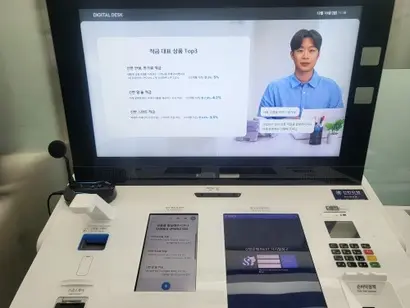
Shinhan Bank is one of the financial institutions leading the way in AI adoption. It has been deploying AI bank tellers at unmanned branches since September 2021, three years ago. Recently, Shinhan Bank revamped its testbed branch in Seosomun into an "AI Branch." The AI bank teller here is a generative AI powered by a large language model (LLM) developed in-house by Shinhan Bank, which, unlike simple chatbots, is capable of natural voice conversation.
When you visit the branch, an AI bank teller greets you at the entrance. An employee appears on a large screen, and once you state your desired service into a microphone, the guidance begins. The branch is equipped with several private rooms where customers can conduct business with the AI bank teller. The AI handles tasks such as opening deposit and withdrawal accounts, issuing new cards, currency exchange, and document issuance. I visited the AI branch on the 16th and attempted to open an account. Compared to my visit to the same branch two years ago, the AI teller’s speech recognition was more accurate, and the workflow was much smoother (Related article: [On-site] Attempting to sign up for a savings account through an 'AI Bank Teller'—and a human employee appeared).
However, even with generative AI, there was still a clear distinction from a "human" employee. The AI bank teller had limitations in its role, such as not being able to respond to questions outside its designated scope. For example, when I asked it to "show me products with a short subscription period," it replied, "Please receive detailed guidance at the counter." While the AI teller can present representative products, it does not provide detailed explanations, forcing me to compare subscription terms by looking at the screen myself. Even for tasks that were not complex, I still had to go through a human staff member to reach a resolution.
As financial firms dive into using generative AI, the government has also stepped up to provide active support. The Financial Services Commission (FSC) announced its "Support Plan for Generative AI Utilization in the Financial Sector" at a council meeting held on the 12th. The measures announced include: building an AI platform for the financial sector, providing financial-specific data support, and revising AI guidelines for the financial sector. The goal is to create an environment where financial companies can utilize generative AI according to their specific services and provide institutional backing.
In line with the easing of regulations, applications for innovative financial services have also poured in. When the government allowed financial firms to use generative AI and software through special regulatory exemptions on network separation in August, 74 companies applied for 141 services. On November 27, the FSC designated 10 services from 9 financial firms as innovative financial services. The selected institutions include Shinhan Bank, KB Kookmin Bank, NH Nonghyup Bank, KakaoBank323410, NH Securities, KB Securities, Kyobo Life, Hanwha Life088350, and KB Kookmin Card, with most focusing on providing financial consultations or information via generative AI.
Against this backdrop, Woori Bank became the first in the industry on the 9th to deploy generative AI for loan counseling. Loan counseling is considered a complex task, and one that the banking sector has traditionally avoided delegating to AI. It is available within the Woori Bank app under the "AI Chatbot Lab," though currently, it is limited to mortgage consultations (Woori WON Mortgage Loan). Unlike basic chatbots, it provides detailed, situation-specific responses, making it much easier to understand the products.
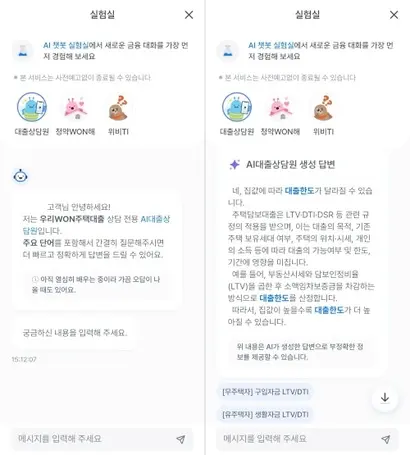
Woori Bank's generative AI service was developed before the network separation regulations were improved and currently uses an internal model. The AI loan consultant provides information based on the bank's internal financial data. Woori Bank was not included among the 9 financial firms designated as innovative financial services under the recent regulatory exemptions. However, it has been confirmed that they have completed their application and are awaiting results. Woori Bank plans to expand the AI consultant’s role to include subscription-based products followed by additional loan consultations.
Shinhan Bank is also preparing investment consultation services using generative AI. Its "AI Investment Mate" was recently designated as an innovative financial service. Shinhan Bank explained, "Investment counseling requires understanding an investor's personality and financial situation. We will adopt an external generative AI model to better understand customer inquiries and upgrade the service to recommend products tailored to the user's investment profile." Shinhan Bank's AI Investment Mate is scheduled for launch in January 2025.
While the financial sector is actively using generative AI alongside regulatory easing, there is still a long way to go. Although consultation is possible for complex tasks like investment, loans, and asset management, AI cannot yet be used in areas requiring legal responsibility, such as signing up for products. A financial industry official noted, "Now that we have regulatory exemptions, we must view development as a long-term goal. We need to continuously accumulate and train data to provide truly useful services."
The issue of accuracy also remains, due to phenomena like "hallucinations," where generative AI provides incorrect information. Jeon Chang-bae, Chairman of the International AI Ethics Association (IAAE), expressed concern, stating, "If you use only internal data, the risk of false information is low, but bringing in external models creates issues with accuracy. Even with data curated by experts and institutions, current technology cannot completely filter out errors. I believe it is dangerous to bring in external data in the financial sector, where technology is technically imperfect and reliability is a matter of life and death." Currently, the AI loan consultant in the Woori Bank app adds a disclaimer to every response stating, "The content above is generated by AI and may provide inaccurate information."