

[비즈한국] Following the passage of the impeachment motion against President Yoon Suk Yeol at the National Assembly on the 14th, citizens celebrated, calling it a "victory for democracy." Investors also hoped that domestic financial markets would find some relief from political uncertainty. This sentiment was bolstered by the fact that the KOSPI index trended upward following the impeachment of former President Park Geun-hye. On the 16th, the first trading day after the motion to impeach President Yoon passed, the domestic stock market opened higher.
However, contrary to investor expectations, experts caution that it is unclear whether the stock market will maintain this upward momentum, as the current economic environment differs significantly from that time. Cho Jae-woon, a researcher at Daishin Securities, stated, "Unlike the past, we are currently facing a global economic slowdown and a downturn in the semiconductor industry, so it is difficult to assert that a rebound will occur this time based on past patterns."
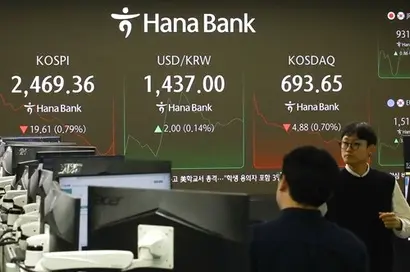
While most expect a gradual inflow of foreign capital, 'fundamentals' are the critical factor for the stock market to sustain a rebound. Researcher Cho Jae-woon pointed out, "In times of high uncertainty, one should focus on earnings-based fundamentals rather than being swayed by short-term news and issues." He added, "Since August, while the KOSPI earnings outlook was downgraded by 1.3% and the index fell by 10.2%, sectors with upward earnings revisions recorded decent returns, demonstrating that the earnings reflection mechanism in the domestic stock market is still functioning."
He identified shipbuilding, software, and healthcare as sectors with both attractive valuations and expected improvement in fundamentals. "Shipbuilding is expected to grow due to the strengthening of U.S. naval power and increased orders; software is benefiting from AI and digital transformation; and healthcare is poised for growth due to an aging population and rising demand," he forecasted. "These sectors, based on their fundamentals, are prime targets for foreign capital inflows amid reduced political risk and are highly likely to lead a KOSPI rebound."
Lee Jae-man, a researcher at Hana Securities, said, "There is still room for an additional rebound in the domestic stock market following the impeachment," adding, "Given that expectations for a base rate cut by the Federal Reserve remain valid, the domestic market is likely to rebound primarily in sectors that experienced excessive losses this year but are expected to see net profit growth next year." He highlighted semiconductors, banks, software, IT hardware, and defense as key sectors and projected that a recovery to the 2,600-point level for the KOSPI is possible.
Immediate market attention is now turning to the U.S. Federal Open Market Committee (FOMC) meeting scheduled for the 17th and 18th. While a rate cut is expected at this FOMC, there is speculation that the message will be 'hawkish' due to slower-than-expected progress in cooling inflation and a cooling labor market.
Kim Ji-na, a researcher at Eugene Investment & Securities, predicted, "The Fed will cut the base rate by 25bp, but it will likely maintain a cautious stance on future rate cuts by slightly raising the dot plot."
Kang Seung-won, a researcher at NH Investment & Securities, also noted, "Despite the surge in the probability of a December rate cut reflected in the Federal Funds (FF) futures market, the 10-year Treasury yield spiked ahead of the FOMC." He explained, "This is because although labor and inflation indicators supported a December cut, they did not provide sufficient conviction regarding the number of rate cuts for next year, which is crucial for the 10-year yield."
What about the KRW/USD exchange rate? The rate, which had hovered in the 1,400-won range, soared to the 1,440-won level during the declaration of martial law and the impeachment turmoil. Although it has since fallen to the 1,430-won range, it remains at a high altitude. Researcher Lee Jae-man said, "While the president's suspension from duty is inevitable following the impeachment, some of the exchange rate rise caused by political uncertainty is likely to be reversed," and predicted, "We expect fluctuations within the 1,400–1,430 won band until the end of the year."
He continued, "However, due to factors supporting a strong dollar, such as U.S. exceptionalism and potential trade disputes under the second Trump administration, it is highly likely that the exchange rate will remain in the 1,400-won range through the first half of next year."
Kwon Ah-min, a researcher at NH Investment & Securities, stated, "The direction of the exchange rate in the mid-to-long term is still most heavily influenced by the dollar index tied to the U.S. economy." She added, "As expectations for Fed rate cuts have retreated ahead of Trump's inauguration and the outlook for U.S. dominance (a strong dollar) persists, it is highly likely that the KRW/USD exchange rate will fluctuate around 1,400 won at least through the first half of the year."