

[비즈한국] Following financial fraud involving illegal investment 'leading rooms,' there has been a recent surge in secondary financial scams targeting the initial victims. These scams involve individuals impersonating lawyers and law firms, turning victims into victims once again. As more financial fraud victims seek legal consultations, 'customized' fraudulent schemes have emerged.

From Telegram to LINE
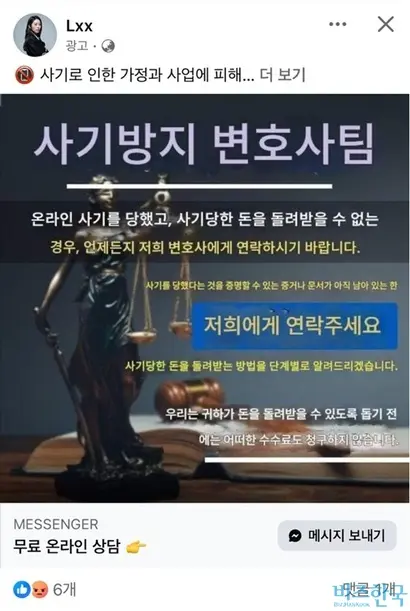
"We will help you recover all of your money." These are the ad slogans of 'fake' law firms spreading online, particularly on Facebook. Their advertisements, which claim they can recover money for victims who lost it to online fraud, are similar to those for 'illegal leading rooms.' They use fake lawyers, impersonated law firms, or even steal the names of real lawyers to run these ads. Once a victim sends a message, they are directed to the scammers' own chat rooms.
Bizhankook investigated the reality of various types of law firm scam ads on Facebook. The reporter sent messages to 10 advertising firms, claiming to have been a victim of a "leading room scam." They each stated that they were not lawyers themselves, but consultants.
While the ads were different, the methods were identical. First, they asked for the amount lost and whether the victim had reported it to the police. They also verified how the fraud occurred. Regardless of the reporter's response, once notified that "fraud occurred and there is a financial loss," they guided the reporter to consult with a lawyer via Naver LINE.
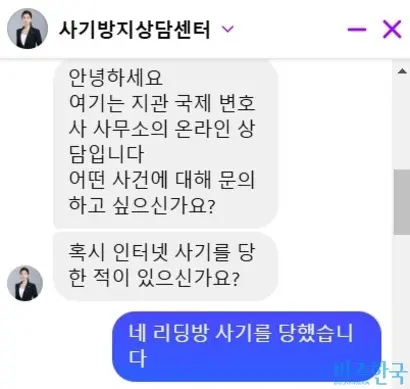
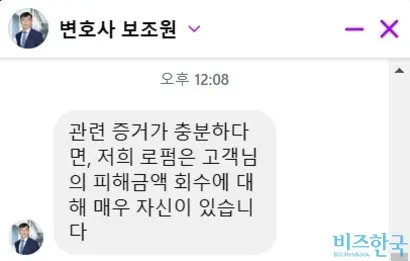
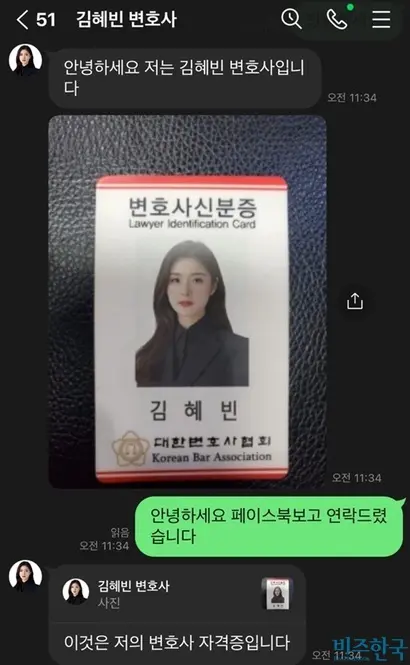
They also promised not to charge legal fees until the lost money was recovered, under the condition that they would receive 20% of the recovered amount as a legal fee. Victims who fell for these scam ads say that after the consultation, they were encouraged to sign up for gambling websites. The method involves promising principal recovery after sending an ID card, then pressuring the victim to join the gambling site. Victim 'A' stated, "They promised to recover my principal if I signed up for a gambling site and deposited money."
Jeon Joong-hyeok, a lawyer at Law Firm Hanwon who handles many financial fraud cases, explained, "There are many secondary victims of law firm advertising scams. It is a scheme where victims who were already scammed by leading rooms are targeted again by those claiming they can get their money back."
Featuring Fake Lawyers or Impersonating Famous Ones
The problem is that it is difficult to distinguish whether such 'law firm advertisements' are legitimate or fraudulent. Scammer groups often lead with advertisements featuring real, well-known lawyers, or they create fake, non-existent lawyers. The style and wording of the ads are also similar to those of actual law firms.
When the reporter saw an ad suspected of 'identity theft' on a portal site and checked with the actual law firm, it turned out to be a legitimate ad in some cases. Attorney Jeon Joong-hyeok notes that 'scam law firm ads' are often indistinguishable from real ones. Attorney Jeon explained, "Many law firms employ non-lawyer staff or office managers for consultations. Therefore, clients don't get suspicious even if a lawyer isn't the one conducting the initial consultation. There are also cases where they rent a lawyer's name to conduct fraud."
Attorney Jeon also pointed out that it is problematic that the scam law firm groups and financial fraud groups like leading rooms are often the same entities. "Because they already have the victim's information, it is easy to carry out further fraud based on their profiles and tendencies," he noted.
A hallmark of lawyer/law firm advertising scams is that they ask for personal information before money. Victim 'B' said, "At first, I only sent my ID, so I didn't suspect it was a scam." Attorney Jeon Joong-hyeok said, "The databases held by financial fraud groups have rankings. People who have participated in gambling or overseas futures have high rankings, similar to bank credit scores. They become the primary targets for scams, and in the case of law firm ad scams, the primary goal is often just to build or verify these databases."
Hard to Determine Fraud via Ads... Still Rampant on SNS
Facebook is also aware of the recent surge in law firm advertising scams. Facebook maintains that they are doing their best to block fraudulent ads. A Meta representative explained to Bizhankook, "Currently, most scam ads are being filtered. Only about 1% are exposed. We are investing technology and personnel to block these ads."
On April 5th, Meta released a notice regarding impersonation ads, stating, "We are aware that these impersonation accounts exist on our platform and are engaging in fraudulent activities," and "In the fourth quarter of 2023 alone, a total of 691 million fake accounts, including those for impersonation ads, were removed from Facebook and Instagram, and 99.2% of them were removed proactively before user reports were filed."
The Korean Bar Association also advised, "The Korean Bar Association takes strict measures against impersonation of lawyers and law firms," adding, "You can search for registered lawyers on the website."
However, scam ads impersonating lawyers and law firms remain rampant. A lawyer and former judge whose name is frequently used by scammers lamented, "I know there are many ads using my name. There is no way to deal with it. It's the same even for the victims of identity theft. Unless the fraud victim comes forward directly, there is no special action I can take."
Investigative authorities explain that they do not separately investigate lawyer or law firm scam ads. An official from the National Office of Investigation at the National Police Agency explained, "Impersonation scams are not managed separately. Since the victims of these scams are often victims of leading rooms, they are integrated and managed as cases related to leading room fraud."