

[비즈한국] As the opposition-led 'reduced budget bill' passed the National Assembly plenary session on the 10th, resulting in cuts to defense and military industry budgets, major defense projects for next year have hit a roadblock. With regular personnel appointments effectively frozen—including the vacancy of the Minister of National Defense amid the impeachment situation—the development of urgent weapon systems, such as the integrated anti-drone system, is expected to face setbacks.
Next year's budget bill passed the National Assembly plenary session on the 10th. The National Assembly approved the budget with 183 votes in favor, 94 against, and 1 abstention out of 278 members present. Since the President cannot exercise the right to request reconsideration (veto power) on budget bills, it is finalized once passed by the National Assembly.
In particular, defense spending, including soldiers' wages and drone countermeasures, was cut by 340.9 billion won compared to the government's proposal. The reduction in the defense budget accounts for 8.3% of the total. Within the Defense Acquisition Program Administration's (DAPA) budget, 570 million won was cut from the 71.2 billion won allocated for the 'Block-I' laser air defense weapon, which is designed to shoot down small unmanned aerial vehicles (drones). The R&D budget for 155mm precision-guided munitions, intended to strike the origin of enemy provocations with high accuracy, was slashed by 6.5 billion won from its original 7.7 billion won. Additionally, budgets for the military broadband integrated network, ammunition maintenance, and long-range ship-to-air missiles were also reduced.
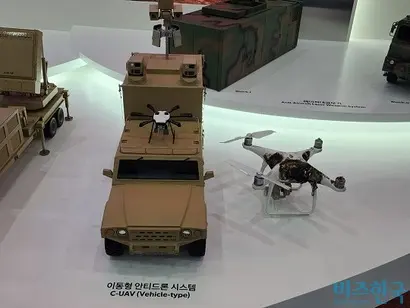
Most notably, the budget for the 'Frontline Area Integrated Anti-Drone System,' designed to counter North Korean drone threats, was slashed by 9.954 billion won out of the 10 billion won allocated, effectively canceling the project. While the establishment of the 'Critical Area Integrated Anti-Drone System' for rear regions is proceeding as planned, the 'Frontline Area Integrated Anti-Drone System,' focused on General Outpost (GOP) areas, will be unable to start next year due to the budget cuts.
The frontline anti-drone integrated system project, pursued by DAPA, aims to establish drone detection and defense systems along the border areas facing North Korea. It was expected to provide unmanned aerial vehicle defense capabilities for frontlines and critical regions, utilizing hard-kill methods to directly strike drones and waste-filled balloons. However, due to the setbacks in the frontline anti-drone project, military vulnerabilities regarding future drone intrusions are expected to increase.
Furthermore, companies that were expected to participate in the project—such as Hanwha Systems, LIG Nex1079550, Hyundai WIA011210, and Toris Square—are expected to prepare until the next budget allocation. Last year, Hanwha Systems won the contract for the 'Critical Area Integrated Anti-Drone System' project, having aggressively pursued it by lowering the price by more than 40% even at the cost of profitability. It appears Hanwha Systems will have to delay its goal of winning all front and rear anti-drone related contracts until after next year. Toris Square, which was considered a strong contender for this project, is also reported to have shifted its focus to other businesses.
Operational disruptions have also become inevitable as regular personnel appointments at the Ministry of National Defense have effectively halted. With the position of the Minister of National Defense—the chairman of the Defense Acquisition Program Promotion Committee—remaining vacant, all new projects are expected to come to a standstill. While the current committee maintains that the Vice Minister of National Defense can act as a substitute to push projects forward, the prevailing view is that business proceedings will be delayed until the launch of a new administration.
Drone experts explained that while strengthening surveillance and reconnaissance capabilities is necessary, the development of 'anti-drone' technology and the deployment of equipment to block drone attacks on military facilities and critical national infrastructure are truly essential. They collectively emphasized that continuous government interest and the allocation of separate budgets are urgently required.